
Transcode Therapeutics Strengthens Clinical Base Amid Financing and Equity Pressure
Transcode Therapeutics advances RNA-based oncology pipeline with clinical and acquisition progress while managing Nasdaq listing risks through strategic financing.
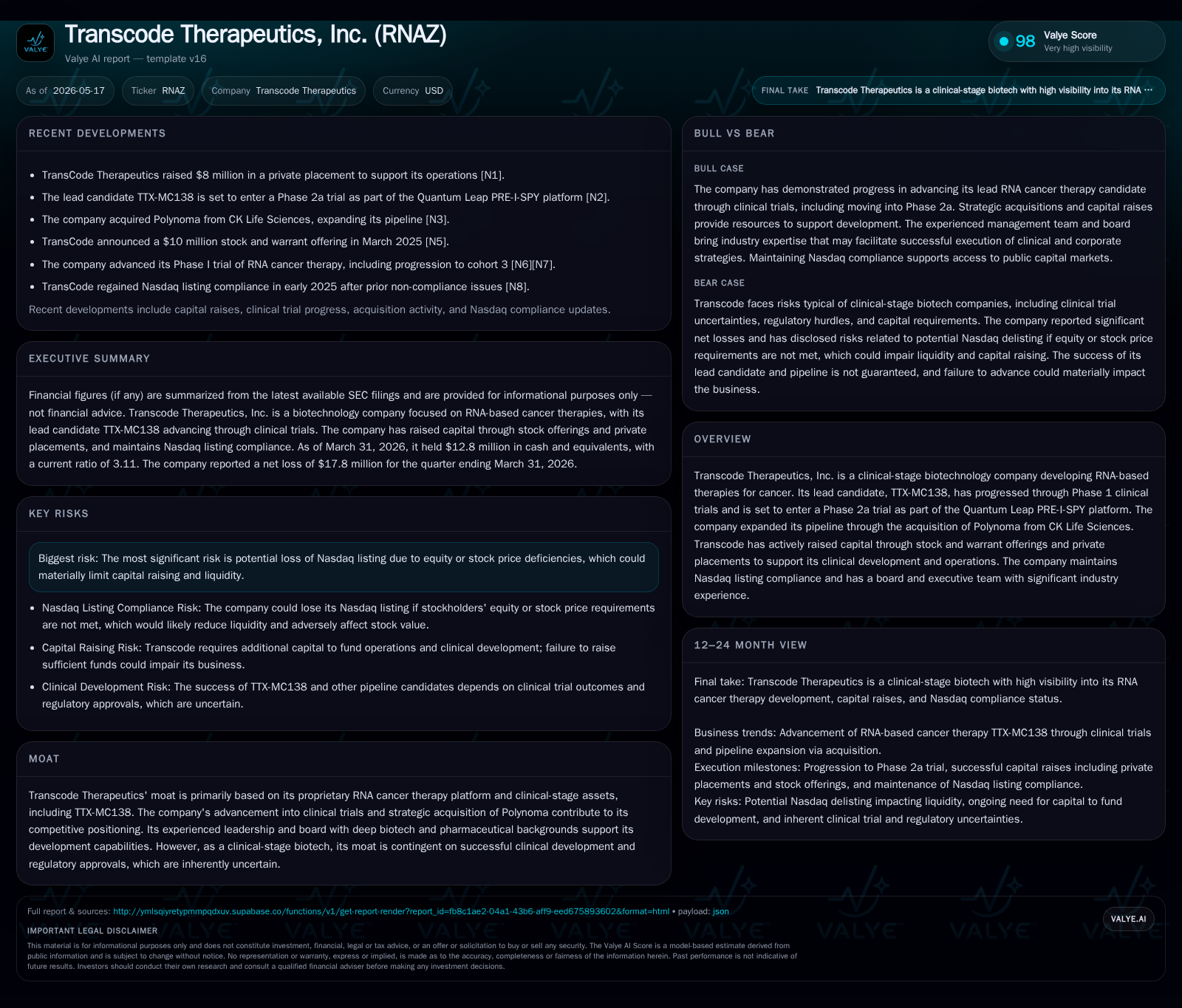
In its latest 10-Q filing, Transcode Therapeutics disclosed critical developments including an imminent Nasdaq listing deficiency notice tied to stockholders' equity shortfall, offset by a new Standby Equity Purchase Agreement (SEPA) with Yorkville enabling up to $14 million in capital raises. The company's lead RNA cancer therapy candidate, TTX-MC138, is progressing from Phase 1 into a Phase 2a trial under the Quantum Leap PRE-I-SPY platform, with pipeline expansion via acquisition of Polynoma. Despite clinical momentum supported by seasoned leadership, the company faces acute funding pressures and potential delisting risks that may constrain near-term operations and growth execution.
Latest Quarterly Developments: Operational and Compliance Outlook
Transcode Therapeutics’ most recent quarterly report filed on May 15, 2026 [S2] prominently highlights the company’s looming challenge regarding Nasdaq listing standards. Specifically, the company’s stockholders' equity falls below the minimum threshold required for continued listing on the Nasdaq Capital Market. Management anticipates receipt of a deficiency notice but intends to respond with a compliance plan predicated on shareholder approval for preferred stock conversion. This conversion is expected to restore compliance to equity requirements if approved but remains uncertain.
To bolster liquidity during this pressure, Transcode entered into a Standby Equity Purchase Agreement (SEPA) with Yorkville on April 6, 2026 [S3], granting the company the right to draw up to $14 million via common stock sales over time. The SEPA includes commitment fees and convertible note issuance provisions that provide near-term cash inflows subject to market conditions and regulatory approvals. As of March 31, 2026, Transcode reported cash and equivalents totaling approximately $12.8 million against current liabilities of about $5.4 million, producing a healthy current ratio above 3 [F1]. This financial snapshot suggests adequate short-term liquidity to sustain operations through ongoing clinical development phases.
Business Model and RNA Therapeutic Platform Overview
Transcode operates as a clinical-stage biotechnology entity specializing in RNA-based therapies targeting cancer indications [S1]. Its business model revolves around the discovery, development, and clinical advancement of RNA therapeutics designed to modulate gene expression or immune response pathways relevant to oncology. The lead candidate, TTX-MC138, has completed Phase 1 trials successfully and is preparing for Phase 2a evaluation within the Quantum Leap PRE-I-SPY clinical platform — an adaptive design collaborative aimed at accelerating novel breast cancer therapies [N1][S1].
The economics underpinning Transcode’s model reflect typical biotech R&D cycles: substantial upfront investment in discovery and clinic-ready candidates with monetization events tied to regulatory milestones such as IND approvals, clinical trial progression, and ultimately, commercialization or licensing partnerships. Margins are currently negative due to operating expenses concentrated in research, development, and administrative costs preceding any product revenue realization [F1]. This profile aligns with clinical-stage biotech characteristics where valuation depends heavily on translational progress and milestone achievements.
Further strategic expansion was realized through acquisition of Polynoma from CK Life Sciences [S1], a move that diversifies Transcode’s pipeline with additional preclinical or early clinical assets potentially suitable for immuno-oncology indications. Such horizontal expansion may improve risk profiles by broadening therapeutic focus while leveraging internal platform capabilities.
Competitive Positioning and Industry Dynamics
Within the specialized niche of RNA therapeutics for oncology applications, Transcode competes alongside emerging biotechs exploring messenger RNA modalities, oligonucleotide constructs, or viral vector-mediated gene therapies. The competitive environment is marked by high innovation intensity, lengthy development timelines, significant regulatory oversight, and capital-intensive operations. Barriers include complex technology platforms requiring deep expertise and high regulatory risk given uncertain clinical outcomes.
Despite these challenges, Transcode’s advancement of TTX-MC138 into adaptive trial platforms such as Quantum Leap signifies engagement with cutting-edge collaborative clinical models that can accelerate data generation relative to traditional designs. This may confer differentiation in trial efficiency and subsequent market readiness.
In addition to R&D innovation hurdles, switching costs for institutional investors arise principally from volatility related to trial results and regulatory newsflow rather than product adoption cycles at this stage. Intellectual property rights concerning proprietary RNA sequences or delivery mechanisms form critical moat components but remain contingent on patent grant success and freedom-to-operate assessments typical in biotech alliances.
Growth Drivers: Clinical Pipeline and Strategic Acquisitions
The principal growth catalyst remains TTX-MC138’s entry into the Phase 2a trial segment under the Quantum Leap PRE-I-SPY umbrella [S2][N1], expected to provide early efficacy signals which can validate clinical hypotheses underlying RNA-based treatment paradigms for breast cancer subtypes. Positive interim or final readouts here would represent validation points triggering potential partner interest or elevated capital market value.
Complementing this is the pipeline broadening via Polynoma acquisition [S1], furnishing additional encapsulated programs possibly addressing immuno-oncology targets or complementary mechanisms aimed at synergistic anti-cancer activity profiles. Pipeline diversification supports both scientific breadth and commercial optioning strategies common among small biotechs seeking de-risked portfolios.
Continued capital inflows through Yorkville SEPA [S3] enable funded advancement yet depend critically on market receptivity to equity issuances controlled under exchange caps requiring shareholder approvals—activities which are scheduled catalysts requiring monitoring.
Risks and Growth Constraints: Nasdaq Compliance and Funding Sensitivities
Convertible notes issued in connection with Yorkville financing carry escalating interest penalties potentially rising from standard ~5% annually up to an onerous 18% after default scenarios defined by missed payments or governance breaches [S3]. This structure intensifies refinancing difficulty amid capital scarcity.
Regulatory risks inherent in all clinical-stage biopharma apply—clinical failure or delays in TTX-MC138 or other candidates could abruptly impair valuation prospects given absence of commercial revenues.
Execution depends not only on science but shareholder actions including approvals needed for conversion of preferred stocks which influence equity levels critical for Nasdaq retention. Failure here could exacerbate funding constraints creating operational bottlenecks.
What to Watch: Milestones and Financing Signals Ahead
Key near-term milestones include shareholder proxy votes planned to approve preferred stock conversions designed to remedy Nasdaq equity deficiencies [S3][S18]. Successful passage pivots toward compliance restoration improving capital access prospects.
Clinical trial progression timing for Phase 2a workstreams involving TTX-MC138 under Quantum Leap represents major sliding scale impact events for investor sentiment and partnership dialogues typically prevalent in early oncology biotech valuation juice.
Monitoring actual drawn amounts under the Yorkville SEPA facility will reflect management’s confidence level amid market price fluctuations affecting issuance pricing power [S16]. Capital availability timing and cost remain pivotal operational issues.
Any announcements concerning additional acquisitions or licensing deals will be scrutinized as signals of strategic intent toward pipeline robustness.
Brief Current Financial Profile
As of March 31, 2026, Transcode held approximately $12.8 million in cash equivalents against current liabilities around $5.4 million yielding a current ratio near 3.11 indicative of a solid short-term liquidity cushion supporting ongoing R&D expenditures amidst substantial operating losses totaling about $28 million over recent periods [F1]. Total debt reported earlier (~$2.24 million) primarily comprises convertible notes bearing contingent financial covenant risks including sharp interest rate escalations post-default [S3]. The company's net debt position is negative reflecting net positive liquidity at present [F1].
This financial posture provides runway extending through immediate forthcoming phases; nevertheless it underscores dependency on continued equity raises or milestone-driven financing inflections needed before any revenue generation window opens typical within developmental-stage biotechs.
Disclaimer: This is research-only, informational analysis and not investment advice. It may include AI-generated interpretation and general industry context. Always verify important details using primary sources.

Comments