
RingCentral Leverages AI and Channel Partnerships Amid Debt Constraints
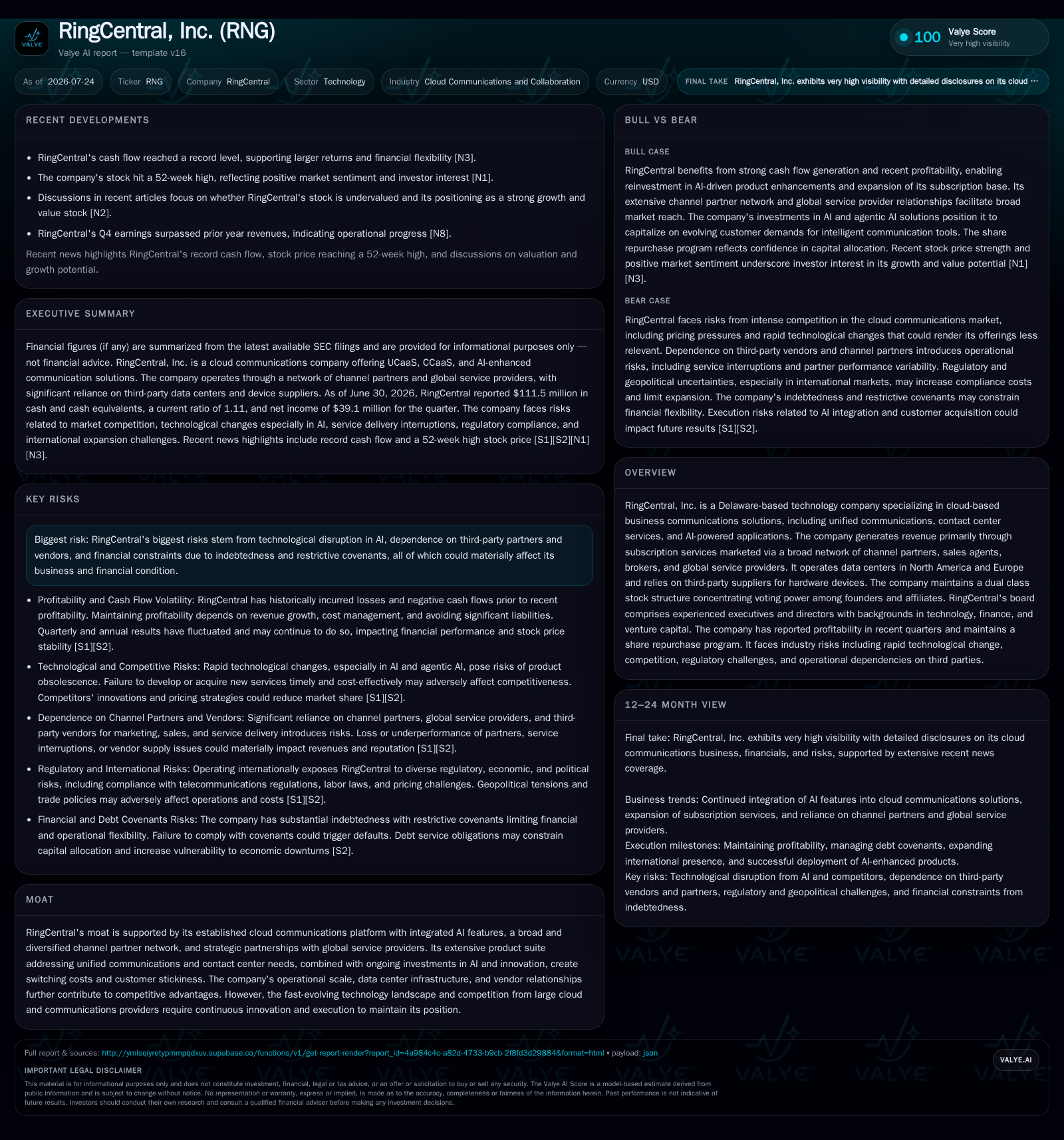
RingCentral’s Q2 2026 results highlight growth in AI-driven unified communications, while debt covenants impose strategic capital discipline.
RingCentral reported continued profitability and strong subscription revenue growth in Q2 2026, driven by expanded AI capabilities and a broad channel partner network. The company's SaaS-based unified communications and contact center platform benefits from high recurring revenue visibility, although leverage and restrictive debt covenants limit financial flexibility. Ongoing investments in AI integration and platform innovation are critical to maintaining competitive differentiation amid intense pressure from larger cloud providers. Risks include technological disruption, dependence on third-party vendors, and the impact of debt-related limitations on acquisitions or share repurchases.
Recent Operating Update
RingCentral’s latest quarterly filing for Q2 ended June 30, 2026, reveals a continuation of its trajectory toward profitability with stronger-than-expected subscription revenue growth supported by its evolving AI product portfolio [S2], [N1]. The company highlighted success in expanding AI-powered applications within its UCaaS (Unified Communications as a Service) and CCaaS (Contact Center as a Service) offerings—a strategic focus area intended to differentiate from both pure-play UCaaS specialists like 8x8 and large cloud communication incumbents such as Microsoft Teams or Zoom [N3], [S1]. This cadence underscores how embedding artificial intelligence enhances user engagement, automation capabilities, and client retention.
Alongside product innovation, RingCentral’s sales strategy leverages an expansive global channel partner network composed of agents, brokers, and service providers enabling broader market reach without proportional increases in Customer Acquisition Cost (CAC). This scalable indirect sales model supports sustainable recurring revenue expansion while functioning as a key moat against competitors relying solely on direct sales forces [S1]. However, reliance on third-party channels also introduces execution risk if partnerships weaken or market conditions shift [S2].
Business Model Analysis
At its core, RingCentral operates a subscription SaaS business model where customers subscribe to cloud-hosted communication platforms delivering integrated voice, video conferencing, messaging, and contact center services. Customers range from small-medium businesses deploying standardized packages to larger enterprises requiring tailored communication ecosystems. Revenue derives largely from subscription fees recurring monthly or annually with variations in Average Revenue Per User (ARPU) based on feature add-ons like AI tools.
The company owns and operates data centers primarily in North America and Europe to underpin platform scalability, performance consistency, and regulatory compliance—a competitive advantage in retaining enterprise-grade clients wary of geographic data sovereignty issues [S1]. Product innovation includes layered AI functionalities enhancing speech analytics, automated responses, and collaboration insights that improve operational efficiencies for clients.
An important monetization mechanic involves upselling existing customers on new AI-driven capabilities or premium contact center modules—both contributing to improved Net Revenue Retention (NRR) rates essential for long-term SaaS health. Given the indirect channel sales model’s contribution to bookings growth, measuring channel partner contribution percentage alongside MRR trends offers critical insight into customer acquisition effectiveness.
Industry Structure and Competitive Positioning
RingCentral competes amidst a bifurcated market: specialized pure-play UCaaS/CCaaS vendors such as 8x8 or Vonage who focus solely on cloud communications solutions, versus large generalist cloud platform providers like Microsoft (Teams), Zoom Video Communications that bundle communication offerings within broader productivity suites. Unlike these hyperscalers with massive scale and cross-platform ecosystems, RingCentral’s differentiation comes via integrated AI-enhanced communication products combined with deep channel partner penetration.
Competitive dynamics entail continuous innovation cycles due to rapid technological evolution driven by not only conventional VoIP enhancements but also emerging AI trends shaping user experiences. Given increasing customer expectations for seamless hybrid work enablement coupled with global service availability requirements, RingCentral’s data center footprint and global service partnerships form critical competitive levers.
That said, the industry presents margin compression risks due to aggressive pricing among peers seeking scale gains. Customer churn management through product quality preservation plus value-added features remains vital. Additionally, dependencies on hardware suppliers for endpoint devices introduce potential supply chain vulnerabilities.
Growth Drivers
Key drivers powering RingCentral’s growth include ongoing migration by enterprises from legacy on-premises telephony systems toward unified cloud communication platforms capable of supporting increasingly distributed workforces. The acceleration of hybrid work post-pandemic has bolstered demand for comprehensive collaboration tools encompassing voice/video/chat workflows.
Moreover, corporate interest in AI-powered automation—especially within contact centers focused on enhancing customer experience efficiencies—offers material upsell opportunities. Geographic expansion initiatives targeting regions demanding multi-region cloud services further underpin potential addressable market gains.
Channels continue to be pivotal growth engines; expanding the breadth of channel partners globally facilitates rapid market penetration without linear scaling of sales expense ratios. Cross-selling bundled solutions combining UCaaS with CCaaS offerings drives increased wallet share per client.
Risks and Watchpoints
Operational risks prominently stem from rapid technological change demanding sustained investment in R&D to maintain competitive product relevance—particularly in advancing AI features which carry inherent legal/regulatory uncertainties alongside technical development challenges [S2]. Failure to timely innovate could erode customer loyalty.
Further risk arises from heavy reliance on channel partners whose shifting incentives or market conditions may affect new customer acquisition volumes. Elevated competition exerts pricing pressure that can compress margins if product differentiation weakens.
Financially, elevated leverage is noteworthy; at quarter-end June 30, 2026, total debt stood near $1.13 billion against roughly $111 million cash reserves (net debt approx. $1 billion), resulting in a current ratio of 1.11 indicating limited liquidity cushion [F1]. Coupled with restrictive covenants limiting additional indebtedness incurrence, asset disposals, acquisition activity and share repurchases intensifies capital allocation constraints impeding optionality for growth investments or shareholder returns [S4], [S5], [S6], [S22].
Customer churn remains a perennial risk impacting recurring revenue sustainability; higher-than-expected turnover would exert downside pressure on top-line consistency.
What to Watch Next
Critical near-term milestones include monitoring progress against key AI innovation deployments impacting product usage metrics such as minutes of usage or active users—a leading indicator reflecting feature adoption drive retention. Tracking net revenue retention rates will clarify upsell effectiveness amid evolving competitive pressures.
Further clarity around expansion efforts into new geographies or verticals would inform potential secular growth runway extensions. Updates on channel partner program scalability could reveal incremental upside capacity beyond baseline organic demand.
On the financial front, ringfencing free cash flow generation capacity post-debt service obligations will help gauge prospects for sustaining dividend payments or augmenting share buybacks under board discretion [S26]
Financial Profile Discussion
RingCentral reported cash & equivalents of approximately $111.5 million versus total debt near $1.13 billion as of June 30, 2026—leaving net debt roughly at $1 billion which poses leverage-related risks typical for capital-intensive SaaS companies balancing infrastructure investments with recurring revenue models [F1]. The current ratio is 1.11, indicating a modest liquidity buffer under normal operating conditions [F1].
Restrictive covenants contained in senior notes indentures impose operational limits including restrictions on new indebtedness issuance or asset disposals which constrain balance sheet optimization strategies [S22], [S28]. Profitability has stabilized recently after prior losses evidencing operational leverage improvements but ongoing investments in AI may weigh intermittently on margins going forward [F1], [N2].
Overall financial positioning reflects typical maturity-phase SaaS characteristics with steadily growing recurring revenues offset by significant debt service commitments necessitating cautious capital deployment aligned with long-term sustainability objectives.
Disclaimer: This analysis is based solely on publicly available information including SEC filings dated through July 23, 2026 ([S1]-[S28]), recent news reports ([N1]-[N9]), and standard industry knowledge applicable to cloud communications providers offering UCaaS solutions. It is intended for informational purposes without investment advice.
Disclaimer: This is research-only, informational analysis and not investment advice. It may include AI-generated interpretation and general industry context. Always verify important details using primary sources.

Comments