
Range Impact Revamps Appalachian Land: Unlocking Value Through Reclamation and Redevelopment
Range Impact’s strategic transition centers on land ownership and in-house reclamation services in Appalachia, aiming to convert legacy mine liabilities into multi-use development opportunities despite financial headwinds.
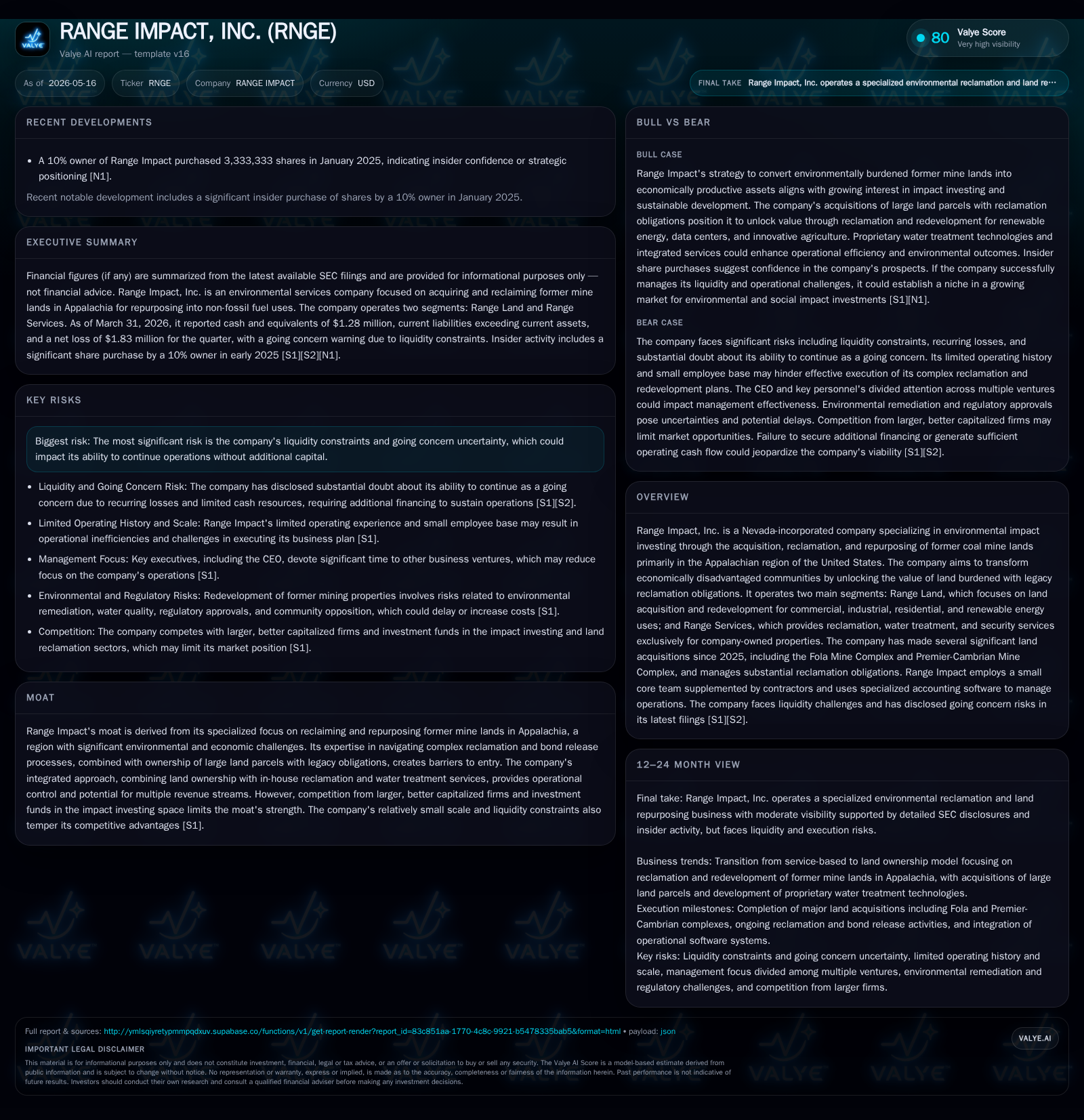
Range Impact, Inc. updated its operational trajectory in its latest 10-Q, emphasizing continued land acquisitions and direct reclamation activities concentrated in Appalachia’s economically challenged coal communities. This reflects a pivot from fee-for-service operations toward a vertically integrated land redevelopment model combining ownership with reclamation and environmental services. Structural competitive advantages stem from its niche expertise and integrated approach, though the company remains impeded by liquidity constraints and competition from larger capital players. Growth catalysts depend on securing bond releases, expanding renewable energy or industrial leases on reclaimed lands, and scaling proprietary service offerings. Critical near-term risk factors include tight working capital and the ongoing going concern uncertainty.
Latest Quarterly Filing and Operating Updates
In its May 15, 2026 10-Q filing [S2], Range Impact reinforced its strategic transition away from primarily providing reclamation services under third-party contracts toward an asset-ownership model focused on acquiring former coal mine sites in Appalachia burdened by significant environmental reclamation obligations. The company disclosed ongoing efforts to advance reclamation work on these holdings with the goal of obtaining bond releases—the regulatory certification that reclamation activities meet mandated environmental standards—thus unlocking the land’s underlying economic potential for various uses including commercial development or renewable energy projects.
As of March 31, 2026, cash and equivalents stood at approximately $1.28 million against current liabilities exceeding $4 million, yielding a current ratio around 0.57 based on companyfacts data [F1]. No material debt financing was reported, indicating that working capital deficits arise primarily from accrued payables or short-term obligations rather than leverage. These conditions highlight continuing going concern disclosures signaled in both the latest annual report [S1] and quarterly risk factor references [S2], emphasizing the company’s critical need for new capital injections to sustain its operational runway.
Complementing the filing was an attached press release issued simultaneously via Form 8-K on May 15, 2026 [S3][S4], summarizing first-quarter financial results without notable revenue increases but reaffirming commitment to executing reclamation milestones on key assets such as the Fola Mine Complex acquired since early 2025. This event filing solidifies the company's disclosed near-term focus and provides fresh quarterly context beyond the annual narrative.
Strategic Business Model Evolution and Services Overview
Range Impact’s distinct business model bifurcates into two principal segments: Range Land and Range Services [S1].
Range Land spearheads land acquisition and redevelopment efforts centered on ex-coal mine properties predominantly located in Appalachia’s economically distressed regions. By targeting large parcels encumbered with legacy reclamation bonds—financial guarantees required for environmental cleanup—the company assumes full responsibility for remediation activities while positioning the land for diversified post-reclamation uses including industrial facilities, commercial developments, residential projects, or renewable power generation sites.
Range Services operates as an internal contractor delivering environmental remediation (reclamation), water treatment solutions addressing acid mine drainage common in former mining areas, and security services exclusively across company-owned sites. This vertical integration affords Range Impact more transparency and cost control over complex regulatory compliance processes pivotal to bond release achievements.
This dual-pronged approach reflects a significant pivot initiated in early 2025 away from reliance on external service contracts toward cultivating asset-backed recurring revenue streams predicated upon enhancing land value through proactive remediation. The firm leverages specialized expertise navigating difficult Appalachian permitting environments where socioeconomic constraints heighten both legal complexity and stakeholder sensitivity around environmental restoration efforts.
Industry Context and Competitive Dynamics in Appalachian Land Reclamation
The Appalachian region presents a uniquely challenging but potentially rewarding niche within environmental impact investing due to its legacy of extensive coal mining coupled with persistent socio-economic challenges [S1]. Vast tracts of land remain burdened by costly reclamation obligations enforced by state and federal regulatory frameworks mandating surface restoration, water quality remediation, and ecosystem rehabilitation before permits can be released.
Range Impact operates amid established competition from larger entities including private equity-backed environmental services firms, established mining operators diversifying into remedial work, regional specialist contractors, and impact investing funds deploying capital into similar mine land redevelopment initiatives. While these peers typically benefit from greater scale, more substantial capital reserves, or broader geographic footprints allowing resource sharing across projects, Range Impact’s competitive moat lies in its narrow geographical specialization combined with integrated ownership-plus-services model granting streamlined decision-making authority over remediation timelines.
Barriers to entry in this segment remain significant due to technical complexities managing legacy contaminants unique to Appalachian mines (e.g., acid mine drainage), stringent bonding release processes overseen by regulatory agencies such as state Departments of Environmental Protection (DEP), and high upfront capital intensity relative to other land development sectors. Additionally, accessing mission-driven impact investing capital that values both strong environmental outcomes alongside financial returns plays a vital role in sustaining activity amid market volatility and policy shifts favoring sustainable regional redevelopment.
Catalysts for Growth: Unlocking Land Value and Expanding Service Offerings
Range Impact's growth prospects hinge primarily on measurable progress unlocking economic value embedded in reclamation-bound lands:
Bond Releases: Achieving full bond releases on properties like the Fola Mine Complex remains critical. Each regulatory release reduces ongoing liability exposure while increasing marketability of reclaimed acreage for leasing or sale [S2].
Multi-use Permitting: Securing approvals for alternative land uses such as renewable energy projects (solar or wind farms), light industrial facilities oriented towards sustainable manufacturing, or mixed-use commercial developments represent tangible revenue expansion vectors beyond pure remediation activity [S1].
Scaling Proprietary Services: Enhancing capacity within Range Services to deliver comprehensive water treatment systems tackles one of Appalachia’s most persistent environmental legacies—acid mine drainage—and can generate recurring service revenues exclusive to owned properties given exclusivity clauses often embedded within such contracts [S1][S2].
Strategic Acquisitions: Opportunistic acquisitions of undervalued mine sites with manageable bond obligations could allow selective scaling of acreage under management while leveraging existing operational teams for efficiency gains.
Performance against these catalysts can be tracked via KPIs including acres reclaimed annually, number of successful bond releases versus targets set per quarter/year, new lease agreements signed post-reclamation facilitating cash flow diversification, expansion of water treatment system deployments onsite generating steady contract income streams, and pipeline additions from acquisition activity evidenced in SEC disclosures.
Risks Including Liquidity Constraints and Market Competition
While strategic execution offers upside potential, several critical risks warrant attention:
Going Concern Uncertainty: Both annual report footnotes and quarterly risk disclosures emphasize substantial doubt regarding ability to continue as a going concern absent new capital or improved operating cash flows—a material hazard that may impact supplier terms or employee retention risks alongside investor sentiment [S1][S2].
Competitive Pressure: Larger entities with deeper pockets possess advantages securing access to impact investing pools, wider vendor/distribution networks for remediation technology deployment, or stronger bargaining power with regulators potentially compressing margins or slowing permit turnaround times faced by smaller players like Range Impact.
Operational Execution Risk: Limited employee headcount necessitates reliance on contractors or consultants creating execution complexity across geographically dispersed sites requiring specialized knowledge; loss of key technical staff could impede progress given the highly regulated nature of environmental remediation work in Appalachia [S1].
Regulatory Complexity: Changing environmental regulations at federal/state levels governing bonding requirements or remediation standards introduce compliance uncertainty that could delay project completions integral to unlocking land value over multiple years.
Forthcoming Milestones and Key Metrics to Monitor
Investors should track several forward-looking indicators validating Range Impact’s execution capabilities:
Timing of bond release certifications at major acquired complexes such as Fola Mine; each release is a trigger event reducing liability exposure while enabling incremental leasing or sales revenue streams.
Announcements of new renewable energy project approvals or commercial lease agreements reflecting successful repositioning of reclaimed lands.
Quarterly updates on acreage reclaimed relative to targeted thresholds shedding light on operational effectiveness versus goals stated during filings.
Changes in cash burn rates contextualized against any fresh equity issuances or financing arrangements disclosed might indicate runway extension or tightening liquidity constraints.
Monitoring these milestones will provide clarity over whether Range Impact can translate its foundational assets into sustainable multi-revenue pathway operations amidst resource constraints.
Current Financial Position Snapshot
As illustrated above using companyfacts figures as of March 31st, Range Impact holds just under $1.3 million in cash amidst total current liabilities that considerably exceed liquid resources resulting in a low current ratio underscoring working capital stress consistent with publicly disclosed going concern risks [F1]. The absence of long-term debt reflects a non-leveraged balance sheet but also constrains the firm’s ability to bridge funding gaps internally without recourse to fresh equity capital raises or asset monetizations becoming increasingly urgent themes noted across SEC filings this year [S1][S2].
Disclaimer: This analysis is based solely on publicly available SEC filings and does not constitute investment advice or recommendation. All financial metrics are as reported through respective filings dated up to May 15th, 2026.
Disclaimer: This is research-only, informational analysis and not investment advice. It may include AI-generated interpretation and general industry context. Always verify important details using primary sources.

Comments