
Rank One Computing Advances U.S. Sovereign Vision AI with Expanding Global Footprint
Rank One Computing’s latest quarterly report highlights strengthened liquidity and operational progress underpinning its strategic expansion in high-accuracy Vision AI biometrics across global government and commercial markets.
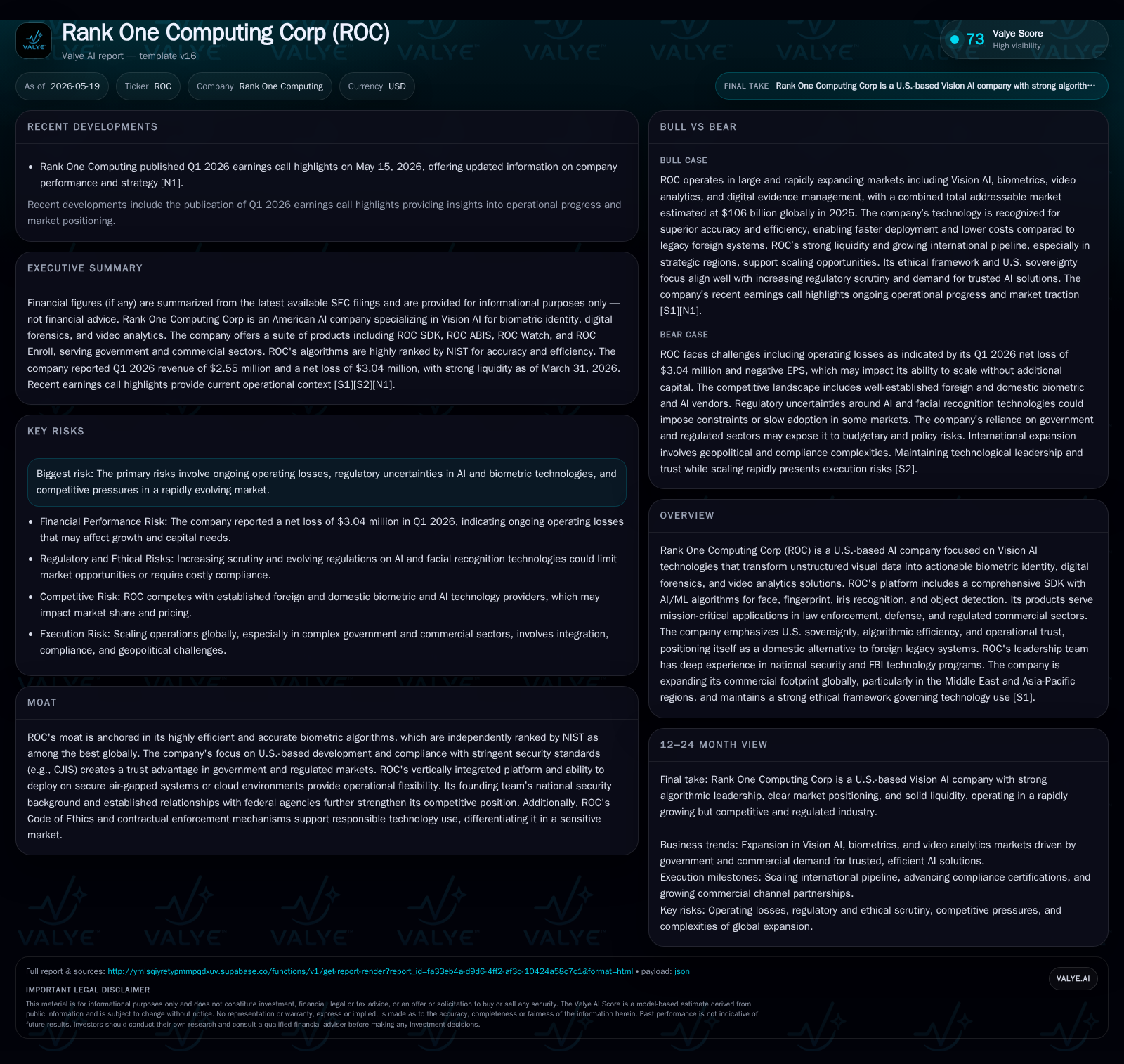
Rank One Computing Corporation (ROC) reported its quarter ending March 31, 2026, with enhanced liquidity post-IPO, alleviating prior going-concern concerns and enabling investment in growth initiatives. ROC’s core competency is highly efficient, NIST-ranked biometric and Vision AI algorithms built on a sovereign U.S. technology platform that serves law enforcement, defense, and regulated commercial sectors. While customer concentration and regulatory compliance remain watchpoints, ROC is leveraging its domestic origin and operational trust to expand internationally, notably in the Middle East and Asia-Pacific regions. The company’s vertically integrated SDK platform and deployment flexibility provide competitive differentiation amid legacy foreign incumbents. Continued contract renewals, international penetration, and product evolution shape the near- to medium-term growth outlook.
Latest Quarterly Operating Update and Significance
Rank One Computing’s 10-Q filing dated May 15, 2026 ([S2]) outlines a quarter marked by stabilization and strategic runway extension enabled by its January 2026 IPO ([S1]). The IPO infused approximately $21.5 million net proceeds into the balance sheet substantially alleviating earlier substantial doubt about continuation as a going concern noted for September 30, 2025 ([S1]). As of March 31, 2026, ROC held $16.1 million in cash with current assets totaling roughly $20 million against liabilities under $3.5 million yielding a robust current ratio of about 5.7 ([F1]). This liquidity backing underpins planned investments in product development and expanded sales initiatives fundamental to ROC’s growth trajectory.
The company confirmed no material changes to risk factors relative to their previously disclosed annual report ([S2]), signaling operational consistency without new adverse developments amid heightened regulatory scrutiny of AI technologies. Additionally, their recent Form 8-K filed May 15 ([S3]) reiterated the financial results alongside commentary emphasizing progress toward broadening customer engagement post-IPO.
Rank One Computing’s Business Model and Product Differentiation
ROC operates on a software licensing model anchored by its proprietary ROC SDK—a comprehensive library of AI/ML-driven computer vision algorithms focused on biometric identity modalities including face recognition, fingerprint analysis (including latent prints), iris recognition, alongside object detection capabilities such as Automated License Plate Recognition (ALPR) ([S1],[S23]). Revenue stems from multi-year contracts often involving upfront licensing fees coupled with potential recurring revenues tied to ongoing support or incremental feature deployments.
Distinctively competing against entrenched legacy systems primarily developed abroad, ROC asserts a sovereign American technology base facilitating compliance with stringent U.S. security mandates like CJIS critical for law enforcement deployments ([S1]). This sovereignty lends a strategic moat by mitigating supply chain opacity risks inherent in foreign-built platforms while delivering more computationally efficient solutions often at lower cost.
Key product offerings extend beyond the core SDK to include ROC ABIS—an enterprise-grade Automated Biometric Identification System designed for rapid case resolution within forensic workflows—and ROC Watch providing real-time multimodal video analytics suited for security-sensitive environments such as airports or schools ([S1]).
Additionally, ROC Enroll addresses remote identity verification needs blending biometric capture with document verification integrations enabling flexible commercial applications catering to regulated sectors such as fintech ([S1]). The platform supports both air-gapped deployments required by classified government environments and cloud-hosted solutions favored commercially demonstrating versatility in delivery.
Competitive Landscape and Industry Positioning
Within the Vision AI space encompassing biometrics and video analytics, Rank One Computing positions itself against both global incumbents with large-scale government contracts and smaller niche providers specialized in key biometric modalities ([S1],[S17]). Its competitive advantage rests heavily on algorithms ranked among the highest accuracy benchmarks by NIST—a globally recognized standard—reinforcing confidence particularly among U.S. federal agencies emphasizing security provenance ([S1]).
Furthermore, U.S.-origin development reduces reliance on foreign components subject to export controls or geopolitical risks thus appealing to governments prioritizing trusted supply chains under regimes like FASA ([S18]).
Sector-Specific Dynamics: Market Drivers and Adoption Realities
ROC serves public safety (law enforcement), defense intelligence communities, regulated commercial sectors such as financial services and healthcare—all domains experiencing rising demand for real-time accurate biometric identity solutions often mandated by evolving privacy laws or regulatory frameworks ([S1],[S4]). Markets like access control security within commercial buildings or event venues represent emerging verticals expanding ROC's addressable market.
Geographically the U.S. leads the global Vision AI market accounting for about 30% of revenue as of 2024; North America has overtaken Asia-Pacific reflecting accelerated domestic adoption particularly in federal programs investing heavily in upgrading legacy systems ([S1]). Parallel international opportunities stem from Middle Eastern and Asia-Pacific nations significantly expanding sovereign Vision AI infrastructure investing aggressively amid rising geopolitical tensions ([S1],[N1]).
Contracts frequently involve multi-year terms but allow customer opt-out provisions demanding continuous performance excellence and relationship management. Pricing models incorporate volume-based schedules reflecting scale economics achievable through deep technology integration ensuring cost efficiency relative to legacy providers reliant on fragmented vendor stacks ([S4],[S7]).
Drivers of Near-Term and Medium-Term Growth
Key growth levers include deeper penetration within existing major government accounts evidenced historically by expanded deployments yielding incremental recurring revenue streams ([S4]). Expanding beyond components toward integrated full-platform solutions—such as digital evidence management linked to biometric verification—is a strategic priority aimed at driving higher client wallet share while addressing broader mission workflows ([S17]).
International expansion constitutes another growth pillar leveraging America’s brand as a trusted source for sensitive surveillance technologies amidst concerns over non-U.S. alternatives ([N1],[S1]). Success here depends on navigating export controls while building local channel partnerships aligned with operating rigorous compliance protocols.
Ongoing R&D investment enhances algorithm portfolio moving into newer biometrics (e.g., tattoo matching), deeper video analytics features like threat detection combining multi-sensor inputs—all intended to sustain technical differentiation absent from aging competitor suites ([S23]). Further upgrading the SaaS delivery model incorporating managed services aims to accelerate commercial sector recurring revenue driven by demand for scalable subscription pricing versus upfront license fees ([N1],[S17]).
Risks, Customer Concentration, and Regulatory Challenges
Despite evident opportunities ROC's revenue concentration is significant: two customers represented approximately 43% of total revenue in 2025—creating vulnerability should these clients reduce spend or terminate agreements without guaranteed renewal clauses ([S4],[S7]). Shorter-term contract structures requiring opt-in renewals heighten quarterly volatility risks.
Operating losses persist requiring management to raise additional capital beyond the IPO proceeds funded in early 2026; failure to secure financing on acceptable terms could constrain growth initiatives including innovation investments or sales expansion programs ([S1],[S9]).
The company faces substantial legal/regulatory exposure given its involvement in sensitive biometric/AI applications subject to evolving national policies regarding privacy rights enabled surveillance ([S5],[S11]-[S13],[S16],[S18]-[S19]). Legal claims currently active are considered immaterial financially but could divert focus if litigation escalates or if there is reputational fallout affecting customer confidence.
Additionally complexities around ensuring compliance with anti-corruption laws during international expansion pose enhanced operational risk especially across jurisdictions with less stable governance frameworks ([S16]).
Monitoring Milestones: Key Factors to Watch Next
Investors should focus on quarterly guidance updates that reflect post-IPO scaling effectiveness including sales pipeline health particularly outside the core U.S. government verticals where international bookings progress is critical ([N1],[S2],[S3]).
Announcements of sizable new contracts especially multi-year deals securing recurring revenue streams will be meaningful validation points.
Advancements or certifications related to algorithm accuracy improvements or compliance with emerging biometric data standards could materially affect competitive positioning.
Progression toward product-led growth exemplified by increased adoption of cloud-based SaaS modules like ROC Enroll within commercial accounts may unlock higher margin streams complementing traditional licensing models.
Financial Overview: Liquidity, Losses, and Capital Needs
As of March 31, 2026, Rank One Computing holds $16.1 million cash equivalents supported by total current assets near $20 million against current liabilities around $3.5 million resulting in a healthy short-term liquidity buffer reflected by a current ratio above 5.6—significantly improved from prior periods due to IPO capital infusion ([F1],[S2],[S3]).
The company continues operating at a loss—net loss exceeded $2.6 million in the last annual period—with operating expenses geared toward R&D investment and expanding go-to-market capabilities critical for capturing growth opportunities but implying continued need for capital beyond existing cash balances ([F1],[S9]).
This analysis synthesizes all pertinent publicly available SEC filings including Rank One Computing Corp's latest quarterly update as primary discussion anchors alongside recent annual disclosures forming business context foundations. The perspective provided strictly adheres to disclosed facts without speculative projections or investment advice.
Disclaimer: This is research-only, informational analysis and not investment advice. It may include AI-generated interpretation and general industry context. Always verify important details using primary sources.

Comments