
RTX Strengthens Backlog and Revenue Mix Amid Defense and Commercial Aerospace Demand
RTX’s Q2 2026 results highlight robust demand across its diversified aerospace and defense segments, supported by a solid backlog and stable government contracts.
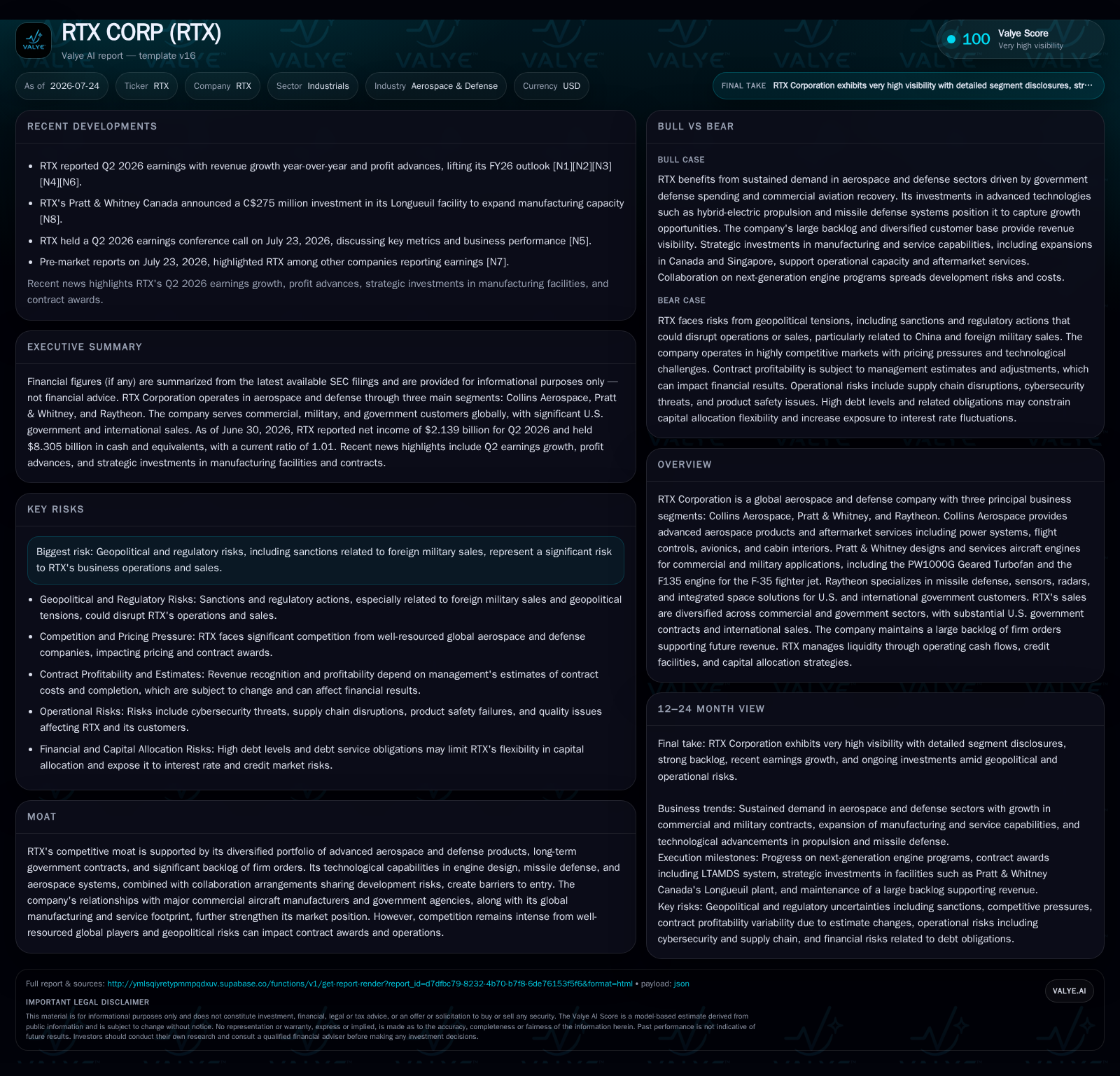
RTX Corporation’s latest quarter reflects continued growth driven by its three key segments: Collins Aerospace, Pratt & Whitney, and Raytheon. The company benefits from a $268 billion backlog providing revenue visibility and a well-balanced commercial and defense revenue mix. While geopolitical and regulatory risks persist, RTX’s technological leadership and aftermarket services underpin resilience. Financially, RTX maintains a strong liquidity position with manageable leverage supporting operational investments and contract fulfillment.
Recent Operating Update
RTX Corporation reported strong operational performance in Q2 2026, driven by sustained demand across its aerospace original equipment manufacturing (OEM) and defense segments. The company reaffirmed its positive outlook supported by backlog growth and disciplined execution, with revenue growth notably propelled by Pratt & Whitney’s engine deliveries and Raytheon’s missile defense systems [S2],[S3],[N1],[N2],[N3]. The firm’s liquidity position remains robust, underpinned by an undrawn $5 billion revolving credit facility [S2].
Business Model Analysis
RTX operates through three principal segments: Collins Aerospace, Pratt & Whitney, and Raytheon Technologies. Collins Aerospace delivers a broad portfolio of aerospace systems and aftermarket services, including electric power systems, flight controls, cabin interiors, and connected aviation solutions. This segment generates revenue from OEM sales to aircraft manufacturers and recurring aftermarket services such as spare parts, overhaul, fleet management, and digital maintenance solutions that enhance lifecycle cost efficiency for operators [S1]
Pratt & Whitney specializes in advanced aircraft engine design and manufacturing for commercial and military applications. Its revenue mix includes firm engine deliveries under fixed-price or cost-plus contracts, supplemented by long-term service agreements that provide stable aftermarket revenue streams [S1]. These maintenance programs are critical for margin stability, offsetting the cyclical nature of new engine orders
Raytheon Technologies focuses on defense and missile systems, acting primarily as a prime contractor or subcontractor on government contracts. Its portfolio includes integrated missile defense, threat detection, and tracking systems sold to U.S. and allied military customers. Revenue is largely derived from medium- to long-term government contracts, which provide revenue visibility but are subject to federal budget appropriations and geopolitical risks [S1]
The company’s backlog, representing remaining performance obligations from firm orders excluding options and indefinite-delivery/indefinite-quantity (IDIQ) contracts, stood at approximately $268 billion at the end of 2025, up from $218 billion a year earlier [S1]. About 25% of this backlog is expected to convert into revenue within the next 12 months, supporting short-term cash flow predictability, while the remainder reflects multi-year production and defense system deployment schedules
Collins Aerospace’s aftermarket services constitute a significant recurring revenue base, contributing to gross margin resilience during periods of lower new equipment production [S1]. This segment’s growing connected aviation offerings leverage data analytics to optimize maintenance schedules and reduce operational costs for commercial and military operators, enhancing customer retention and contract renewal potential
Industry Structure and Competitive Positioning
The aerospace and defense industry is characterized by complex, highly regulated supply chains involving prime contractors, OEMs, and maintenance, repair, and overhaul (MRO) providers. RTX serves as a prime contractor in defense programs while also supplying OEM components to major commercial aircraft manufacturers such as Boeing.
Key competitors include Lockheed Martin, which holds a dominant position in U.S. defense prime contracting with a substantial government backlog, and General Electric Aerospace, a leading competitor in commercial and military engine manufacturing, directly contesting Pratt & Whitney’s market share. Northrop Grumman specializes in defense electronics and missile systems, overlapping with Raytheon’s defense portfolio. RTX’s competitive advantage lies in its diversified aerospace and defense technologies, ranging from cabin interiors and propulsion systems to integrated missile defense solutions.
Technological innovation is a critical moat for RTX. Pratt & Whitney’s geared turbofan engines target fuel efficiency improvements aligned with evolving environmental and operational standards. Raytheon’s advancements in integrated missile defense systems maintain technological leadership amid increasing global defense spending. Collaborative development programs help share R&D costs and risks, aligning with government customers’ long lead times and regulatory requirements [S1].
Growth Drivers
RTX’s growth is supported by multiple structural factors:
- U.S. Defense Budget Expansion: Heightened geopolitical tensions have led to increased appropriations for next-generation weapons systems, directly benefiting Raytheon’s order pipeline.
- Commercial Aerospace Fleet Modernization: Global airline growth and fleet renewal sustain demand for Pratt & Whitney’s new engines and Collins Aerospace’s aftermarket parts and services.
- Aftermarket Services Growth: The expanding installed base of aircraft drives higher demand for maintenance, repair, and overhaul services, with digital connected aviation solutions enhancing customer value and contract stickiness.
- International Defense Sales: Foreign military sales programs provide incremental revenue streams, although these remain sensitive to U.S. export controls and geopolitical developments.
- Collaborative R&D Programs: Partnerships that share development costs reduce upfront capital intensity and accelerate innovation cycles, crucial for maintaining competitive technology offerings.
These drivers collectively support steady top-line growth, underpinned by program renewals and evolving propulsion and missile defense technology standards favored by allied governments [S1].
Risks and Growth Constraints
RTX faces several key risks that could impact its operating performance:
- Government Budget Volatility: Dependence on U.S. Department of Defense appropriations introduces earnings uncertainty. Delays in congressional funding or continuing resolutions can disrupt contract awards, payments, and working capital management [S1].
- Contract Performance Risks: Large-scale aerospace and defense programs carry inherent schedule and cost overrun risks. Contract termination for convenience clauses expose RTX to potential revenue losses, although cost recoveries and termination fees may mitigate impacts [S1].
- Geopolitical and Export Control Risks: Changes in export regulations and sanctions can constrain foreign military sales, affecting Raytheon’s international contract flows.
- Supply Chain Disruptions: Raw material shortages, supplier delays, and inflationary pressures may affect production schedules and cost structures.
- Technological Obsolescence: Continuous heavy investment in R&D is required to maintain technological leadership. Failure to innovate could erode competitive positioning.
Effective risk management requires close monitoring of contract definitization timing, program cost performance, and regulatory compliance, particularly in export-controlled defense technologies [S1].
What to Watch Next
Key operational and market indicators include:
- Backlog and Order Intake: Trends in Pratt & Whitney’s engine bookings and Raytheon’s missile defense contracts, especially foreign military sales, will signal demand momentum and geographic diversification.
- Delivery Milestones: On-time fulfillment of large aerospace programs is critical to avoid cost overruns and maintain customer confidence.
- Aftermarket Revenue Growth: Expansion in Collins Aerospace’s aftermarket services will provide margin stability amid new equipment order cyclicality.
- Geopolitical Developments: Changes in export controls or defense procurement priorities could materially affect contract timing and award volumes.
- Capital Expenditures: Investments in manufacturing modernization and digital transformation initiatives will impact production efficiency and long-term competitiveness.
Monitoring these variables will clarify RTX’s ability to balance commercial aerospace cyclicality with defense sector stability while leveraging innovation investments effectively.
Financial Profile Discussion
As of June 30, 2026, RTX held $8.3 billion in cash and equivalents, supporting liquidity needs alongside total long-term debt of approximately $37.2 billion, primarily consisting of fixed-rate notes maturing between 2047 and the mid-2050s. This maturity laddering aligns with industry practices to manage refinancing risk amid volatile capital markets [F1],[S2].
Net debt, after accounting for cash, stood near $28.9 billion, reflecting moderate leverage consistent with large aerospace OEMs balancing substantial capital expenditures and steady free cash flow generation potential [F1]
Current assets of $63.9 billion slightly exceeded current liabilities of $63.2 billion, yielding a current ratio of approximately 1.01, indicating adequate short-term liquidity to support operational funding without strain [F1]. This is particularly relevant given the timing of government receivables and contract payments
Operating cash flows remain sufficient to fund ongoing R&D investments critical for technology upgrades across RTX’s product lines, as well as pension obligations with stable expense profiles quarter-over-quarter [S2]. The absence of commercial paper borrowings at quarter-end further underscores conservative short-term debt management, supplemented by an ample revolving credit facility [S2].
This financial position provides RTX with flexibility to pursue selective acquisitions or internal capacity expansions while prudently managing interest cost exposure within a low-rate environment prevailing at the time of note issuances [S2]
Disclaimer: This report is intended solely for informational purposes to provide analysis of RTX Corporation's business model, operating performance, industry positioning, growth drivers, risks, and financial profile based on publicly available filings up to July 2026. It does not constitute investment advice or research views.
Disclaimer: This is research-only, informational analysis and not investment advice. It may include AI-generated interpretation and general industry context. Always verify important details using primary sources.

Comments