
XCF Global Accelerates Sustainable Fuel Capacity Amid Growth and Liquidity Challenges
XCF Global advances strategic production scaling through a complex business combination while navigating liquidity constraints and execution risks.
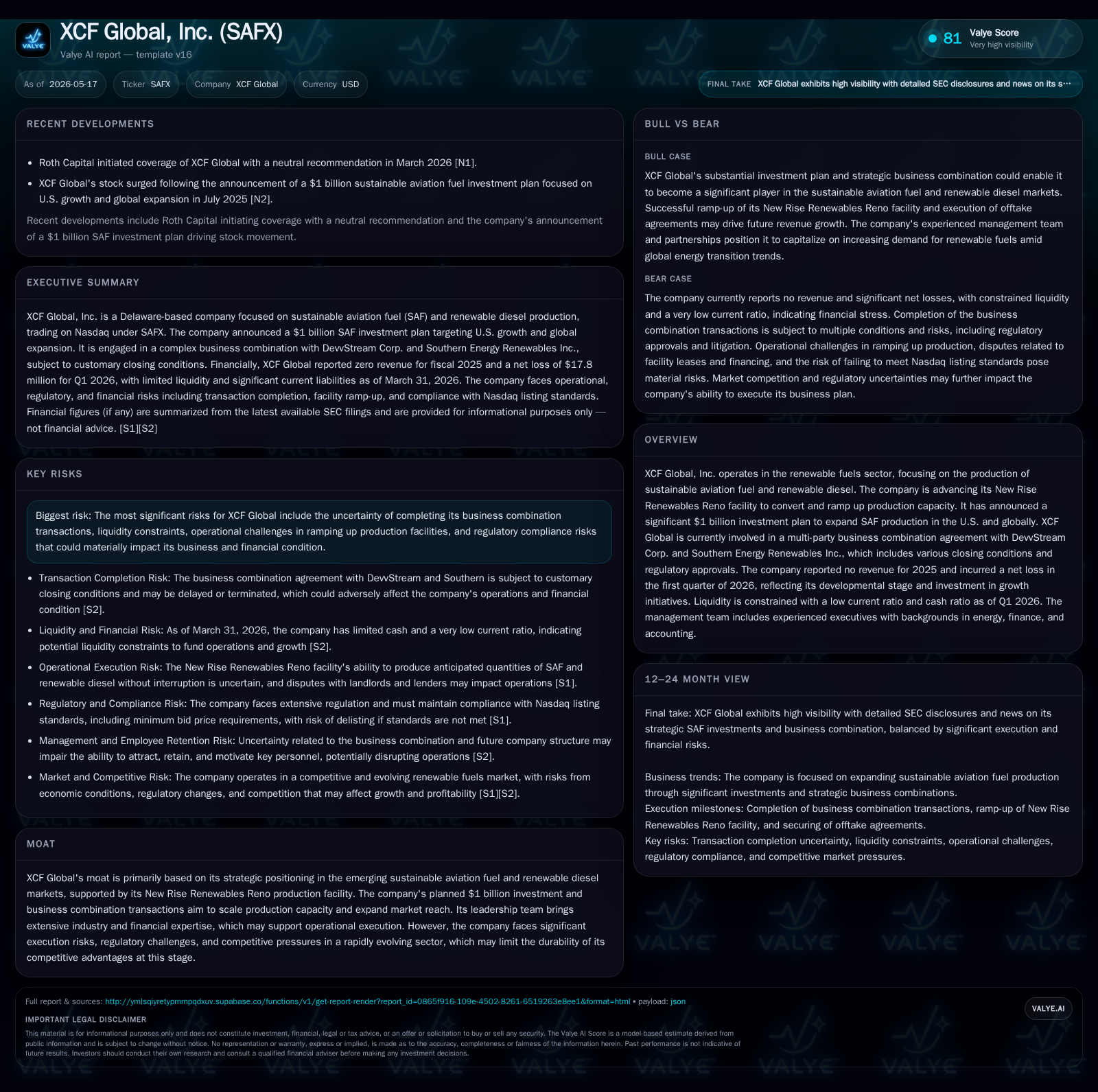
In its latest quarterly filing, XCF Global, Inc. disclosed ongoing progress in its ambitious multi-party business combination aimed at expanding sustainable aviation fuel (SAF) and renewable diesel production capacity. The company’s New Rise Renewables Reno facility serves as the operational cornerstone for this scaling effort, supported by a planned $1 billion capital investment. However, significant uncertainties remain regarding transaction completion under customary closing conditions, regulatory approvals, and plant conversion timelines. Liquidity is strained with a current ratio near 0.02 as of Q1 2026, underscoring financial risk alongside growth ambitions.
Latest Quarterly Operational Update: Transaction Progress and Capital Position
XCF Global’s latest 10-Q filed May 15, 2026 provides the most current operational snapshot highlighting key developments in its strategic business combination efforts and financial condition [S2]. On January 26, 2026, the company entered into a term sheet with DevvStream Corp. and Southern Energy Renewables Inc., followed by execution of a definitive Business Combination Agreement (BCA) on April 13, 2026 [S24]. This multi-party transaction contemplates merging DevvStream and Southern subsidiaries into XCF to create an integrated platform across renewable fuels.
Completion remains subject to customary closing conditions including receipt of fairness opinions, regulatory approvals, shareholder vote thresholds, Nasdaq listing compliance, and absence of injunctive legal actions [S24]. Failure to meet these could delay or terminate the transactions. The filings explicitly note litigation risks related to these deals that could increase costs or distract management [S24].
Liquidity remains notably strained through March 31, 2026 with reported cash & equivalents around $1.05 million versus current liabilities exceeding $244 million yielding an extremely low current ratio near 0.02 [F1]. Total debt stood at roughly $3.7 million with net debt—debt less cash—of approximately $2.7 million [F1]. Recent settlement agreements targeting Encore DEC LLC debt reduction aim to address some debt burdens but overall working capital remains tight with limited financial cushion [S3].
The constrained liquidity landscape heightens execution risk inherent in completing capital-intensive plant conversions while pursuing sizable business combination closures.
Company Business Model: Renewable Fuels Production and Market Relevance
XCF Global derives value principally through developing renewable fuels—sustainable aviation fuel (SAF) and renewable diesel—from existing refining assets adapted for bio-feedstock processing [S1]. Central is the New Rise Renewables Reno facility where the company is converting traditional infrastructure to produce low-carbon fuels aligned with growing airline industry decarbonization commitments,
Revenue drivers ultimately rest on successfully ramping commercial production volumes alongside blending mandates that require higher penetration of SAF within jet fuel supply chains globally. Given zero revenue reported for fiscal year 2025 [F1], XCF is clearly in a developmental stage investing heavily in asset transformation rather than commercial delivery.
Pricing power depends partly on evolving policy incentives such as Renewable Fuel Standard credits in the U.S., carbon pricing regimes internationally, and end-customer willingness—primarily airlines—to pay premiums for SAF to meet sustainability goals (analysis). The sizeable announced $1 billion expansion reflects confidence in anticipating structural long-term demand growth driven by tightening emissions regulations in aviation.
This model is capital intensive requiring significant upfront plant conversion expenditure before generating meaningful free cash flow. Customer contracts likely involve long-term off-take agreements or industry partnerships incentivizing early supply chain adoption though details remain undisclosed.
Competitive Set and Industry Structure in Sustainable Aviation Fuels
The sustainable aviation fuels industry is experiencing rapid evolution driven by global policy frameworks targeting aviation emissions reductions through blending mandates (e.g., International Civil Aviation Organization’s CORSIA program) and government subsidies supporting low-carbon fuel producers (analysis). Large incumbent refiners have begun integrating bio-refining capabilities adding competitive pressure.
Feedstock sourcing constitutes a critical supply chain challenge since availability of low-cost sustainable biomass (waste oils, plant oils) is geographically variable and volumes limited relative to ambition (analysis). Pricing dynamics fluctuate volatilely across feedstocks impacting production economics.
XCF's strategy hinges on retrofitting existing refinery assets (New Rise Renewables Reno) for cost-efficient production scale-up contrasting ground-up greenfield projects requiring longer lead times. This approach could offer speed-to-market advantage if successfully executed. However, competing projects backed by major energy companies benefit from greater capital depth possibly constraining XCF’s market share capture absent effective differentiation or strategic partnerships.
Growth Drivers: Capacity Expansion, Strategic Investments, and Market Adoption
Key growth drivers rest on progressing timely completion of the planned plant conversion at New Rise Renewables Reno enabling commercial SAF/renewable diesel output ramp from zero production baseline noted in 2025 [S1],. Successful execution unlocks revenue scale linked directly to volume produced and shipped.
The $1 billion planned capital investment signals an aggressive scaling intent extending beyond Reno potentially including future site expansions or complementary renewable assets globally. The multi-party business combination consolidates complementary expertise and assets broadening operational capacity.
Structural demand underpinning comes from increasing airline industry pressure amid rising climate regulation regimes globally boosting SAF adoption mandates over medium to long term (10+ years). Growing environmental corporate governance standards among transport fuel buyers further support volume off-take potential.
Closing these mergers would increase operational scale while potentially improving access to capital markets given combined entity size enhancing financing capability essential for capex-intensive industry segment growth [S24], [S26].
Risk Factors: Execution Uncertainty, Regulatory Hurdles, and Liquidity Constraints
The most salient risks revolve around completion uncertainty inherent in XCF's conditional definitive agreements. Closing failures due to unmet conditions (fairness opinions not received timely), shareholder vote shortfalls or adverse litigation could derail transformative deals reducing strategic options markedly [S24].
Regulatory approvals for facility conversions carry inherent timelines that may extend because of permitting delays or stricter environmental compliance standards potentially increasing costs or deferring revenues beyond original expectations, [S24].
Liquidity challenges pose immediate operational threats given cash balances totaling just over $1 million compared to outsized near-term liabilities over $244 million creating fragile working capital position with minimal buffer against unforeseen expenses or project overruns [F1], [S3].
Additionally, failure to regain compliance with Nasdaq minimum bid price standard risks delisting potentially limiting access to public equity funding just when needed most during scaling phase [S24].
Sector competition from better-capitalized incumbents simultaneously building biofuel portfolios represents ongoing pressure reducing pricing leverage while feedstock volatility affects raw material cost predictability limiting margin sustainability (analysis).
Investor Watchpoints: Transaction Closures, Plant Conversion Milestones, and Financial Health
Watch closely official announcements around closing timings for mergers with DevvStream and Southern as these represent critical catalysts shaping XCF’s scale trajectory post-2026 [S24], [S25]. Any delays or termination announcements would significantly alter growth prospects.
Monitor progress reports on New Rise Renewables Reno facility conversion status versus forecasted timelines; ramp milestones including commissioning phases then commercial production startup benchmarks provide tangible volume visibility indicating movement toward generating first sustainable fuels revenue streams.[S4], [S5],
Subsequent liquidity updates including incremental capital raises or debt restructuring efforts will serve as key indicators of financial resilience amid expansion demands given precarious current balance sheet metrics.[F1],[S3]
Market reception reflected via early off-take agreements if disclosed alongside pipeline contract renewals post-business combination will reveal customer confidence level underpinning future revenue predictability.
Financial Profile Snapshot: Capital Structure and Liquidity Status
As of Q1 ending March 31, 2026, XCF holds approximately $1.05 million in cash & equivalents juxtaposed against total current liabilities nearing $245 million resulting in an exceptionally low current ratio near 0.02—a critical warning flag regarding near-term liquidity risk under normal operating assumptions [F1]
Total debt registered roughly at $3.7 million contributing modest leverage but overshadowed by enormous short-term creditor obligations predominantly linked with asset redevelopment costs or accrued transactional payables [F1]
Recent agreement filed May 12 addressing Encore DEC LLC debt reduction paired with equity capitalization illustrates management efforts targeting deleveraging tactics albeit impacting ownership structure as typical in growth-stage renewal energy plays relying heavily on external financing cycles [S3]
Absence of reported revenues sustains ongoing net losses reflecting developmental spending; thus positive cash flow generation remains dependent on successful asset operationalization combined with effective capital deployment strategies moving forward [F1]
Disclaimer: This is research-only, informational analysis and not investment advice. It may include AI-generated interpretation and general industry context. Always verify important details using primary sources.

Comments