
Banco Santander’s Pursuit of Profitability: Integration, Innovation, and Capital Discipline
The bank leverages major acquisitions and digital transformation within a disciplined capital allocation framework to target sustainable profit growth.
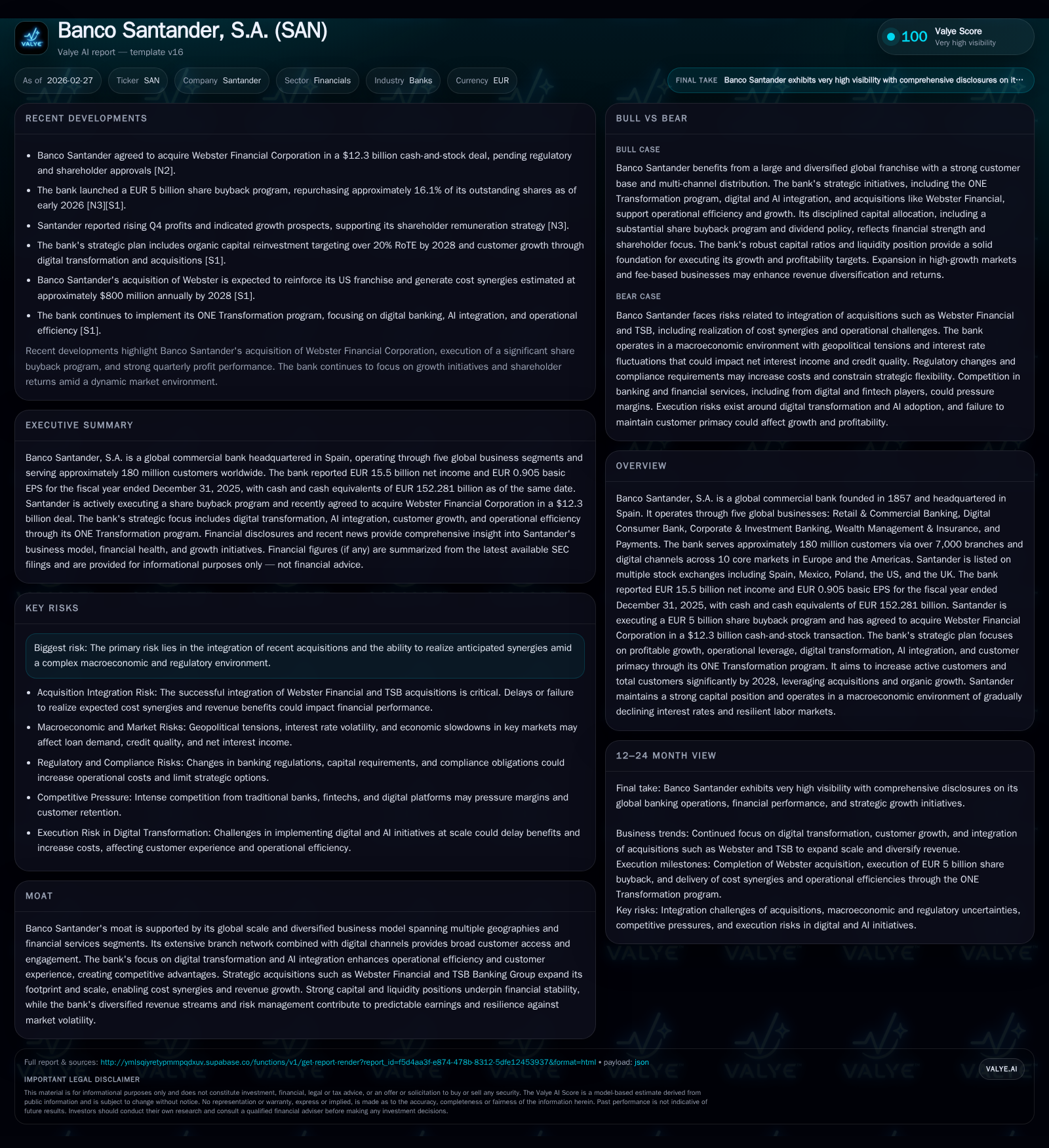
Banco Santander reported a 12.8% year-over-year net income increase in 2025, reaching EUR 15.5 billion with a solid ROE of approximately 13.7% driven by diversified global operations. The recent $12.3 billion Webster Financial acquisition and TSB Banking Group deal are strategic moves to expand footprint and achieve synergy, though integration and regulatory challenges pose risks. Digital initiatives including AI adoption and platform unification aim to improve customer engagement and reduce costs, supporting Santander’s target of >20% RoTE by 2028. Capital allocation balances dividends, buybacks, and funding for growth amid a strong CET1 ratio above 13%. Key near-term milestones include acquisition closures, synergy realization, and digital rollout progress.
1. Historical Financial Growth and Profit Drivers
Banco Santander has demonstrated consistent growth across recent years, with net income rising from EUR 10.76 billion in FY2022 to EUR 15.5 billion in FY2025—a compound annual growth rate of approximately 12.8% [F1]. This performance reflects the bank's diversified global footprint spanning Europe and the Americas and its multipronged business model covering Retail & Commercial Banking, Digital Consumer Banking (Openbank), Corporate & Investment Banking (CIB), Wealth Management & Insurance, and Payments.
Equity expanded in parallel from EUR 97.6 billion in 2022 to EUR 112.7 billion in 2025 [F1], enabling an approximate return on equity (ROE) of 13.7% in the latest fiscal year — indicative of effective capital utilization amidst evolving market dynamics. Revenue streams have broadened substantially, notably fee-based income which has been boosted by scale advantages from global retail banking operations.
Historical performance (annual)
| FY | Net ($bn) | Net YoY |
|---|---|---|
| 2025 | 15.5 | +12.8% |
| 2024 | 13.7 | +12.8% |
| 2023 | 12.2 | +13.2% |
| 2022 | 10.8 |
Source: SEC companyfacts cache [F1].
Capital returns and efficiency (annual)
| FY | Div ($bn) | ROE% |
|---|---|---|
| 2025 | 4.2 | 13.7 |
| 2024 | 3.7 | 12.8 |
| 2023 | 3.0 | 11.7 |
| 2022 | 2.3 | 11.0 |
Source: SEC companyfacts cache [F1].
The steady increase in dividends paid also signals confidence in free cash flow generation capacity over this period [F1].
2. Strategic Expansion: Webster Acquisition and M&A Integration Challenges
In early February 2026, Banco Santander announced the acquisition of Webster Financial Corporation for $12.3 billion in a cash-and-stock transaction [N1]. Alongside this, the bank is advancing its purchase of TSB Banking Group in the UK as part of a broader expansion strategy focusing on hard-currency geographies—Europe and North America—to improve profitability metrics such as RoTE.
These bolt-on acquisitions are intended to deliver meaningful revenue growth supported by cost synergies estimated at hundreds of millions annually once fully realized by end-2028 [S12]. Such synergies stem primarily from de-duplication of infrastructure and branch consolidation alongside IT system migrations leveraging best-in-class technology stacks.
Yet integration complexity embodies the principal risk vector given operational challenges combining diverse cultures, compliance frameworks among multiple regulators (ECB, FDIC, PRA), and potential disruption to client retention during transition [N5][S6]. The bank has committed to disciplined organic growth alongside acquisitions to mitigate execution risks while maintaining capital adequacy.
3. Digital-First Transformation and AI Initiatives
Santander emphasizes its "ONE Transformation" strategy that consolidates digital capabilities across Retail & Commercial Banking and Openbank into a unified platform designed to increase customer engagement through personalized experiences.
AI deployment is central here; it enables process automation, enhances CRM-driven advisory models, reduces servicing costs per active customer aiming toward less than EUR 220 annually from EUR 264 recorded in previous years [S19]. The strategy also incorporates Openbank’s expansion into new markets such as Mexico, Spain, Germany, and the US while strengthening underlying payment ecosystems like Openbank Pay.
Operational leverage is targeted through simplified products and streamlined operating models that advance RoRWA (Return on Risk Weighted Assets) beyond 16% by 2028 from current mid-teens levels—signaling improved capital efficiency across segments [S4][S8]. Cross-selling scalability benefits further enhanced fee-income dynamics.
4. Future Growth Opportunities and Margin Enhancement Plans
Santander has explicit high-single-digit revenue CAGR ambitions for Corporate & Investment Banking segments anchored on fee income growth exceeding lending spread expansion.
Partnerships within wealth management aim at delivering both asset accumulation solutions plus decumulation offerings such as retirement products with embedded insurance protections driving incremental fees estimated at +20% penetration by end-2028 [S7][S8]. Moreover, payments volumes are expected to double by leveraging proprietary software APIs for integrated acquiring services enhancing margins toward projected EBITDA margins around 45%.
Fee income intensification complements traditional interest margin revenues and underpins Santander’s overall goal to exceed a >20% RoTE group-wide by financial year-end 2028—reflecting structural shifts toward higher-value-added products [S4][S7].
5. Capital Allocation Framework: Dividends, Buybacks, and Return on Equity
The bank’s capital policy unfolds through a rigorous hierarchy balancing organic reinvestment with shareholder returns [S5]. For fiscal year-end results from 2026 onward through at least 2028:
- Approximately half of underlying profits are earmarked for distributions with an even split between dividends (
35%) starting in 2027—and share buybacks (15%) supporting EPS accretion without excessive capital strain. - A EUR 5 billion share buyback program was launched early in February 2026 with about one-third (~31%) deployed within weeks—enhancing capital efficiency measures alongside ongoing acquisitions [N7][S2].
- The Common Equity Tier One (CET1) capital ratio held steady above the prudent operating range of 12–13%, targeting >13% post-acquisitions ensuring robust buffers amid regulatory demands [S6][S28].
This balanced approach aims to sustain an ROE near current levels (~13.7%) while methodically growing tangible book value per share through well-executed investments.
6. Risks and Considerations for Execution and Regulatory Environment
Execution risks primarily cluster around successful integration of Webster Financial and TSB deals within complex multi-jurisdictional regulatory regimes subject to approvals including US SEC/FDIC for Webster as well as UK FCA/PRA for TSB [N1][S6]. Delays or failure to realize anticipated cost synergies could impair profit accretion forecasts.
Additionally, macroeconomic uncertainties spanning inflationary pressures in Latin America soft currencies exposure necessitate vigilance over loan portfolio quality management with defined cost-of-risk (CoR) targets around ~1.1% maintained through conservative underwriting policies [F1][S6]. Market volatility could impact fee-generating business lines such as CIB adversely if risk appetite loosens prematurely.
7. What to Watch: Milestones on Profitability, Synergies, and Regulatory Approvals
Investors should monitor several key developments over the coming quarters:
- Regulatory clearance progress enabling formal closings of Webster Financial acquisition ($12.3 billion deal) along with TSB transaction finalization timelines impacting scope for near-term integration plans [N1][N7][S5].
- Quarterly updates detailing cost synergy captures aiming for full run-rate achievement by end-2028 will signal operational execution quality.
- Metrics reflecting digital platform rollout advancement including AI scaling impacts on cost per active customer usage rates can validate strategic readiness.
- Maintenance of CET1 ratios above target thresholds demonstrating capital resilience alongside any potential special distributions once excess capital emerges at period-end.[N7][S5]
These milestones collectively determine whether Banco Santander can sustain its trajectory towards >20% RoTE medium term while delivering shareholder value through disciplined financial stewardship.
Santander operates a uniquely integrated model blending scale with innovation across diversified business units anchored geographically across hard currency regions predominantly Europe, UK, US—and Latin America supplemented with digital channels representing majority client access points.
This analysis references only data explicitly disclosed via SEC filings ([F1],[S#]) or publicly verifiable news releases ([N#]) up to February 27th, 2026 reflecting the bank's latest strategic disclosures.
While forward-looking aspirations are articulated based on company guidance where available ([S#],[N#]), unforeseen uncertainties inherent in M&A integration or macroeconomic context impose typical levels of execution risk.
This report is analytical with no direct investment advice or recommendations offered.
Disclaimer: This is research-only, informational analysis and not investment advice. It may include AI-generated interpretation and general industry context. Always verify important details using primary sources.

Comments