
Sanmina Expands Cloud Infrastructure Exposure While Managing Customer Concentration and Regulatory Risks
Sanmina's latest quarterly update reveals growth in cloud infrastructure business and ongoing focus on operational efficiency amid macro uncertainties.
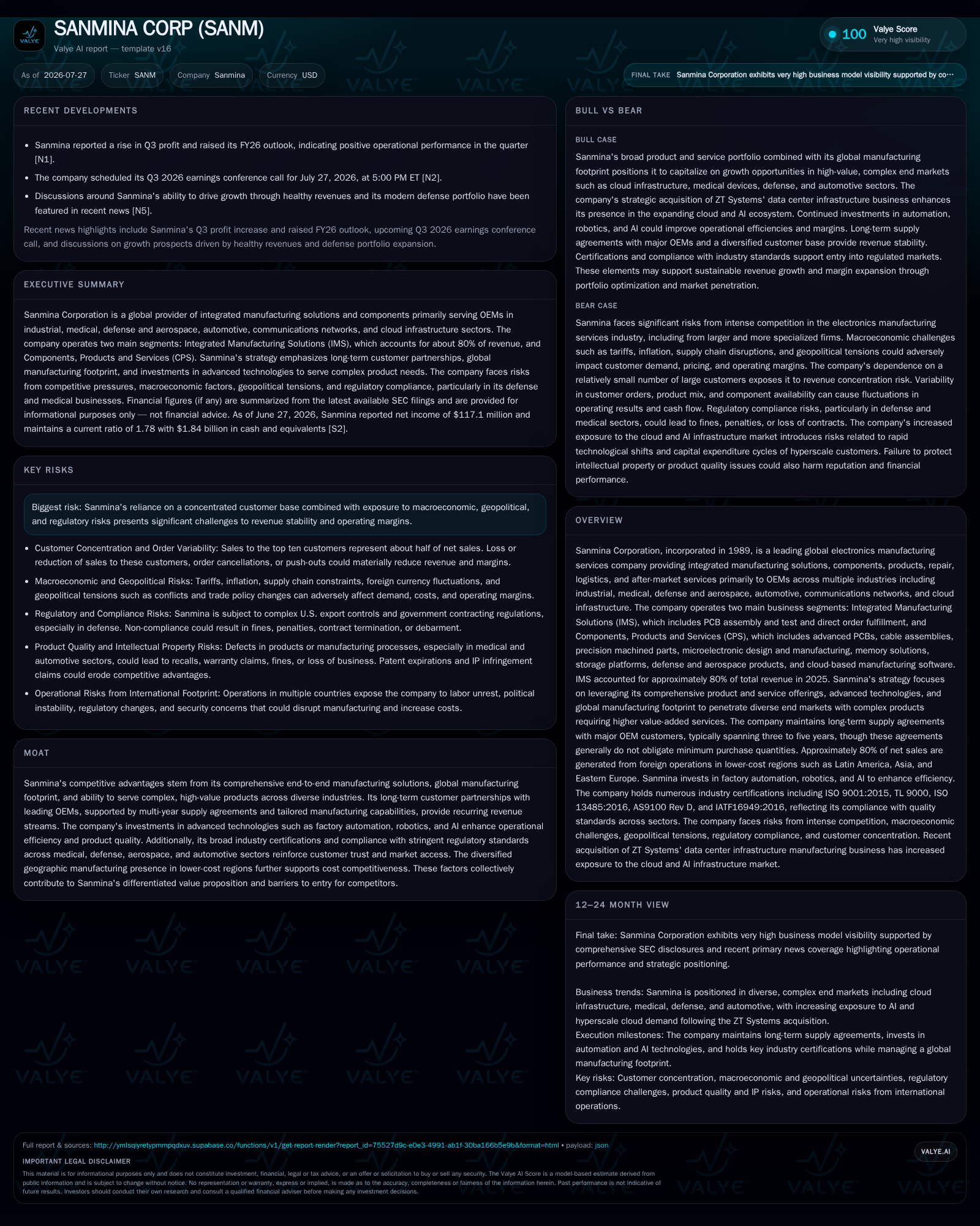
Sanmina Corporation reported solid Q3 results on July 27, 2026, driven by increased demand in the cloud infrastructure segment following the acquisition of ZT Systems. The company leverages its Integrated Manufacturing Solutions (IMS) and Components, Products and Services (CPS) segments to serve diverse end markets including industrial, medical, defense, aerospace, automotive, communications networks, and hyperscale cloud providers. While Sanmina benefits from a global manufacturing footprint and advanced automation investments, it faces risks from customer concentration—especially reliance on a few hyperscalers—and complex regulatory compliance in defense and medical sectors. Its capital structure reflects recent acquisition financing with moderate net leverage supported by strong liquidity.
Recent Operating Update
On July 27, 2026, Sanmina Corporation released its Q3 quarterly results reporting revenue growth driven primarily by its expanded exposure to the cloud infrastructure market following its recent acquisition of ZT Systems. This segment’s capital-intensive demand from hyperscale cloud providers has become a significant component of Sanmina’s revenue mix post-acquisition. The company confirmed continued strong orders but flagged the inherent unpredictability of long-term demand tied to these customers’ capital expenditure cycles [S2][N1]. The quarter also reflected operational efficiencies garnered through factory automation investments and enhanced supply chain management.
Business Model Overview
Sanmina operates as a leading contract manufacturer within the Electronics Manufacturing Services (EMS) industry supplying end-to-end solutions primarily to original equipment manufacturers (OEMs). Its revenues derive chiefly from two segments: Integrated Manufacturing Solutions (IMS), which constitutes approximately 80% of total sales and centers on high-volume printed circuit board (PCB) assembly and testing services; and Components, Products and Services (CPS), offering more specialized products such as advanced PCBs, cable assemblies, precision-machined parts, microelectronic design/manufacturing capabilities, memory/storage platforms, plus defense/aerospace manufacturing [S1]
Its customers span critical end markets including industrial machinery, medical devices requiring stringent FDA-regulated manufacturing processes certified under ISO 13485:2016 standards, automotive electronics demanding compliance with rigorous quality controls like TL 9000 certification for telecom-grade products, aerospace components subject to highly regulated performance criteria, and large-scale communications networks encompassing hyperscale data centers supporting AI workloads [S1][S14]
Revenue mechanics rely heavily on long-term supply contracts often customized per client specifications involving multi-stage production flows from component sourcing to final order fulfillment. Contractual volume variability emerges mainly from product life cycle maturity stages—ramping up new designs demands upfront tooling investments raising start-up costs before volume stabilizes whereas mature product lines tend toward steady-state production generating recurring revenue streams. Pricing incorporates both fixed-fee arrangements linked to unit volumes and cost-plus models protecting margin during component price fluctuations.
Factory automation initiatives employing robotics and AI-driven process controls underpin cost competitiveness while ensuring quality consistency demanded by OEM partners. The geographically diversified manufacturing footprint—in North America (largely Mexico), Asia Pacific (notably Malaysia), and Europe—balances labor cost advantages against logistical considerations enabling adaptive production allocations amid global supply chain challenges.
Industry Structure and Competitive Position
Within the EMS space alongside peers such as Flex Ltd., Jabil Inc., and Celestica Inc., Sanmina differentiates itself through a comprehensive offering that integrates advanced PCB technologies with precision machining and microelectronics design support—extending beyond standard assembly services. Its broad industry certifications facilitate entry into heavily regulated markets like medical device manufacture and defense aerospace where compliance barriers deter less-experienced EMS providers.
Customer concentration remains a notable challenge: the top ten customers contributed over half of revenues recently ([S14]), with heightened dependence on a limited number of hyperscale cloud customers following the ZT Systems acquisition amplifying exposure to cyclical capital spending patterns that are difficult to forecast reliably. Peer EMS players similarly face this concentration risk though some have pursued diversification strategies or expanded into emerging markets to mitigate it.
Pricing pressure persists due to intense competition among EMS firms competing for large OEM engagements effectively leveraging scale economies or low-cost regional production bases. Success rests not only on competitive pricing but also responsiveness to OEM innovation cycles requiring agility in ramping production lines for new products—areas where Sanmina’s automation investments afford some advantage.
Growth Drivers
Growth prospects hinge on increasing outsourcing trends by OEMs aiming to reduce fixed costs associated with direct manufacturing investments. Expanding demand in end markets related to cloud infrastructure reflects underlying secular trends toward digital transformation fostering demand for hyperscale data center buildouts requiring complex electronic platforms.
Moreover, growth opportunities arise from accelerated adoption of advanced PCBs supporting AI applications alongside rising needs for sophisticated microelectronics across automotive electrification initiatives and aerospace modernization efforts—in all cases benefitting providers capable of handling complex manufacturing processes certified under relevant regulatory frameworks.
Multi-year supply agreements with major OEMs provide revenue longevity visibility when secured successfully. Furthermore, expanding after-market repair service offerings present incremental profit levers by leveraging installed product bases for lifecycle support commercialized through dedicated service contracts.
Risks and Watchpoints
Key risks stem from substantial customer concentration notably among hyperscale cloud providers whose capital budgets can abruptly contract reacting to broader economic conditions or internal strategic shifts. This volatility complicates forecasting revenue streams given Sanmina’s outsized exposure post-ZT acquisition [S2]
Regulatory exposures are pronounced given the intricate U.S. export control laws governing defense-related manufacturing activities requiring sustained compliance efforts including audits by government bodies like the Department of Justice—noncompliance can trigger material fines or contract terminations [S8]. Similarly stringent FDA standards impose operational discipline on medical device manufacturing facilities certified under ISO 13485:2016 reinforcing compliance cost pressures.
Global supply chain instability contributed by geopolitical tensions affecting China-based operations impose risk on component availability challenging supply continuity despite Sanmina’s diversified geographic footprint [S2]. Further uncertainties relate to inflationary cost pressures compounded by tight or variable supplier payment terms impacting working capital management.[S5]
Finally, intellectual property protection amidst rapidly evolving technology landscapes necessitates continuous investment in design capabilities paired with capital expenditures scaling factory automation—the timing of these investments demands careful calibration against shifting demand cycles.
What To Watch Next
Beyond monitoring quarterly sales trends particularly order backlog evolution within cloud infrastructure markets supplying hyperscalers is pivotal given potential swings in their procurement behavior affecting near-term performance.
Sanmina’s ability to replace revenues lost from programs reaching end-of-life with new business wins in emerging technology areas will be key KPIs signaling sustainability of growth trajectories. Integration effectiveness of ZT Systems operations represents another critical execution milestone impacting margins.
Contract renewal activity particularly multiyear agreements will offer insight into revenue visibility duration while any material shifts in regulatory compliance environment or export control policy could materially alter operating conditions.
Lastly, continued progress optimizing working capital—management of inventory turnover rates versus customer payment practices—and margin expansion via operational efficiencies remain central metrics supporting financial health going forward.
Financial Profile Discussion
At quarter-end June 2026, Sanmina held $1.84 billion in cash and equivalents against total debt of approximately $2.17 billion yielding a moderate net debt position near $327 million with a current ratio around 1.78 indicating adequate near-term liquidity available to fund operational needs including sustained capex demands required by complex manufacturing processes [F1]
The capital structure reflects financing incurred during fiscal 2025 associated primarily with the $1.6 billion acquisition of ZT Systems funded through draws on Term Loan facilities totalling $2.2 billion combined ($1.4B Term Loan A plus $800M Term Loan B) [S4][S20]
Despite macroeconomic uncertainties encompassing inflationary pressures and interest rate headwinds potentially squeezing margins through higher supplier costs and financing expenses respectively, Sanmina continues generating positive earnings supported by scale economies inherent in its diversified global manufacturing network [N1][F1].
Maintaining covenant compliance under credit agreements is facilitated by consistent cash generation paired with disciplined capital allocation balancing necessary investment in facility upgrades while managing share repurchase programs prudently when market conditions permit [S4][F1]
This analysis synthesizes Sanmina Corporation's recent regulatory disclosures and market context without providing investment advice or research views.
Disclaimer: This is research-only, informational analysis and not investment advice. It may include AI-generated interpretation and general industry context. Always verify important details using primary sources.

Comments