
SBC Medical Group Q2 2026: Strong Liquidity and Governance Challenges Amid Nasdaq Compliance Risk
SBC Medical Group Holdings reported positive net income and strong liquidity in Q2 2026 but faces Nasdaq governance non-compliance risking delisting.
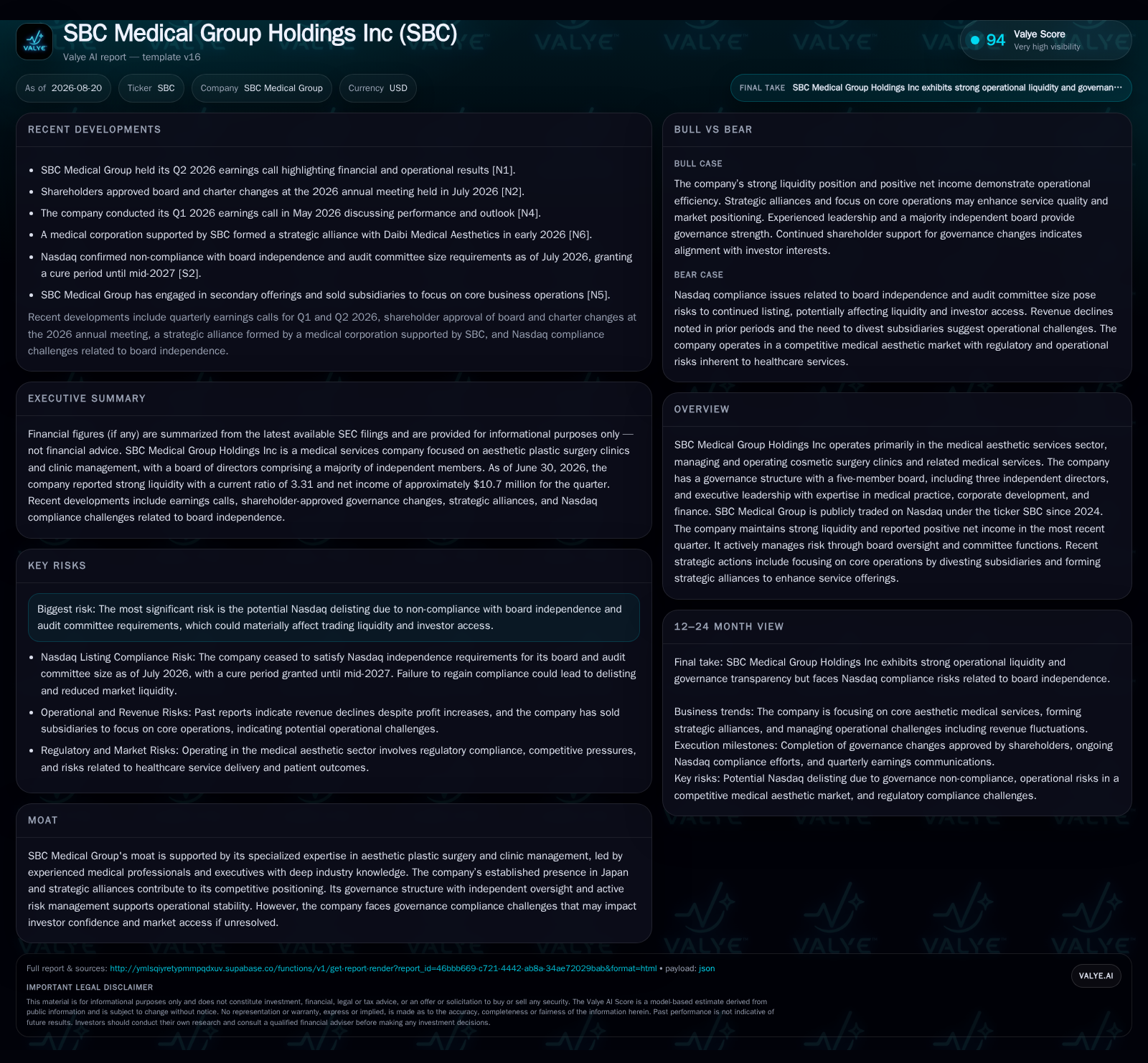
In Q2 2026, SBC Medical Group Holdings demonstrated operational profitability and maintained a robust liquidity position with a current ratio of 3.31 and net cash of approximately $146.6 million. Despite these financial strengths, the company disclosed non-compliance with Nasdaq’s board independence and audit committee size requirements following an independent director’s departure, initiating a cure period that expires in mid-2027. This governance risk poses a material threat to the company’s Nasdaq listing, potentially impacting trading liquidity and investor access.
Q2 2026 Operating and Financial Performance
SBC Medical Group Holdings reported positive net income in the second quarter of 2026, signaling operational profitability during the period [S2]. This profitability supports the company’s ability to generate positive cash flow from its core medical aesthetic services, which include cosmetic surgery and related treatments provided directly to patients at its clinics [S1].
This results in a net cash position of approximately $146.6 million and a current ratio of 3.31, indicating ample working capital to cover short-term obligations [F1]. Such a liquidity profile reduces near-term refinancing risk and offers operational flexibility in a sector where clinic utilization rates and procedure mix can impact revenue and margin dynamics.
Governance and Nasdaq Compliance Risk
Despite the favorable financial position, SBC Medical Group disclosed a significant governance challenge. On July 8, 2026, the company ceased to meet Nasdaq’s requirements for board independence and audit committee size [S2]. This non-compliance arose when one of the independent directors chose not to stand for re-election, reducing the number of independent directors below Nasdaq’s mandated threshold and shrinking the audit committee below the required size.
Nasdaq confirmed the non-compliance on July 10, 2026, and granted SBC a cure period extending to the earlier of the next annual meeting or July 9, 2027, with a stipulation that if the annual meeting occurs before January 5, 2027, compliance must be evidenced by that date [S2]. Failure to regain compliance within this timeframe could lead to delisting of SBC’s securities from the Nasdaq exchange, which would materially affect investor access and trading liquidity.
The company is actively seeking to appoint an additional independent director to restore compliance, but there is no assurance this will occur within the cure period.
Business Model and Competitive Positioning
SBC Medical Group operates in the medical aesthetic services sector, generating revenue primarily from fees charged directly to patients for cosmetic surgery and related medical aesthetic procedures performed at its clinics [S1]. The company’s financial performance depends on clinic utilization rates, procedure mix between surgical and non-surgical treatments, and operational efficiency, including cost control and fixed-cost absorption.
In this sector, maintaining regulatory compliance and governance standards is critical not only for operational licensing but also for sustaining investor confidence and exchange listings. SBC’s established clinic network and specialized expertise in aesthetic plastic surgery position it competitively, but governance risks could undermine market perception and valuation.
Scenario Analysis and Investment Considerations
One plausible scenario is that SBC successfully appoints an independent director before the cure period expires, thereby regaining Nasdaq compliance and maintaining its listing. Confirmation would come from SEC filings or press releases announcing new director appointments and Nasdaq’s acknowledgment of compliance.
Conversely, failure to appoint a qualified independent director could lead to delisting from Nasdaq, forcing the company’s securities to trade on less liquid over-the-counter markets. This would likely reduce investor interest and trading volume, negatively impacting the stock price and complicating future capital raises [S2]. However, the company faces a material governance risk due to non-compliance with Nasdaq’s board independence and audit committee size rules. This risk could lead to delisting, which would materially affect market liquidity and investor access.
Key watchpoints for stakeholders include the company’s progress in appointing new independent directors, subsequent SEC disclosures on governance status, quarterly operating results that might indicate financial resilience, and any Nasdaq communications regarding listing status. Monitoring these factors will be critical to assessing SBC’s ability to maintain its Nasdaq listing and support its strategic objectives.
Disclaimer: This is research-only, informational analysis and not investment advice. It may include AI-generated interpretation and general industry context. Always verify important details using primary sources.

Comments