
Seacoast Banking's Expansion and Earnings Dynamics Signal Strategic Florida Growth
Seacoast Banking’s recent branch acquisitions and disciplined credit management are reshaping its earnings trajectory and competitive stance in Florida.
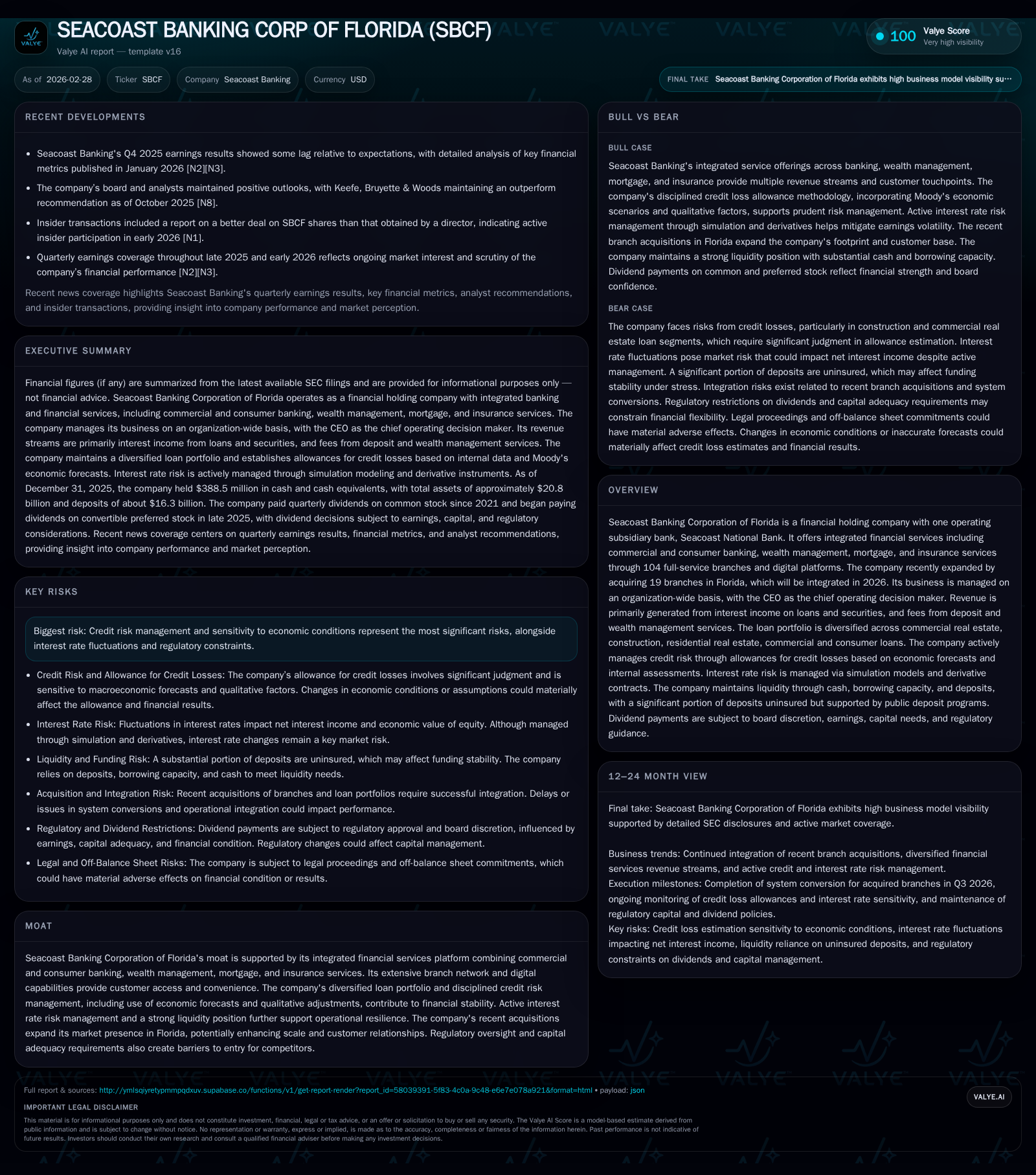
Seacoast Banking Corporation of Florida experienced notable net income growth of nearly 20% in 2025, bolstered by the integration of 19 newly acquired branches and expansion of its loan portfolio. The bank’s diversification across commercial real estate, construction, residential loans, and consumer credits, coupled with prudent credit loss allowances based on economic forecasts, underpin its stable financial position. Capital allocation continued to prioritize dividends with a cautious stance on share repurchases amid expansion investments. Looking forward, the full conversion of acquired branches scheduled for Q3 2026 should further enhance scale and fee-based revenues, although integration costs and regulatory dynamics remain key watch points.
Earnings Momentum Driven by Branch Network Expansion
Historical performance (annual)
| FY | Net ($mm) | CFO ($mm) | Net YoY |
|---|---|---|---|
| 2025 | 145 | 188 | +19.7% |
| 2024 | 121 | 180 | +16.3% |
| 2023 | 104 | 151 | -2.3% |
| 2022 | 107 | 196 |
Source: SEC companyfacts cache [F1].
Capital returns and efficiency (annual)
| FY | Buybacks ($mm) | ROE% |
|---|---|---|
| 2025 | 0 | 5.3 |
| 2024 | 1 | 5.5 |
| 2023 | 11 | 4.9 |
| 2022 | 6.6 |
Source: SEC companyfacts cache [F1].
Seacoast Banking Corp of Florida recorded a robust increase in net income to $144.9 million for fiscal year 2025, representing a year-over-year jump of approximately 19.7% [F1]. This growth was materially influenced by the strategic acquisition of 19 branches located primarily within North Central Florida, expanding Seacoast’s community banking footprint under the operational name Citizens First Bank until their systems fully convert post-acquisition. Branch integration typically fuels incremental deposit gathering opportunities alongside enhanced cross-selling for wealth management and mortgage products — a standard dynamic within Florida’s regional banking landscape [S5][N9].
However, this expansion incurred elevated merger and integration costs totaling $32.4 million during the year (absent prior comparable periods), contributing to increased adjusted noninterest expenses [S1]. Market commentary on Q4 earnings highlighted these costs as factors softening near-term earnings relative to analyst estimates but underscored management’s longer-term view on scale benefits via enhanced noninterest income streams tied to fee-based services [N2].
Loan Portfolio Diversification and Credit Risk Controls
Seacoast maintains a diversified loan portfolio spanning commercial real estate (CRE), construction loans, residential real estate lending alongside commercial and consumer segments [S1][S6]. This diversification moderates concentration risks inherent in Florida’s cyclical real estate markets.
Credit risk is managed through allowance for credit losses (ACL) calibrated using evolving economic forecasts combined with qualitative overlays reflecting industry trends and borrower concentrations. This approach aligns with best practices among regional banks aimed at anticipating default probabilities rather than relying solely on historical data; it also buffers volatility related to unfunded commitments which totaled approximately $3.48 billion at end-2025 compared to $2.85 billion a year earlier [S13][S15]. Provisions for credit losses on these unfunded commitments rose modestly to $1.26 million from $1 million previously, indicative of a conservative provisioning stance amid changing economic conditions.
Capital Structure and Liquidity: Foundations for Sustainable Growth
Total assets increased more than $5.7 billion year-over-year driven largely by acquisitions reaching approximately $20.8 billion at year-end 2025 [S24]. Shareholders’ equity grew roughly 24%, rising from $2.18 billion in FY24 to $2.71 billion at FY25 close reflecting retained earnings accumulation alongside acquisition-related capital inputs [F1].
Liquidity remained strong with $388.5 million in cash and equivalents supplemented by $7.6 billion in borrowing capacity comprised mainly of secured lines such as Federal Home Loan Bank (FHLB) advances totaling $835 million at an attractive weighted average rate near 3.82%, down from about 4.19% last year—a deliberate cost optimization move in wholesale funding strategies [S4][S8]. Long-term subordinated debt instruments contribute to regulatory Tier I capital compliance with amortizing discounts recognized within interest expense calculations [S11][S12][S14], supporting Basel III capital adequacy standards while preserving flexible collateralized funding access.
Dividend Policy and Capital Allocation Amid Expansion
Since initiating common stock dividends quarterly from Q2 2021 onward, Seacoast began paying preferred stock dividends following issuance in late 2025 linked to acquisition financing involving convertible preferred shares issued against VBI shareholders’ interests [S22]. The board exercises regulatory prudence consistent with Federal Reserve guidance assessing dividend viability against net income streams, retained earnings sufficiency, anticipated capital needs, and regulatory capital adequacy thresholds ensuring dividends do not constitute unsafe or unsound practices [S1].
Common share repurchases were modest in FY23 ($10.9 million) and nearly negligible in FY24 ($0.88 million), but no buyback activity occurred during FY25 reflecting management's preference for retaining capital amid ongoing branch integrations and market expansion efforts [F1].
Forward Look: Integration Milestones and Market Penetration Prospects
The newly acquired branch network continues operating under Citizens First Bank branding pending system conversion expected early Q3 2026—a critical milestone where technological assimilation unlocks economies of scale through unified data platforms enhancing fee income generation from wealth management services alongside more efficient deposit product offerings across an expanded customer base [N9][S5].
Successful conversion is crucial not only for consolidating operational workflows but also positioning Seacoast competitively against larger Florida banks leveraging digital tools combined with physical footprints.
Effective branch integration could elevate cross-selling ratios, improve deposit retention metrics from acquired customers formerly served under smaller community brands, and deepen market penetration especially among affluent demographics attracted by Seacoast’s integrated financial services including mortgage origination capabilities — an increasingly significant fee driver amid rising housing market interest rates.
Monitoring Key Financial Metrics: What Investors Should Watch Next
Investor focus should center on adjusted net income excluding merger-related expenses as an indicator of operational profitability once one-time costs wane [N4][S1]. Tracking noninterest income growth post-acquisition reflecting wealth management fee increases relative to cost absorption progress will also be important.
Credit quality indicators including provision levels versus actual charge-offs remain essential given loan portfolio expansion; evolving trends here provide early signals on economic cycle impacts particularly within Sun Belt real estate sectors heavily represented in Seacoast’s book.
Net interest margin evolution merits attention due to sensitivity from acquired assets’ yield characteristics combined with wholesale funding rate shifts detailed earlier along with new debt instruments affecting interest expense dynamics [F1][S24]. Efficiency ratio improvements following full integration will further signal managerial execution effectiveness.
This analysis leverages verified SEC filings alongside recent market commentary up through February 2026 disclosures by Seacoast Banking Corporation of Florida without predictive or investment advisory elements. Readers should consult regulatory filings directly for comprehensive details or institutional research sources for tailored investment evaluations.
Disclaimer: This is research-only, informational analysis and not investment advice. It may include AI-generated interpretation and general industry context. Always verify important details using primary sources.

Comments