
Southside Bancshares Inc: Navigating Texas Regional Banking Amid Credit and Liquidity Challenges
Southside Bancshares operates a Texas-focused regional banking platform balancing commercial lending and government-backed securities, facing mounting credit and deposit pressures.
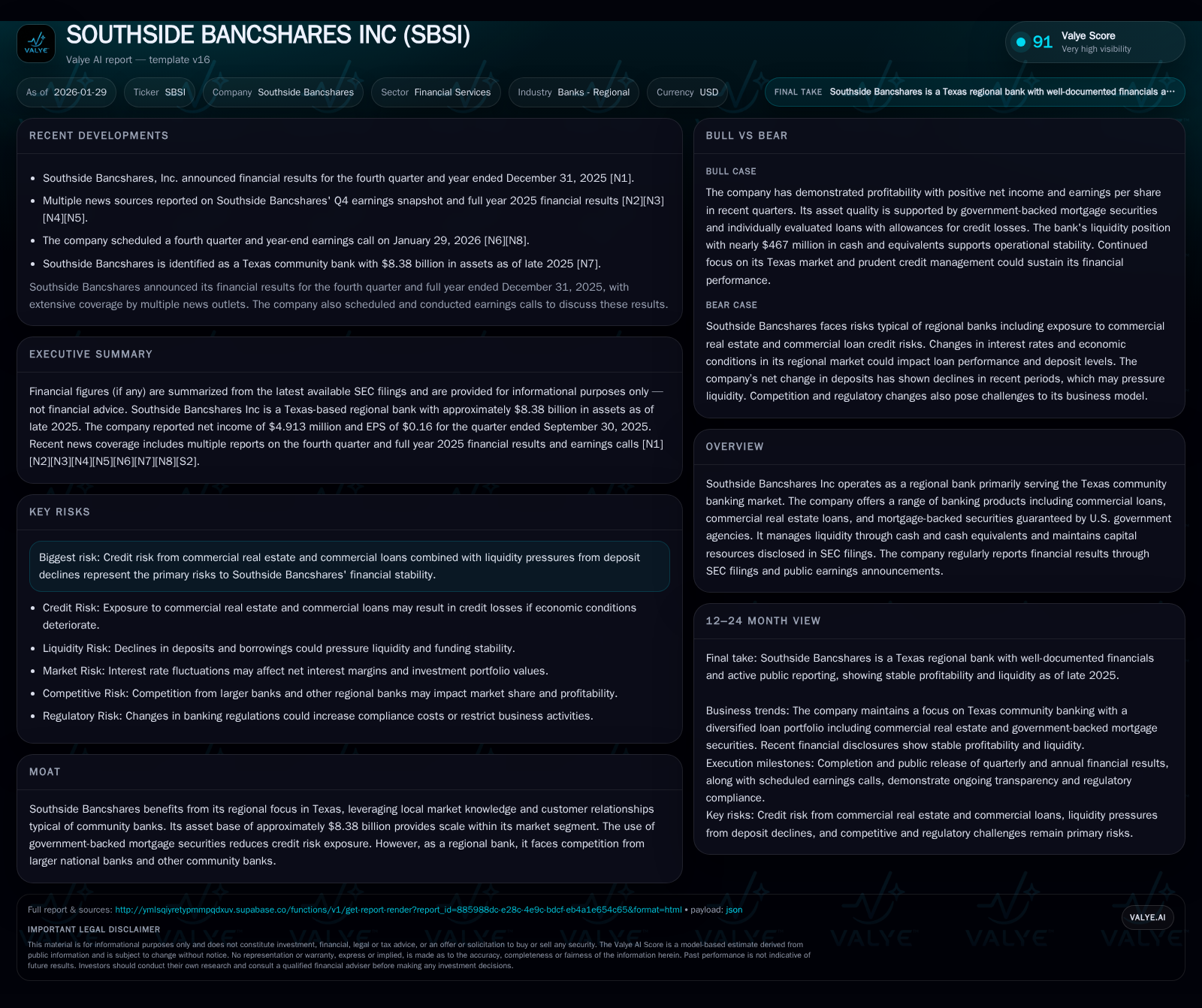
Southside Bancshares Inc (SBSI) remains a significant community banking institution in Texas with an $8.38 billion asset base, offering commercial and real estate loans alongside mortgage-backed securities guaranteed by U.S. agencies. Recent results show mixed signals with asset quality pressures evident in rising nonperforming assets and restructured loans, offset by stable government-backed MBS holdings that mitigate credit risk. Deposit contraction and competitive pressures from national banks underscore liquidity management challenges. The bank’s economics hinge on loan portfolio mix, credit risk management, and deposit stability within a competitive regional banking landscape.
What Changed Recently
Southside Bancshares Inc released its fourth-quarter and full-year 2025 financial results on January 29, 2026, reaffirming its position as a key Texas-based regional bank with $8.38 billion in total assets [N1][N3]. Media and analyst summaries stress the bank's navigation through a challenging environment marked by rising credit concerns and deposit declines [N2][N4][N5]. The company announced an earnings call to discuss results and outlook, emphasizing strategic responses to these headwinds [N8][N9]. Notably, nonperforming assets increased dramatically, largely driven by a $27.5 million commercial real estate loan restructuring to accommodate extended lease-up periods, signaling stress in that portfolio segment [S15]. Deposit outflows intensified, necessitating adjustments in liquidity management and borrowings [S15][S16]. This quarter's results reflect the dual challenge of maintaining asset quality while competing for deposits amid the Texas regional banking sector's evolving dynamics.
Business Model as a System
Southside Bancshares operates primarily as a regional community bank focused on the Texas market, leveraging local knowledge and customer relationships typical of community banking models [Valye excerpt]. Its product mix centers on commercial loans, commercial real estate loans, municipal loans, and residential loans, alongside an investment portfolio of mortgage-backed securities (MBS) guaranteed by U.S. government agencies or government-sponsored enterprises (GSEs) [S1][S6]. This triad of lending and investment products forms the core revenue engine.
Loan portfolios are segmented into commercial real estate, commercial loans, municipal loans, and various residential loans, with credit risk mitigated through collateral evaluation and allowance for loan losses based on fair value assessments [S2][S4]. MBS holdings provide liquidity and credit risk mitigation benefits, as these securities have government guarantees, limiting exposure to borrower default risk [S1].
Liquidity management involves balancing deposit inflows and outflows with borrowings, including Federal Home Loan Bank borrowings, whose related stock holdings declined in 2025 alongside reduced borrowings [S15]. Capital adequacy is maintained through retained earnings and equity issuances, with dividends paid reflecting capital return policies [S18].
The bank earns net interest income by leveraging interest rate spreads between lending yields and funding costs, while fee income and service charges supplement revenue streams. Operating costs include personnel, compliance, and technology investments required to compete in a regional banking environment and meet regulatory standards.
Industry Map & Competitive Battlefield
Operating as a Texas-focused regional bank, Southside Bancshares competes within a fragmented banking landscape characterized by competition from large national banks, regional banks, and smaller community banks [Valye excerpt]. The Texas banking market is dynamic, with substantial commercial real estate activity, energy sector exposure, and a growing population driving demand for diverse banking services.
National banks offer scale advantages, broader product suites, and technological capabilities, attracting larger corporate clients and some retail customers. Community banks like Southside Bancshares differentiate through localized customer service, regional market expertise, and flexible lending tailored to small and mid-sized businesses [Valye excerpt].
Competitive dynamics are shaped by deposit pricing, loan underwriting standards, and the ability to manage credit risk in cyclical sectors such as commercial real estate. Regulatory compliance costs and capital requirements further pressure margins, particularly for banks of Southside's size.
The bank’s use of U.S. government agency-backed MBS reflects a conservative investment approach compared to riskier securities held by some peers, emphasizing credit quality but limiting yield enhancement opportunities in a rising rate environment.
Where the Economics Become Real
Southside Bancshares’ financial performance hinges on effectively managing the interplay between loan portfolio composition, credit risk, deposit stability, and funding costs. Key unit economics drivers include:
Loan Yield vs Funding Cost: The bank earns interest income primarily from commercial and real estate loans, which typically command higher yields than municipal loans. Funding costs are driven mainly by deposit interest expense and borrowing costs, including FHLB advances [S1][S15]. The net interest margin is sensitive to deposit base fluctuations and competition for higher-yielding loan segments.
Credit Risk and Loan Losses: The sharp increase in nonperforming assets (816.9% rise to $32.9 million) and restructured loans driven by commercial real estate challenges indicate rising credit risk, which directly impacts loan loss provisions and net income [S15]. Maintaining adequate loan loss reserves and collateral valuations is essential to preserve capital.
Deposit Dynamics: Deposit declines in 2025 created liquidity pressures, increasing reliance on borrowings and reducing low-cost funding sources [S16]. Deposit attrition can compress margins due to the need for more expensive funding avenues.
Government-Backed MBS Holdings: These securities add stability to earnings by reducing credit losses but typically yield less than riskier assets, especially in a higher interest rate environment, limiting upside but lowering volatility [S1][S6].
Operational Efficiency: Regulatory compliance, technology upgrades, and staff costs weigh on operating leverage. The bank’s scale and regional focus constrain efficiency gains relative to larger institutions.
Overall, profitability depends on balancing growth in higher-yielding loans against credit quality and funding cost control, within a competitive regional market.
Diligence Questions / Disconfirming Signals
Credit Quality Trajectory: How sustainable is the current level of commercial real estate loan stress? Are there early warning signs of broader sector weakness beyond the $27.5 million restructured loan?
Deposit Stability: What are the underlying causes of deposit declines? Are these temporary shifts or indicative of structural competitive pressures in the Texas market?
Capital Adequacy Under Stress: With rising nonperforming assets and loan restructurings, is current capital sufficient to absorb potential losses without constraining growth?
Competitive Positioning: How effectively does Southside Bancshares differentiate itself against national and other regional banks? Is there risk of losing market share in core segments?
Interest Rate Sensitivity: How does the bank’s earnings profile respond to changes in interest rates, given its asset and liability mix?
Liquidity Management: Are current borrowings and liquidity buffers adequate to handle potential deposit volatility or unexpected loan loss events?
Operational Risks: What are the implications of increasing regulatory and compliance costs on profitability and operational focus?
MBS Portfolio Duration Risk: Could changes in interest rates or policy affect the valuation or earnings contribution of government-backed MBS?
Loan Portfolio Concentrations: Are there concentrations beyond commercial real estate that could pose risks, such as energy sector loans given Texas’ economic profile?
Management Guidance and Strategy: What strategic initiatives are underway to mitigate credit risks, regain deposit growth, and improve operational efficiency?
Conclusion
Southside Bancshares stands as a sizable Texas regional bank with a traditional community banking model emphasizing commercial lending and government-backed securities. Recent results highlight growing credit stresses and deposit outflows that challenge the bank’s liquidity and profitability. The firm’s conservative MBS holdings provide credit risk mitigation but may limit yield in competitive environments. The competitive landscape requires careful balancing of customer relationships, credit risk management, and operational execution. Key risks revolve around commercial real estate exposures, deposit stability, and capital adequacy.
This analysis is grounded in the latest financial disclosures and market context, reflecting the complex interplay of localized banking dynamics and broader economic factors. Readers should consider these findings within the broader financial services industry environment and Southside Bancshares’ disclosed strategic priorities.
This report is for informational purposes only and does not constitute investment advice or recommendations.
Disclaimer: This is research-only, informational analysis and not investment advice. It may include AI-generated interpretation and general industry context. Always verify important details using primary sources.

Comments