
Schrodinger’s Transformative Role in Computational Drug Discovery and Financial Trajectory
Schrodinger advances from software licensing into proprietary drug discovery amid intricate IP risks and evolving financial dynamics.
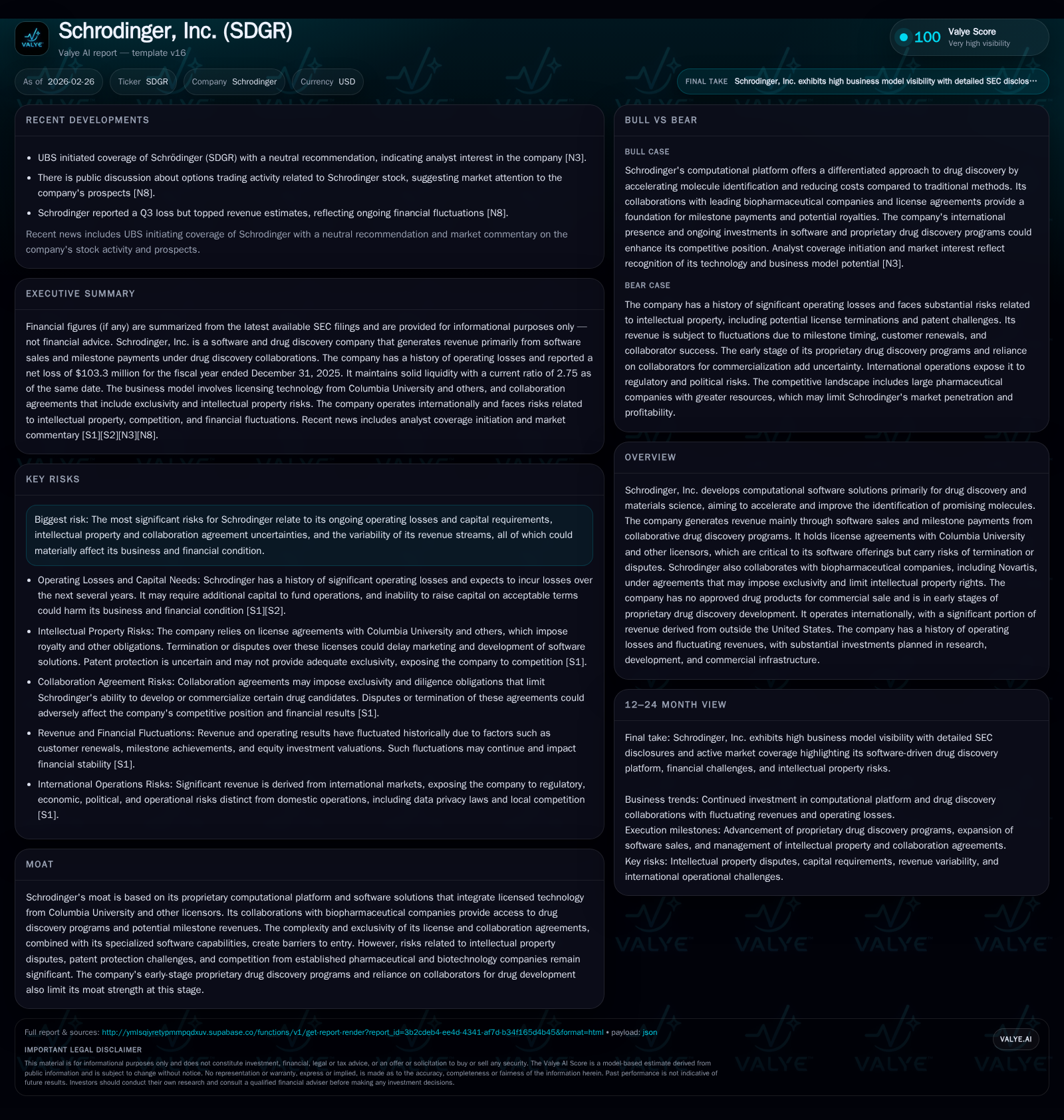
Schrodinger, Inc. has leveraged its proprietary computational platform to fuel consistent software revenue growth, achieving a 23.3% increase in 2025 despite ongoing operational losses. The company’s strategic pivot toward developing proprietary drug candidates introduces considerable uncertainties related to clinical progression and substantial R&D spending without near-term commercial products. Complex licensing agreements with Columbia University and collaborators impose significant intellectual property risks that may affect future commercialization efforts. While operating cash flow turned positive in 2025, signaling improving financial discipline, Schrodinger continues to navigate regulatory, compliance, and capital allocation challenges as it balances innovation with fiscal prudence.
Schrodinger’s Historical Revenue Growth and Operating Trends
Schrodinger has demonstrated consistent top-line expansion driven primarily by its computational platform for drug discovery and materials science. From FY2022 through FY2025, revenue increased from approximately $181 million to $256 million, representing a compound trajectory punctuated by a notable 23.3% year-over-year jump in 2025 alone [F1]. This growth reflects successful monetization of its software licenses coupled with milestone payments tied to collaborative drug discovery programs.
Despite increasing revenues, the company has yet to achieve profitability at the operating level. Operating losses peaked around $209 million in FY2024 but declined approximately 20.3% to $167 million in FY2025 as investment efficiencies emerged from scaling efforts [F1]. Net income similarly improved though remaining negative at around -$103 million for FY2025—better than the -$187 million loss seen the prior year—bolstered by reduced operating expenses and gains linked to equity stakes in collaborators in prior periods now less impactful this cycle [F1][S1].
A critical nuance lies in cash flow dynamics: operating cash flow turned positive at $14 million in FY2025 after multiple years of substantial negative outflows exceeding $100 million per annum previously. This inflection signals an improvement in working capital management or better alignment of outlays with incoming receipts from customers and collaborators [F1]. Capital expenditure commitments saw an abrupt decrease in FY2025 by over 80% compared to FY2024 levels ($1.4 million vs $7.3 million), possibly indicating a temporary reduction in fixed asset investments or completion of essential infrastructure buildouts earlier funded during rapid expansion phases [F1].
The company maintains a strong current ratio of approximately 2.75x as of end-2025, highlighting sound liquidity relative to short-term obligations [F1]. However, substantial accumulated deficits exceeding $600 million underscore the developmental stage of the business focused heavily on growth over profits.
Historical performance (annual)
| FY | Rev ($mm) | Net ($mm) | CFO ($mm) | OpInc ($mm) | Rev YoY | Net YoY |
|---|---|---|---|---|---|---|
| 2025 | 256 | -103 | 14 | -167 | +23.3% | +44.8% |
| 2024 | 208 | -187 | -157 | -209 | -559.5% | |
| 2023 | 41 | -137 | -177 | +127.3% | ||
| 2022 | 181 | -149 | -120 | -147 |
Source: SEC companyfacts cache [F1].
Capital returns and efficiency (annual)
| FY | FCF ($mm) | ROE% |
|---|---|---|
| 2025 | 12 | -28.4 |
| 2024 | -165 | -44.4 |
| 2023 | -150 | 7.4 |
| 2022 | -128 | -33.3 |
Source: SEC companyfacts cache [F1].
Note: Revenue for FY2023 is unavailable per latest data.
Evolution of Schrodinger’s Business Model: Software Licensing and Collaborations
Core to Schrodinger's operation is its highly specialized computational platform underpinned by licensed technologies primarily from Columbia University along with other licensors [S1]. These licensing arrangements grant rights essential for the company’s proprietary molecular modeling and simulation software suite that enables accelerated drug discovery workflows.
These agreements incorporate complex terms including royalty payments, exclusivity clauses restricting certain uses by either party, and potential sublicensing provisions which shape both revenue recognition and the company's freedom-to-operate landscape [S1][S4]. The risk profile attached to these contracts is non-trivial: potential disputes over interpretation of rights scopes or payment obligations could result in costly litigation or contract termination events that disrupt software sales or development timelines.
Furthermore, collaboration engagements with leading biopharmaceutical firms entail joint projects where Schrodinger contributes computational expertise in exchange for upfronts, milestones, or royalties contingent on development success [S1][S4]. These relationships often entail negotiated exclusivity limitations affecting intellectual property ownership generated during collaborations; such conditions serve as both a moat against competition but concurrently impose constraints on Schrodinger's ability to independently exploit resulting inventions.
Together, these layered contractual frameworks create significant entry barriers given technological complexity combined with contractual exclusivities but also elevate legal risk exposure should ambiguities or disagreements arise requiring costly resolution.
Early-Stage Proprietary Drug Discovery: Opportunities and Uncertainties
While historically centered on software productization, Schrodinger has been transitioning toward proprietary drug discovery ventures leveraging its computational platform internally to generate therapeutic candidates [S1][F1]. This strategic dual-engine model aims eventually for downstream commercialization upside beyond traditional software licensing.
At present, none of Schrodinger's drug candidates have reached regulatory approval nor generated commercial sales revenue; all remain under preclinical or early clinical development stages [S1]. The inherent uncertainties classified here include variable R&D durations, costly trial execution phases, unpredictable regulatory decisions across jurisdictions (FDA plus foreign agencies), and highly binary outcome dependency typical for biotech pipelines.
Management highlights escalated investing anticipated across R&D capacities encompassing preclinical studies through clinical trials alongside accompanying regulatory filing preparations; these will drive continued negative net income trends despite maturity efforts within the core software business segment [F1][S2]. As capital-intensive work progresses without immediate offsetting product revenues, expense volatility quarter-to-quarter is expected given milestone-dependent funding deployments plus potential contingency spend buffering unforeseen results.
This stage requires maintaining adequate liquidity buffers while managing partner expectations within jointly developed molecules whose IP ownership shares alter commercialization economics relative to fully controlled assets.
Risks Around Intellectual Property Licensing and Collaboration Agreements
Intellectual property reliance forms one of Schrodinger’s foremost risk vectors rooted both in upstream license dependencies from academic institutions (e.g., Columbia University) and downstream collaborative contract terms governing discovered molecules or improvements arising jointly or individually during partnerships [S1][S4][S5].
Disputes may emerge over several contentious areas such as delineation of licensed patent claims versus residual innovation beyond original scope; financial interpretations regarding royalties owed upon variable triggering events; priority conflicts over invention filing dates; or limits surrounding sublicensing authority under collaboration contracts impacting third-party access rights.
Historical precedents indicate frequent occurrences whereby licensors contest perceived material breaches leading sometimes to license revocations—a scenario potentially devastating due to resultant technology gaps hindering ability to market existing or future computational solutions based on said IP bundles [S1][S4]. Moreover, failure to comply fully with collaboration obligations can restrict vital intellectual property rights necessary for further development or commercialization robustly limiting scalability options.
The computational drug discovery sector uniquely compounds such risks due to multi-layered IP estates combining algorithmic patents with associated biochemical knowledge bases requiring careful stewardship across geographically dispersed partners possessing divergent interests.
Forecasts, Milestones, and What Investors Should Watch Next
Explicit forward-looking guidance remains limited based on disclosed materials; however, material focus areas are identifiable through public corporate communications alongside recent filings detailing resource allocation priorities [N1][S3]. Key inflection points include:
- Expansion velocity of software sales particularly tied directly to new licensees outside traditional pharma incumbents while deepening penetration within existing customers;
- Realization of milestone payments attached to partner advancements encompassing candidate selection successes or regulatory filing completions;
- Advancement timelines of internal proprietary drug candidates through critical preclinical benchmarks into early Phase clinical trials evaluating safety dosing profiles;
- Regulatory interactions shaping submission strategies globally impacting anticipated commercialization windows;
- Responses to evolving data privacy regulations influencing contract negotiation flexibilities especially for European customers impacted by EU Data Act provisions. Monitoring quarterly revenue segmentation evolution between software license income vs collaborative milestones alongside quantifiable R&D progress disclosures will provide timely visibility on trajectory sustainability.
Capital Allocation Review: Operating Cash Flows, ROE, and Investment Priorities
Financial stewardship reveals prudent shifts reflective of maturation imperatives within a high-growth tech-biotech hybrid enterprise model [F1][S1][S2]. Although net losses remain substantial (-$103M FY25), the company generated positive operating cash flow close to $14M last fiscal year—a dramatic reversal compared to prior consistently negative outflows between $120M-$150M annually—indicating improved cash conversion mechanics realized through enhanced collections timing or controlled expense pacing.
Capital expenditures plummeted over 80% year-over-year ($7M down to $1.4M), underscoring a conservative approach toward fixed asset deployment while focusing resources towards intangible-heavy investments like R&D intensification attributable directly to pipeline generation needs rather than physical plant expansions.
The calculated return on equity approximates -28%, evidencing ongoing equity capital consumption against net loss absorption even as equity base expanded from prior years reflecting accumulated deficits management strategies balancing dilution vs funding adequacy concerns.
No dividends have been declared nor are buybacks reported given developmental lifecycle stage consistent with industry peers prioritizing reinvestment over shareholder distributions.
This capital allocation posture suggests internal funding sufficiency emerging paired with keen operational cost containment efforts but continued reliance on external capital markets for sizeable drug development financing appears likely pending pipeline de-risking milestones.
Regulatory and Compliance Landscape Impacting Growth Prospects
Beyond standard pharmaceutical regulatory regimes governing investigational new drugs through marketing approvals (FDA/EMA etc.), Schrodinger confronts nuanced challenges related primarily to its SaaS delivery model hosting sensitive molecular data subjected to evolving cross-border data governance statutes including but not limited to the EU Data Act effective late-September 2025 impacting subscription exit rights and interoperability mandates within European Economic Area usership [S4][S5].
Concurrently U.S.-based enforcement authorities such as FTC aggressively expand oversight towards unpermitted processing of genetic/health-related data augmenting compliance requirements necessitating investments in robust privacy safeguards aligning with HIPAA ramifications plus state-level health data laws exemplified recently by Washington state enactments imposing private litigation risks additionally raising operational cost baselines.
Trade controls including export restrictions compounded by anti-corruption statutes (FCPA/Bribery Act) add another layer complicating international expansion leveraging sensitive technology application domains especially considering recent amendments introducing more stringent DOJ investigation protocols accompanied by undefined remedial actions prospects raising compliance monitoring burdens further still [S6][S7].
Summary: Balancing Innovation with Financial Discipline
Schrodinger stands at an inflection marked by dual operational engines: a mature computational platform generating accelerating recurring revenue streams undergirded by sophisticated academic licenses cultivating niche moats vis-à-vis competitors; contrasted against nascent but strategically crucial proprietary drug discovery programs fraught with well-known biotech developmental risks compounded by intricate intellectual property entanglements constraining freedom-to-operate avenues.
Financially the firm evidences cautious optimism underpinned by tangible improvements reflected notably within positive operating cash flows despite enduring material net losses driven principally by strategic R&D investments required for pipeline advancement absent commercial product sales thus far.
Investors ought to closely track how effectively management mitigates IP litigation exposures associated with Columbia University licensure conditions while advancing pipeline candidates through regulatory inflection points where binary outcomes hold disproportionate valuation impact potential amid competitive pressures within computational biology sectors increasingly contested by large pharma incumbents deploying their own AI-driven innovations.
Overall Schrodinger articulates a compelling vision marrying innovative scientific computation embedded deeply within next-generation pharmaceutical workflows balanced against rigorous capital management discipline essential for sustaining long-term value creation paths amidst inherent operational complexities.
Disclaimer: This is research-only, informational analysis and not investment advice. It may include AI-generated interpretation and general industry context. Always verify important details using primary sources.

Comments