
Smith Douglas Homes’ Land-Light Model Drives Mixed Financial Outcomes and Cash Flow Pressures
The homebuilder’s asset-light approach supports growth yet challenges operating cash flow amid sector cyclicality.
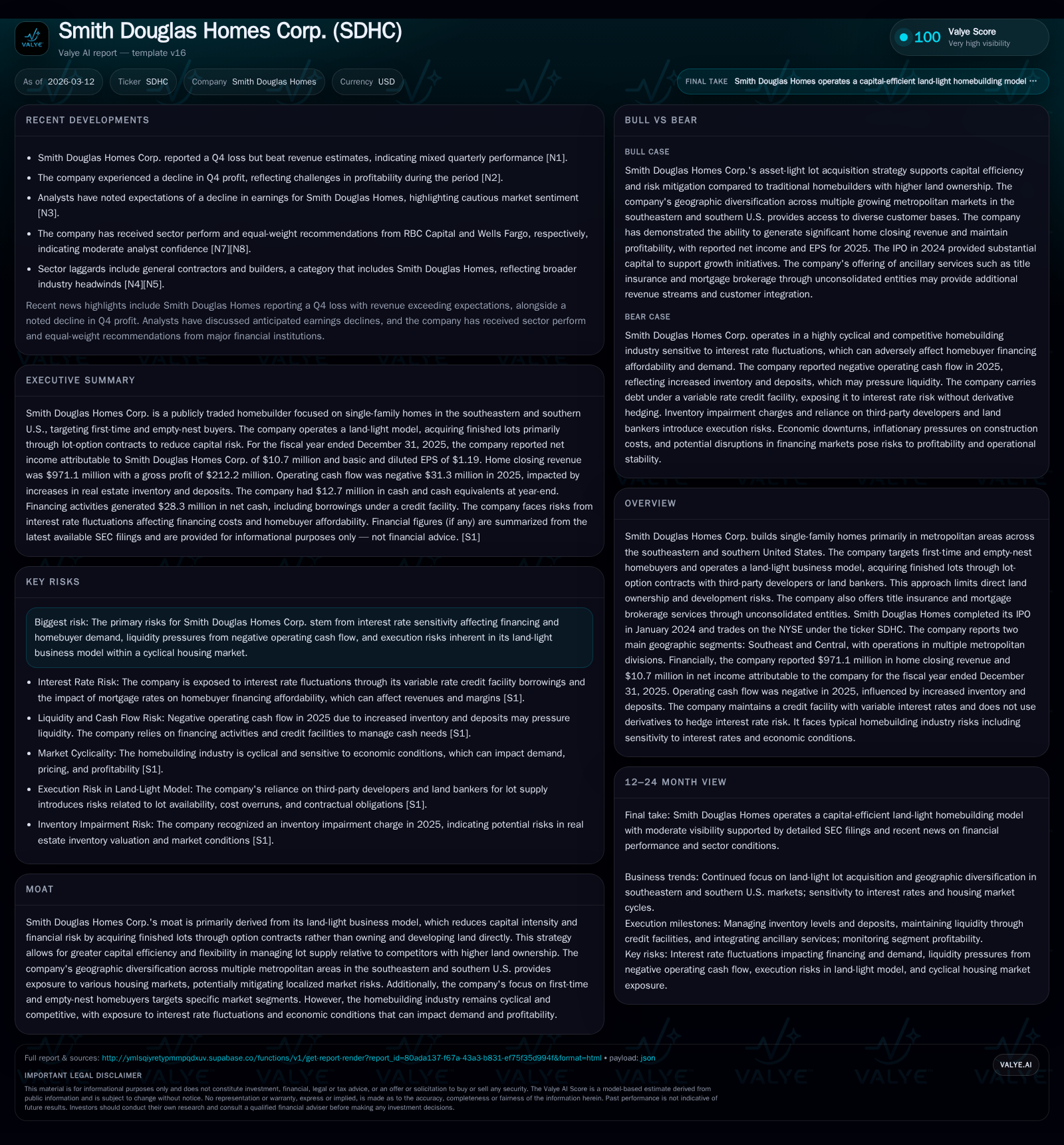
Smith Douglas Homes Corp. leverages a land-light strategy targeting first-time and empty-nest buyers across southeastern U.S. metros, delivering nearly $1 billion in home closing revenue for 2025 with geographic diversification smoothing localized risks. Despite a 33.5% net income decline year-over-year to $10.7 million [F1], the company faces notable operating cash flow headwinds, reporting a $31.3 million outflow, driven by increased real estate inventory and deposits on lot options [S1][F1]. Capital expenditures grew alongside investments in unconsolidated title and mortgage entities, while financing activities rose on borrowed funds and external lot sales [S1]. With no declared dividends or buybacks, Smith Douglas remains compliant with its $325 million revolving credit facility covenants but must monitor liquidity amid volatile interest rates impacting housing demand [S4][S9][S16].
Business Overview
Smith Douglas Homes Corp. operates as a single-family homebuilder primarily serving metropolitan areas across the southeastern and southern United States. The company focuses its product offerings on first-time buyers seeking entry-level homes as well as empty-nest segments looking for smaller footprint residences. It employs a land-light business model wherein finished lots are predominantly acquired through option contracts with third-party developers or land bankers rather than direct land ownership or development.
This strategy limits the capital intensity typical of homebuilders holding substantial land banks by transferring development risks off-balance sheet while still allowing control over lot supply pacing aligned with sales absorption rates. As of December 31, 2025, Smith Douglas controlled approximately 22,547 lots via option contracts while owning only about 804 unstarted lots—just under 4%—demonstrating significant leverage of this asset-light approach [S1][S24].
The company also complements its core homebuilding operations with ancillary services—title insurance and mortgage brokerage—which it conducts through equity method investments in unconsolidated entities [S5].
Historical Performance and Growth Drivers
For fiscal year ended December 31, 2025, Smith Douglas reported home closing revenue of $971.1 million, marginally down from approximately $975.5 million in 2024, signaling stable top-line performance despite broader industry cyclicality [F1][S13]. The decline was more pronounced at the bottom line where net income dropped by roughly one-third to $10.7 million from $16.0 million the prior year—highlighting margin compression or unusual expenses during the period including increased inventory carrying costs and incentive compensations [F1][N3][S1].
Operating cash flow dynamics paint a more challenging picture with a swing from positive $19.1 million in 2024 to a negative $31.3 million in 2025 primarily resulting from a $46.2 million jump in real estate inventory balances and a substantial increase in deposits related to lots controlled under option contracts ($37.4 million), alongside reduced accounts payable balances which cumulatively drained operational liquidity despite net income generation [F1][S9]. This divergence highlights working capital buildup amid slower lot turnover or timing mismatches inherent in the land-light model.
Capital expenditures climbed year-over-year by approximately 42% reaching $5.5 million driven by investments in fixed assets like the acquisition of an office building in Woodstock, Georgia ($4 million purchase financed partly through related party secured promissory note) alongside technology upgrades and equipment additions that support scaling operations across newer markets [F1][S15][S22]. Additional investments were made into unconsolidated title insurance and mortgage brokerage entities contributing increasing equity income [$2.1M] and distributions [$1.9M] that augment core profit streams albeit on small absolute scales relative to homebuilding results [S5].
Financing activities contributed positively with net cash inflows of $28.3 million fueled by drawdowns under an amended revolving credit facility expanded from an initial commitment of $250 million to $325 million during May 2025 along with proceeds generated from sales of real estate not owned (likely related to lot option contract monetizations), offset by tax distributions totaling $28.4 million paid to equity holders and repurchases/payments related to real estate contracts [$21M] reflecting active balance sheet management in a liquidity-preserving environment [F1][S9][S16].
Table: Smith Douglas Homes Corp. Annual Financial Summary
Historical performance (annual)
| FY | Net ($mm) | CFO ($mm) | Capex ($mm) | Net YoY |
|---|---|---|---|---|
| 2025 | 11 | -31 | 6 | -33.5% |
| 2024 | 16 | 19 | 4 |
Source: SEC companyfacts cache [F1].
Capital returns and efficiency (annual)
| FY | FCF ($mm) | ROE% |
|---|---|---|
| 2025 | -37 | 12.3 |
| 2024 | 15 | 21.8 |
Source: SEC companyfacts cache [F1].
Numbers rounded; CFO=Operating Cash Flow; Capex=Capital Expenditures
Segment Operations and Geographic Footprint
The company's operations are organized primarily into two geographic segments: Southeast (comprising Atlanta, Central Georgia, Charlotte, Greenville, Raleigh) and Central (including Alabama divisions plus Dallas-Fort Worth, Houston, Nashville) [S13]. In FY2025 Southeast generated $610.8 million in home closing revenues representing approximately 63% of total revenue with a segment profit margin dampened compared to the prior year reflective of tightening margins within these established markets.
Central segment revenue totaled approximately $360.3 million representing about one-third of the company’s revenue base but experienced profit contraction tied partially to expansion-related costs including recent divisional formations (Dallas-Fort Worth and Alabama Gulf Coast divisions established during 2025) which may weigh on near-term profitability though enabling long-term growth opportunity in higher-growth metro areas [S13].
Goodwill recorded at ~$25.7 million relates primarily to Devon Street acquisition supporting growth in Central markets reflecting strategic M&A activity aimed at complementing organic expansion plans [S26][S28].
Future Growth Prospects
Smith Douglas’s future growth hinges upon effectively managing supply-demand imbalances within its targeted buyer segments amid macroeconomic uncertainties notably fluctuating interest rates influencing mortgage affordability.[N2][N3] Its asset-light lot acquisition approach underpins capital flexibility allowing scalable absorption aligned with housing demand without excessive capital tied in costly land development projects.
Newer geographic ventures represent incremental opportunities but carry execution risks relating to local competitive dynamics alongside costs associated with launching new divisions impacting near-term margins.[N2] Moreover, ongoing inflationary pressures on construction inputs pose potential margin pressure necessitating efficient supply chain management.
Continued expansion into non-homebuilding services such as title insurance and mortgage brokerage may help diversify revenue streams albeit modestly so far; judicious investment here could yield incremental returns.[S5]
Monitoring working capital efficiency improvements is critical given recent operating cash flow deficits attributable largely to inventory builds and option deposits which if persistent could pressure liquidity absent offsetting financing inflows.[S9]
Capital Allocation and Returns
Smith Douglas reported an approximate return on equity near 12% for FY2025 calculated as net income over stockholders' equity ($10.7M / $86.7M), representing moderate profitability amidst industry headwinds.[F1]
The company has not declared dividends nor engaged in share repurchases through FY2025 electing instead to conserve cash presumably due to current operating cash flow constraints.[F1][S16]
Debt structure remains anchored by an unsecured revolving credit facility bearing floating-rate interest indexed primarily off SOFR plus margin ranging between approximately 2.35%-3%, currently compliant with covenants including maximum leverage ratio capped at 60%, minimum tangible net worth requirements (~$286M plus adjustments), EBITDA-to-interest coverage minimums above 2x and liquidity floors set at $15M.[S4][S6]
Net borrowings reached ~$40M at year-end as compared with zero draws at end-2024 enabling flexibility amid working capital needs but illuminates cautious financial stewardship balancing growth investments against cyclical risks.[F1][S6]
Notably the firm maintains sizeable surety bonds commitments (~$47M) related to municipal performance obligations evidencing regulatory complexities within residential construction licensing.[S17]
Key Risks Highlighted
Interest rate volatility remains the paramount risk given its direct impact on mortgage financing costs constraining buyer demand particularly among price-sensitive first-time purchasers central to Smith Douglas’s addressable market.[N2][N3]
Liquidity pressures stemming from negative operating cash flow may intensify if underlying inventory turnover does not accelerate timely leading to potential refinancing risk despite compliance today with credit facility covenants.[S9]
Execution risk inherent in their land-light approach includes reliance on third-party developers or bankers for lot supply coordination which can entail cost overruns under development agreements where Smith Douglas may be liable for certain excess expenses limiting downside protection intrinsic to pure option contract models.[S24][S25]
Competitive pressures across metro markets necessitate ongoing product differentiation while balancing pricing strategies that protect margins without sacrificing volumes.
What To Watch Forward (Analysis)
- Quarterly updates for operating cash flow trends will be critical indicators signaling whether working capital pressures ease or intensify against backdrop of flat-to-soft home closings expected.
- Updates on new division ramp performance (Dallas-Fort Worth & Alabama Gulf Coast) offer insight into successful geographic expansion execution.
- Changes in capital allocation policy including potential dividend initiation or share repurchase programs may signal confidence once free cash flow stabilizes.
- Interest rate movements impacting housing affordability remain catalytic variables affecting demand dynamics within Smith Douglas’s targeted buyer profiles.
- Monitoring level of option contract deposits relative to total controlled lots could reveal adjustments in supply control tactics under changing market conditions.
Conclusion
Smith Douglas Homes operates a distinctive land-light business model driving lower capital requirements than traditional builders concentrated on direct land ownership while covering diverse southeastern U.S metros focused on entry-level buyers vulnerable to economic cycles. Although revenue remained stable near ~$970 million for FY2025, earnings attrition and meaningful operating cash flow deterioration delineate key challenges amid rising inventories and deposits reflecting timing mismatches within lot acquisition strategies. Sound liquidity management anchored by expanded credit lines mitigates immediate solvency concern but continued close monitoring is warranted given interest rate sensitivity of homebuyer demand and inherent cyclicality within residential construction markets. Meanwhile strategic diversification into unconsolidated entity services provides auxiliary income streams adding resilience albeit modestly. The path forward requires judicious balancing of expansion ambitions against evolving macroeconomic headwinds shaping purchase affordability while enhancing working capital efficiency.
This report is provided solely for informational purposes based on publicly available filings, news releases, and standard industry analysis frameworks without any investment advice.
Disclaimer: This is research-only, informational analysis and not investment advice. It may include AI-generated interpretation and general industry context. Always verify important details using primary sources.

Comments