
Simmons First National Corp Faces Turning Point After Sharp Income Decline
A stark plunge in Simmons’ net income contrasts with solid operating cash flow, highlighting tensions in capital deployment amid stringent regulatory oversight.
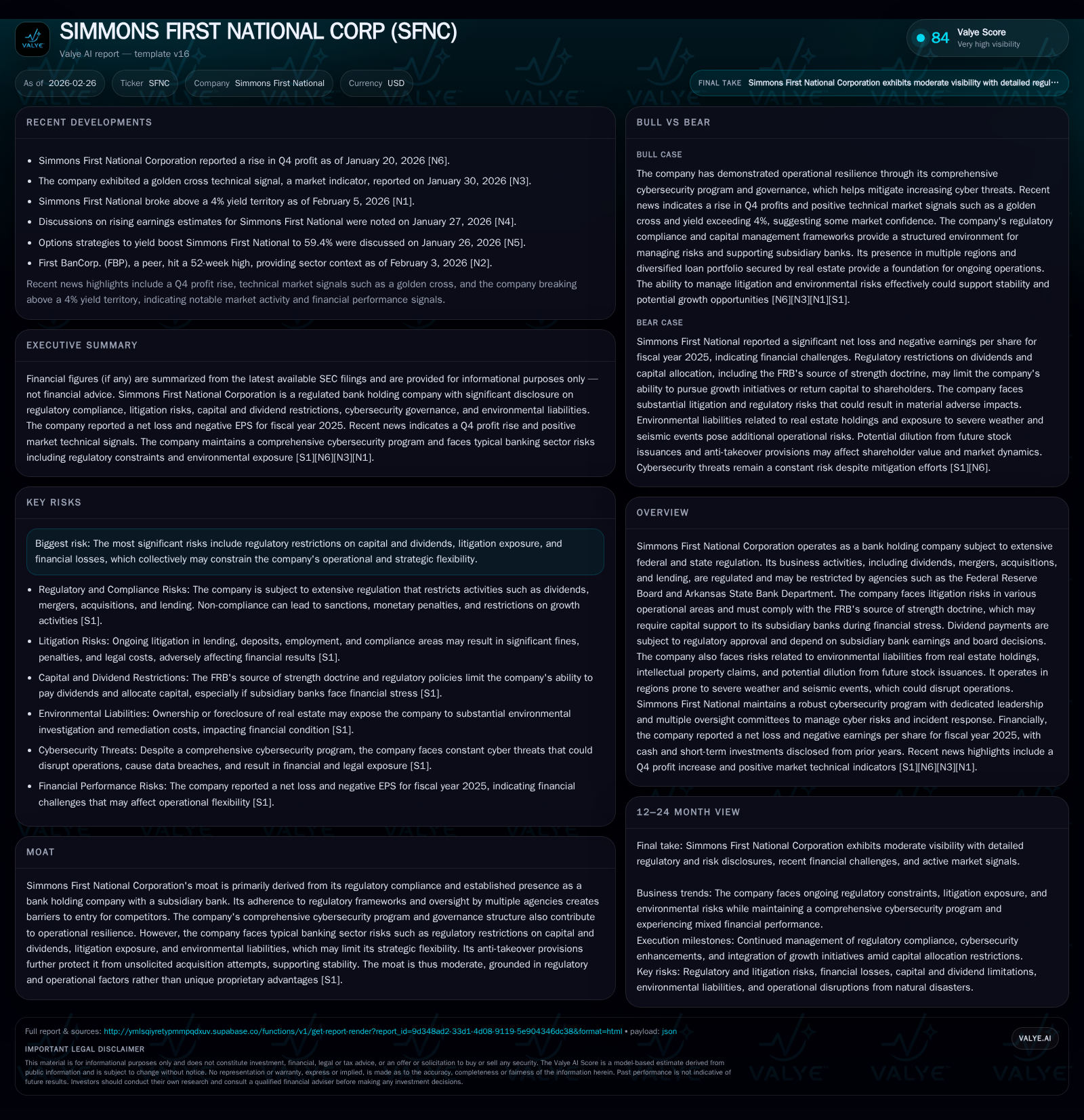
Simmons First National Corporation’s fiscal 2025 financials reveal a dramatic reversal with net income collapsing by over 360% year-over-year to a significant loss, while operating cash flow modestly grew. The regulatory environment, notably the Federal Reserve Board’s source of strength doctrine, constrains capital allocation, impacting dividends, acquisitions, and share repurchases. Litigation exposure and environmental risks in weather-sensitive regions add complexity to operational stability. A recent $175 million stock repurchase authorization underlines efforts to balance shareholder returns despite earnings volatility and regulatory restrictions. Investors should monitor quarterly profitability trajectories, loan portfolio quality, and regulatory developments as Simmons navigates these challenges.
Historical Growth Performance and the Abrupt Earnings Reversal
Simmons First National Corporation experienced a pronounced inflection in its recent financial trajectory. Fiscal year (FY) 2025 witnessed net income plunging into negative territory at approximately -$397.6 million, representing a staggering decline of roughly 360% relative to the prior year's positive net earnings of $152.7 million [F1]. This sharp earnings deterioration contrasts sharply with the company's operating cash flow (CFO), which grew modestly by about 5.5% to $449.5 million in the same period [F1]. The divergence between accrual-based earnings and cash-generation underscores exceptional non-cash charges or extraordinary items contributing to the income reversal.
Capital expenditures (capex) contracted by around 16.2% year-over-year to $38.1 million in FY2025 [F1], signaling restrained investment during a challenging earnings environment. Meanwhile, shareholders' equity exhibited relative stability at approximately $3.42 billion as of FY2025 year-end [F1], supporting an approximate return on equity (ROE) of -11.6%. The negative ROE reflects both the magnitude of losses recorded and ruler-level capital base preservation.
Historical performance (annual)
| FY | Net ($mm) | CFO ($mm) | Capex ($mm) | Net YoY |
|---|---|---|---|---|
| 2025 | -398 | 450 | 38 | -360.4% |
| 2024 | 153 | 426 | 46 | -12.8% |
| 2023 | 175 | 541 | 33 | -31.7% |
| 2022 | 256 | 322 | 35 |
Source: SEC companyfacts cache [F1].
Capital returns and efficiency (annual)
| FY | Buybacks ($mm) | FCF ($mm) | ROE% |
|---|---|---|---|
| 2025 | 0 | 411 | -11.6 |
| 2024 | 0 | 380 | 4.3 |
| 2023 | 40 | 508 | 5.1 |
| 2022 | 111 | 287 | 7.8 |
Source: SEC companyfacts cache [F1].
Note: ROE approximated by dividing reported net income by average yearly equity.
Regulatory Framework and Its Impact on Capital Deployment
As a bank holding company regulated extensively by federal entities including the Federal Reserve Board (FRB), Simmons operates under significant supervisory constraints that shape its capital deployment strategies [S1]. Fundamental among these is the FRB's "source of strength doctrine," mandating bank holding companies maintain adequate financial support for their subsidiary banks during periods of stress or adversity [S1][S7]. This doctrine requires prioritizing capital availability for subsidiaries over shareholder distributions or strategic expansions.
Consequently, Simmons' ability to pay dividends or pursue mergers and acquisitions is contingent upon regulatory approval and subsidiaries’ capacity to transfer earnings upstream without breaching capital adequacy metrics or regulatory limits [S1][S5][S8]. The company's dividend policies are therefore heavily influenced by subsidiary performance and regulatory consent processes that may constrain discretionary payouts.
Additionally, compliance burdens imposed by multiple agencies—FRB, Consumer Financial Protection Bureau (CFPB), Arkansas State Bank Department—are substantial and potentially restrict activities such as lending practices and branch expansions [S1][S5]. Failures could trigger penalties or sanctions severely limiting corporate agility.
Emerging Risks: Litigation, Environmental, and Macro Sensitivities
Litigation risk remains acute within Simmons’ operational environment given exposures across lending activities litigation claims based on employment practices and commercial disputes alongside regulatory scrutiny on compliance programs including anti-money laundering oversight [S5][S6]. These legal challenges entail potentially substantial fines as well as management resource diversion.
Environmental liabilities pose another material concern owing to sizable real estate collateral portfolios located within tornado-prone mid-south states and notably within the New Madrid Seismic Zone—a recognized high seismic risk corridor encompassing parts of Arkansas where Simmons operates extensively [S4][S6][S19]. Physical events could disrupt branch operations directly or indirectly through economic downturn impacts on borrowers’ repayment capacities.
Federal banking regulators have increasingly focused on climate-related risks reflecting both physical disruptions and transition risks impacting financial institutions broadly; Simmons is subject to evolving expectations regarding mitigation strategies for such exposures given regional susceptibility [S19].
Growth Prospects Amid Geographic Concentration and Market Conditions
The company predominantly serves mid-south markets with concentrated regional exposure that embeds both opportunities for growth through community banking relationships but also susceptibility to localized economic cycles [S11][N6][N7]. Analyst upgrades reported recently reflect some optimism based on improving fourth-quarter profitability trends [N7] though paired with caution given heightened uncertainty.
Regulatory restrictions cap Simmons’ pace of expansion primarily via limited capacity for acquisition-driven growth absent strong capital surplus conditions [N1][S4]. Loan demand fluctuations tied to regional economic health remain critical; adverse weather or economic shocks could curtail origination volumes as well as increase credit risk.
Evolving Capital Allocation: Dividends, Buybacks, and Share Issuance
Capital allocation dynamics at Simmons reveal tension between maintaining liquidity buffers mandated by regulations and shareholder return aspirations amidst swings in profitability [F1][S8][S9]. Dividend payments have been historically modest due to regulatory approvals tied to subsidiary earnings streams; recent losses lead management discretion towards retention for internal use rather than distributions [S8][S9].
The Board’s authorization of a new stock repurchase program up to $175 million in early calendar year 2026 demonstrates an intent to support valuation through buybacks despite episodic financial pressures [S12][N2]. However actual repurchases will be contingent on prevailing market conditions alongside capital allocation flexibility restricted under source of strength obligations.
Risks from dilution exist given unrestricted authority to issue additional common or preferred stock for financing or strategic purposes which could depress share value if exercised substantially without commensurate accretive returns [S8]. Anti-takeover provisions incorporated into governance frameworks provide a shield against unsolicited acquisition attempts but may temper market-driven corporate control incentives impacting shareholder value realization over medium term horizons [S8].
Quality of returns is currently challenged as evidenced by roughly -11.6% ROE driven by large net losses despite solid book equity cushions reflected in FY2025 results [F1].
Forecast Indicators and Milestones to Monitor
No formal forward guidance has been published explicitly; therefore key indicators include quarterly profitability changes post-FY2025 large loss event along with any shifts in regulatory capital requirements communicated through FRB engagements that might influence dividends or M&A activities [N1][N7].
Market signals such as technical analysis points—e.g., recent golden cross technical pattern signaled on Simmons stock—may affect investor sentiment but provide no fundamental assurance [N4]. Monitoring loan portfolio health metrics remains paramount given sector-wide concerns around credit quality especially in regional banking niches served by Simmons.
The progression of repurchase execution under the newly authorized $175 million program will also serve as an important barometer reflecting management’s confidence in current valuation levels balanced against capital allocation priorities amid ongoing restrictions [N2][S12].
Sector-Specific Considerations: Banking Regulation, Source of Strength Doctrine, and Asset Risk Management
Broad regulatory adherence forms the backbone of Simmons’ competitive moat stemming not from proprietary products but from prudential compliance discipline reinforced by sustained governance structures focusing heavily on risk management frameworks including operational risk appetite metrics calibrated for cybersecurity threats overseen by dedicated IT steering committees within both holding company and bank subsidiary layers [S1][S11].
Integration of rigorous information security controls supported via layered incident response teams—including vulnerability management working groups—and regular reporting protocols elevates resilience against cyber intrusions which remain industry-wide systemic threats with material potential impacts on confidentiality and continuity of service delivery [S1][S15].
The company’s commitment signals recognition that robust control environments contribute materially not just towards mitigation of financial loss but also sustain trust critical in banking customer retention across geographic segments prone to external shocks such as severe weather events aligned with institutional business continuity planning efforts detailed internally [S19].
Overall strategic latitude balancing growth aspirations against binding Federal Reserve capital doctrines requires meticulous calibration that positions Simmons within an operational niche defined simultaneously by regulatory conservatism and proactive risk governance mandates oriented toward long-term franchise viability rather than rapid expansionist trajectories.
This analysis is derived strictly from disclosed filings and publicly available news sources without speculative assumptions or investment recommendations.
Disclaimer: This is research-only, informational analysis and not investment advice. It may include AI-generated interpretation and general industry context. Always verify important details using primary sources.

Comments