
Seafarer Exploration Faces Acute Liquidity Crisis While Advancing Niche Maritime Archaeology Tech
The latest quarter underscores Seafarer’s ongoing financial distress amid technological development and regulatory navigation in underwater artifact recovery.
Seafarer Exploration Corp, specializing in archaeological exploration of historic shipwrecks, reported troubling liquidity conditions in its Q1 2026 filing, reinforcing long-standing financial constraints. Despite holding unique permits and deploying proprietary SeaSearcher technology, the company has yet to generate meaningful revenue, depending heavily on equity issuance and convertible debt refinancing. Operating losses persist with a substantial working capital deficit, casting doubt on operational continuity without fresh capital. Growth remains contingent on successful exploration outcomes, new permitting, and technological advancements against a backdrop of considerable financial and regulatory risks.
Recent Operating Update: Q1 2026 Financial Challenges
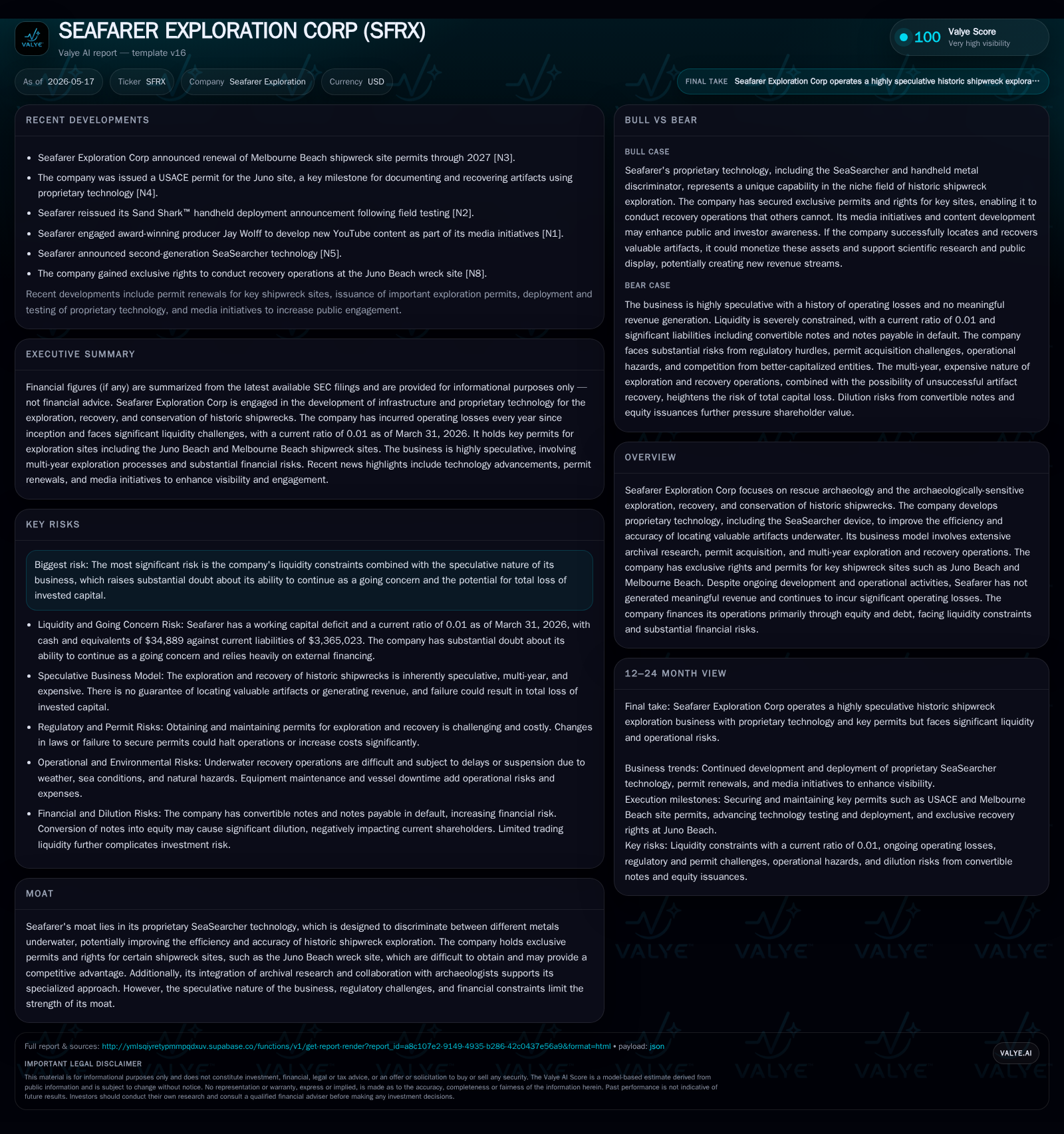
Seafarer Exploration Corp's latest quarterly report filed May 12, 2026 ([S2], [S26]) reveals significant financial distress. The company reported a net loss of approximately $894K for the quarter ended March 31, 2026. It faces a working capital deficit exceeding $3.3 million with cash reserves just above $30,000. Although Seafarer has access to a revolving line of credit capped at $50,000, it had not drawn any funds as of quarter-end ([S2], [F1]). These metrics underscore critical liquidity constraints threatening operational continuity without new capital.
The company's convertible notes payable and other debt instruments remain largely in default ([S3], [S16]), heightening the risk of lender actions including foreclosure. Management acknowledges substantial doubt about Seafarer's ability to continue as a going concern absent successful recapitalization or operational turnaround.
During the period, Seafarer settled certain convertible note obligations via common stock issuance, resulting in significant non-cash losses related to extinguishment of debt ([S21]). These conversions increase shareholder dilution risk due to conversion prices generally below current market levels ([S25]).
Business Model Overview
Seafarer operates in a highly specialized niche focused on the rescue archaeology of historic shipwrecks—a process requiring multi-year research-intensive exploration before any monetization opportunity arises ([S1]). The company's principal asset is its proprietary "SeaSearcher" technology designed to discriminate different metals underwater including gold and silver ([S1]). This innovation aims to improve search efficiency by reducing time and increasing accuracy compared to traditional sonar or magnetometer methods.
The company combines archival historical research with technology development while incurring substantial R&D costs and exploration expenses subject to environmental regulations ([S1]). Operational footprints are minimal to maintain archaeological sensitivity.
Separately, Seafarer's Blockchain software segment operates independently from its core archaeology business and is not currently expected to generate material near-term revenue ([S2]).
Industry Context and Competitive Position
Maritime archaeology involves complex permitting processes, high upfront costs, environmental sensitivities, and extended timelines before potential revenue generation. Within this challenging environment, Seafarer holds exclusive permits for sites such as Juno Beach—a competitive advantage secured through extensive regulatory navigation ([S1], [S26]).
The SeaSearcher technology differentiates Seafarer by offering targeted metal discrimination capabilities that could enable more focused exploration efforts compared to general surveying technologies used by competitors.
However, the company faces inherent risks given its unproven commercialization track record amid an industry marked by speculative ventures with few established players possessing similar permit exclusivity or technological assets.
Growth Drivers
- Regulatory Permitting: Obtaining or renewing environmental permits from agencies like the Army Corps of Engineers is essential for advancing exploration activities at key sites ([S26]).
- Technological Enhancements: Progress in refining SeaSearcher could lower operational costs and improve artifact detection speed and accuracy ([S1]).
- Exploration Success: Discoveries yielding recoverable artifacts would unlock monetization potential through sales or institutional partnerships.
- Capital Access: Securing new equity or debt financing is critical for sustaining long-term exploration programs given current resource limitations ([S1], [S26]).
- Project Pipeline Diversification: Potential expansion into additional historic shipwreck sites beyond current holdings could mitigate concentration risk but requires further permitting efforts.
Risks and Watchpoints
- Liquidity Risk: With cash nearly depleted and significant defaulted debts outstanding ([F1], [S3]), failure to raise new capital may force operational shutdown.
- Speculative Nature: Multi-year exploratory timelines with uncertain success rates complicate sustainable revenue forecasting ([S1]).
- Regulatory Challenges: Delays or denials in permitting can restrict site access critical for operations ([S1], [S26]).
- Technology Dependence: Reliance on SeaSearcher as the only proven technology exposes the company to innovation risk if further developments fail ([S1]).
- Dilution Risk: Convertible note conversions pose potential dilution hazards affecting shareholder value perception ([S25]).
- Competitive Pressures: Emerging competitors with novel technologies or better funding could challenge Seafarer's position despite permit advantages.
Monitoring Points
- Updates on permit approvals or renewals essential for continued site access.
- Announcements regarding new capital raises or debt restructuring efforts indicating liquidity status.
- Results from ongoing explorations validating technology effectiveness or site potential.
- Trends in convertible note conversions impacting equity structure.
- Changes in R&D spending reflecting strategic focus shifts.
Financial Summary (Q1 2026)
At quarter-end March 31, 2026, Seafarer's financial position showed acute distress: cash approximated $30K against total current assets near $37K versus current liabilities over $3.3 million—yielding a critically low current ratio near 0.01 ([F1], [S2]). Operating losses persist driven largely by research & development expenses supporting SeaSearcher enhancements alongside interest expenses tied to defaulted convertible debt ([S5], [S16]). No meaningful operational revenues were reported; instead reliance continues on equity financing evidenced by recent stock issuances settling convertible notes payable ([S21], [S25]). Future viability hinges on securing adequate capital under manageable dilution terms.
Seafarer Exploration Corp represents a highly specialized yet speculative enterprise combining frontier maritime archaeology with innovative technology development. Its proprietary SeaSearcher device and exclusive permits provide some competitive moats but are overshadowed by severe liquidity constraints and extended development horizons. The company’s ability to sustain operations depends critically on timely capital infusions and breakthrough exploration successes amid an uncertain regulatory environment. This analysis is based solely on publicly available SEC filings and does not constitute investment advice.
Disclaimer: This is research-only, informational analysis and not investment advice. It may include AI-generated interpretation and general industry context. Always verify important details using primary sources.

Comments