
Somnigroup International’s Mixed Earnings Momentum and Strategic Retail Expansion
Somnigroup's 2025 financials reveal operational gains amidst revenue softness, driven by Mattress Firm acquisition and omni-channel growth.
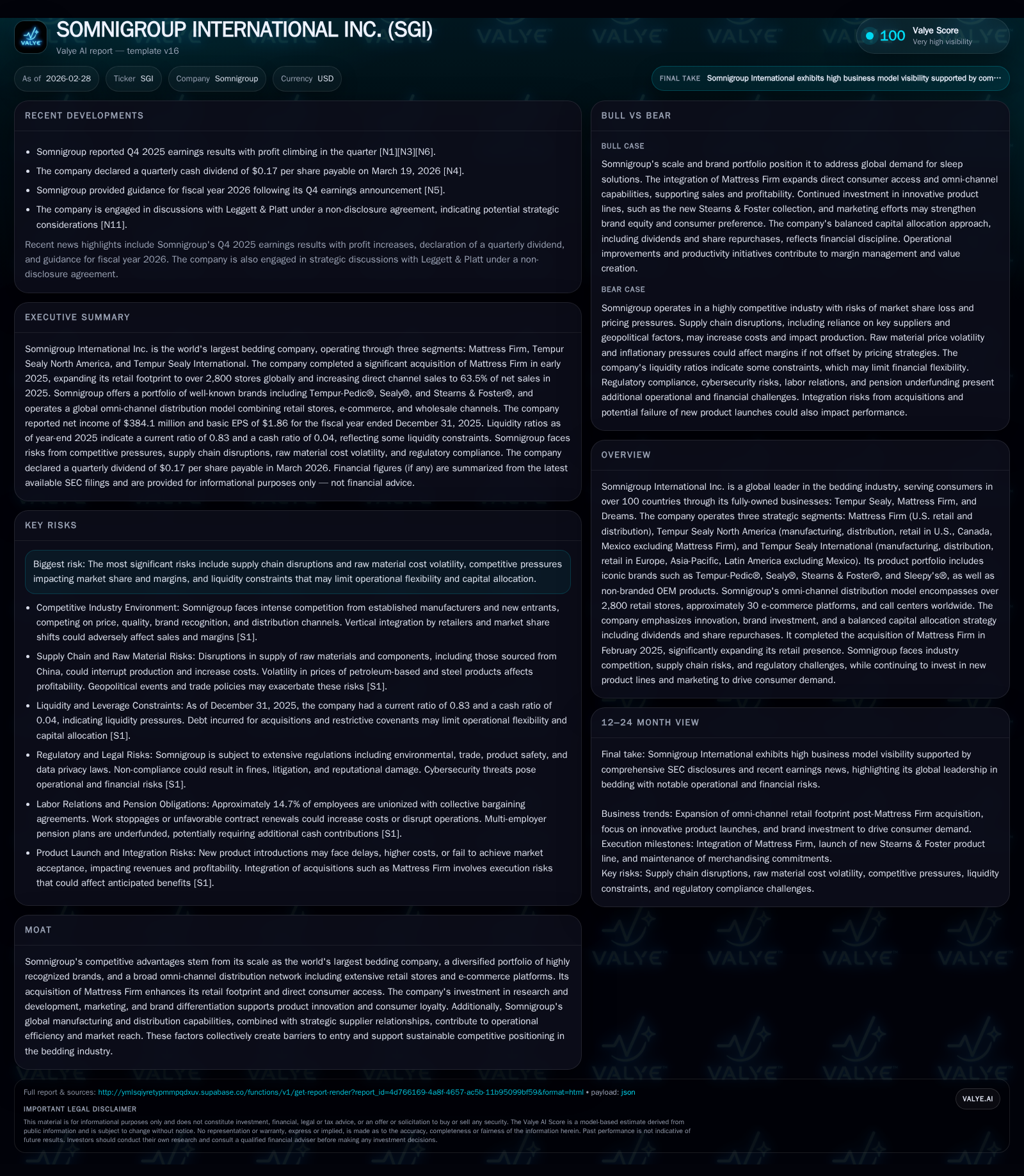
Somnigroup International posted a 15.8% revenue decline in FY2025 contrasted with a 19% rise in operating income, highlighting effective operating leverage post-Mattress Firm acquisition. The $5.1 billion transaction expanded its retail footprint to over 2,800 stores and bolstered direct consumer engagement within its omni-channel model. Despite muted net income growth, strong free cash flow generation and increased capital expenditures underline investments in innovation and distribution scalability amid supply chain risks. Vigilant capital allocation and an evolving product pipeline position Somnigroup strategically within the competitive $120 billion global sleep market.
Historical Earnings Trends Underscore Wholesale Shift in Business Scale
Somnigroup International’s FY2025 financial results show a notable divergence between top-line contraction and bottom-line operational gains—a clear testament to pronounced operating leverage following the Mattress Firm acquisition. Total revenue declined approximately 15.8% year-over-year from prior periods, yet operating income surged by 19%, reaching $754.9 million [F1][S1]. Net income remained essentially flat at $384.1 million with marginal YoY decline [F1]. Operating cash flow exhibited remarkable strength, expanding 111% over FY2024 to just over $800 million [F1], enabling increased reinvestment in capital assets.
This financial profile contrasts with earlier years’ performance where revenue remained below half a billion USD (e.g., $648 million in FY2017), reflecting the transformative growth afforded by the Mattress Firm deal and organic channel expansion [F1]. The company’s omnipresence across approximately 2,800 stores globally—with roughly 2,100 under the Mattress Firm banner—combined with circa 30 e-commerce platforms underscore the enhanced scale underpinning these dynamics [S1].
Historical performance (annual)
| FY | Net ($mm) | CFO ($mm) | OpInc ($mm) | Capex ($mm) | Net YoY |
|---|---|---|---|---|---|
| 2025 | 384 | 800 | 755 | 167 | -0.1% |
| 2024 | 384 | 634 | 97 | +4.4% | |
| 2023 | 368 | 607 | 185 | -19.2% | |
| 2022 | 456 | 379 | 681 | 307 |
Source: SEC companyfacts cache [F1].
Capital returns and efficiency (annual)
| FY | Div ($mm) | FCF ($mm) |
|---|---|---|
| 2025 | 127 | 633 |
| 2024 | 93 | |
| 2023 | 78 | |
| 2022 | 71 | 72 |
Source: SEC companyfacts cache [F1].
Note: Revenue series prior to FY2017 unavailable; CFO prior years partial.
The uptick in capital expenditures (+71.5%) signals targeted investment toward scaling production capabilities and integrating acquired assets—a crucial step given Mattress Firm's operational complexities post-acquisition [F1][S20]. The sustained net income stability against revenue contraction reveals effective mitigation of margin pressure through disciplined cost controls.
Mattress Firm Acquisition: A Retail Channel Game-Changer
The strategic acquisition of Mattress Firm for approximately $5.1 billion (including $3.1 billion cash and issuance of ~34 million shares valued at $65.65 each) closed on February 5, 2025, catapulting Somnigroup’s U.S. retail presence dramatically [S1][N1]. Prior to acquisition, Somnigroup operated primarily through Tempur Sealy segments covering manufacturing and wholesale plus select retail outlets; the inclusion of Mattress Firm added over two thousand specialty retail locations nationwide.
This move was instrumental in cementing an omni-channel retail strategy that approximates consumers’ shifting purchase behaviors—blending brick-and-mortar access with digital touchpoints—to optimize sales conversion and customer experience across segments [S10]. Integration complexities are managed via segment-specific oversight with Mattress Firm forming its own strategic business unit alongside North American and International Tempur Sealy operations [S27].
To satisfy regulatory approval criteria relating to anti-competitive concerns, Somnigroup committed maintaining third-party premium mattress placement accounting for at least 43% of horizontal premium ($1,500+) floor slots across Mattress Firm stores as independently monitored through year-end data [S20]. This constraint preserves competitive diversity within retail merchandising aisles.
Synergies touted encompass logistics optimization leveraging Mattress Firm’s network of 62 distribution centers feeding its extensive store base plus e-commerce fulfillment enhancements likely to generate incremental margin expansion over time [N1][S20].
Revenue Pressure vs. Operating Income Gains: Dissecting the Margin Expansion
Despite top-line headwinds—likely stemming from macroeconomic factors such as inflation dampening discretionary furniture spending and competitive pricing pressure from emerging online direct-to-consumer mattress sellers—Somnigroup demonstrated sharp margin expansion [F1][S1]. Several drivers underpinned this:
- Price/Mix Effects: Strategic premiumization efforts emphasizing top-tier Tempur-Pedic® lines coupled with newly launched Sealy Posturepedic® collections bolstered average selling prices despite overall units softness [S25].
- Cost Control: Tight procurement practices and global supplier relationships helped curb raw material inflation impacts where possible [S21][S22].
- Channel Optimization: Adding Mattress Firm’s retail scale reduced reliance on wholesale distribution margins while growing direct consumer contact points that typically carry higher profitability metrics [S10].
- Innovation Pipeline: Continuous R&D yields product lifecycle improvements supporting better quality perception allowing mildly improved pricing power versus commoditized imported products [S20][N1].
Nonetheless, these gains were balanced against supply chain complexity magnified by geopolitical trade tensions affecting polyester/polyurethane foam raw materials critical for memory foam mattresses, along with steel innerspring cost volatility impacting key product lines [S4][S6][S18]. This environment tests procurement agility but so far has not derailed gross margin recovery.
Innovation and Brand Strategies Fueling Product Differentiation
Somnigroup anchors its market leadership through iconic brands: Tempur-Pedic®, Sealy®, Stearns & Foster®, augmented by Dreams® internationally [S10]. These brands imbue strong consumer loyalty through consistent quality standards created at over seventy manufacturing facilities worldwide supplemented by four dedicated R&D centers specializing in advanced sleep technologies such as proprietary visco-elastic materials.
The recent introduction of advanced Stearns & Foster collections targeting hybrid innerspring offerings leverages patented technologies like PrecisionFit™ coils designed to deliver superior support profiles tailored for evolving sleep preferences [S25][N1]. Similarly, revamps within Sealy Posturepedic® appeal strategically to mid-market segments showing greater sensitivity amid economic tightening.
Brand investment extends beyond product innovation into complementary marketing approaches utilizing multi-platform media including broadcast TV, social media campaigns targeting younger demographics, co-operative promotions with retail partners for shared advertising expenses, plus sophisticated point-of-sale training programs enhancing consumer conversion rates on showroom floors [S16].
This holistic brand equity management ensures presence across price tiers with distinct audiences while enabling product renewal pacing aligned with competitor innovation cycles.
Risks from Supply Chain Volatility and Raw Material Inflation
Critical vulnerabilities remain tied to supply chain disruptions exacerbated by global geopolitical events disrupting international freight routes—such as renewed Middle East conflicts impacting Red Sea access—and fluctuating tariff landscapes particularly affecting China-sourced components essential for adjustable bed bases and foundational elements used in multiple product lines [S4][S6][S18][S21].
Raw material input costs showcase marked sensitivity to petroleum-based PU foam prices and steel market swings directly impacting mattress core constituents. Somnigroup maintains lean inventory buffers which amplify exposure to shipment delays or sudden price spikes requiring or forcing price pass-throughs risking customer pushback [S4][S22].
Environmental regulatory compliance also increases ongoing costs related to chemical usage restrictions in EU markets under REACH directives or California Proposition 65 disclosures domestically creating complexity in material sourcing decisions [S17][S18]. Moreover, labor relations risks from unionized workforces covering about one-seventh of employees introduce potential operational disruptions via contract negotiations or strikes reducing plant outputs unexpectedly.
Lastly cybersecurity threats hold latent risk potential given increasing digital footprint securing online sales platforms and internal IT systems integral for global coordination; breaches could impact reputation or result in regulatory penalties under GDPR or CCPA frameworks should data breaches occur [S12][S18].
Capital Allocation Discipline: Dividends, Share Repurchases, and Cash Flow Management
Strong cash flow generation is a hallmark of Somnigroup’s recent performance; FY2025 operating cash flow neared $800 million with free cash flow approximating $633 million after $167 million of capex investments reflecting strategic factory refurbishments and distribution upgrades post-Mattress Firm integration [F1][S20].
Capital returns show prudence: dividends increased incrementally to $0.17 per share starting Q1 2026 from previous levels signaling confidence in recurring cash availability without jeopardizing reinvestment needs [N7][S5]. Notably however Somnigroup suspended share repurchases for FY2025 despite existing authorization with ~$774 million remaining buyback capacity unused; this reflects judicious balance between deleveraging post-deal debt load and preserving liquidity amid uncertain macro conditions [F1][S7].
Fiscal discipline is evident given a calculated return on equity exceeding an estimated 130%, underscoring efficient use of shareholder capital even while navigating integration complexities and external headwinds [F1]. Further leverage effects are monitored carefully as restrictive covenants accompany acquisition financing necessitating vigilant cash flow planning to avoid covenant triggers constraining operational flexibility [S14][S26].
2026 Outlook and Key Milestones to Monitor
While explicit full-year guidance details remain limited publicly beyond confirmation of stable top-line pressures alongside targeted margin improvements communicated during the Q4 earnings call on February 17, key watchpoints surface clearly from management commentary [N1][N4]:
- Execution progress on integrating Mattress Firm logistics tailored to improve delivery speeds and cost synergies.
- Pricing adjustments reacting dynamically to raw material cost fluctuations without eroding demand excessively.
- Acceleration of e-commerce penetration expanding beyond existing thirty platforms leveraging predictive analytics enhancing inventory positioning.
- Launch cadence for new product families notably refreshed Stearns & Foster® collections aiming for Q3-Q4 rollouts designed for holiday season impact.
- Ongoing R&D productivity initiatives slated to reduce manufacturing waste improving margins further.
- Monitoring supply chain lead times closely amid unpredictable geopolitical events affecting transport corridors.
- Capital conservation measures while assessing opportunistic M&A pipelines remain flexible dependent on valuations.
Stakeholders should focus on quarterly updates related to these milestones as indicators of Somnigroup’s ability to maintain earnings momentum alongside market share retention strategies.
Competitive Positioning within a $120 Billion Sleep Market
Somnigroup stands undisputed as the world’s largest bedding enterprise commanding significant market share driven by scale advantages across manufacturing efficiencies, brand recognition encompassing diverse consumer segments, and unparalleled omni-channel reach combining traditional retail breadth with growing digital footprints spanning North America, Europe, Asia-Pacific and Latin America [S10][S29].
Barriers include entrenched supplier contracts ensuring component continuity; extensive brick-and-mortar networks facilitating personalized consumer interactions resistant to purely digital disruptors; significant marketing budgets enabling sustained brand advocacy; plus patented innovations preserving technological edges especially in memory foam domain unique to Tempur-Pedic®.
Nonetheless competition intensifies as direct-to-consumer startups leverage lower overheads offering aggressive pricing models complemented by retailers pursuing vertical integration squeezing traditional players’ shelf space influencing market dynamics negatively for legacy companies like Somnigroup absent proactive adaptation strategies described here [S13][N10].
Continuous reinvention via omni-channel capabilities combined with innovation pipeline depth will determine continued leadership in this commoditized yet brand-sensitive arena valued at approximately $120 billion globally.
Disclaimer: This report is for informational purposes only based on publicly available filings and news sources as cited; it does not constitute investment advice or recommendations.
Disclaimer: This is research-only, informational analysis and not investment advice. It may include AI-generated interpretation and general industry context. Always verify important details using primary sources.

Comments