
Shake Shack's Return to Profitability Fueled by Expansion and Digital Innovation
Strong revenue growth and a strategic focus on fine-casual dining underpin Shake Shack’s improving financial health.
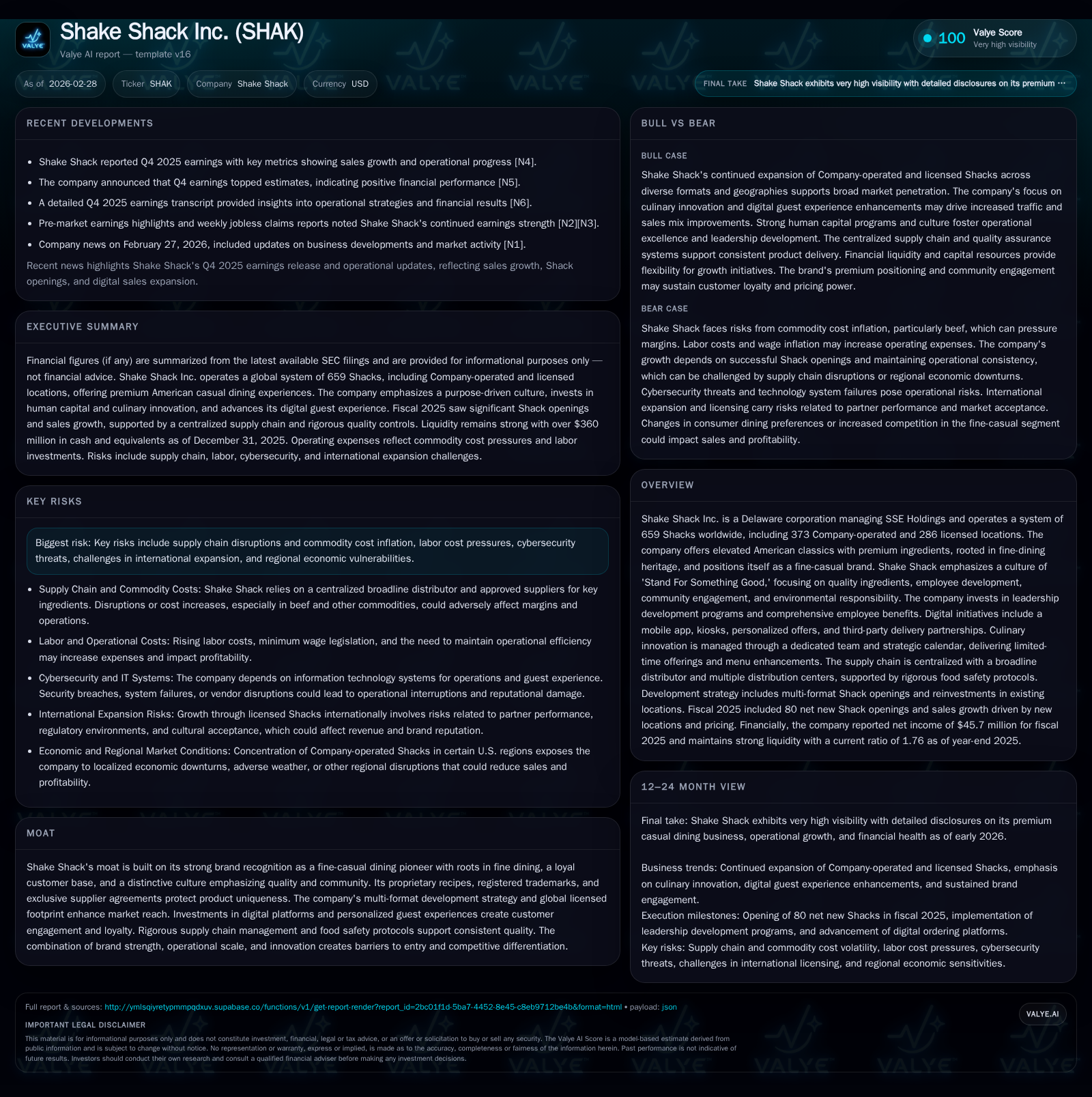
Shake Shack Inc. reported substantial improvements in operating income and net income in fiscal 2025, reversing prior losses driven by strategic expansion, digital engagement, and brand elevation initiatives. Operating cash flow grew significantly while capital expenditures increased to fuel new store openings and technology investments. Despite challenges like supply chain risks and labor costs, the company’s foothold across 659 global locations and strong digital platform momentum position it for continued growth. Monitoring same-store sales trends and international licensed operations will be critical milestones in assessing sustained profitability.
Historical Performance and Growth Drivers
Shake Shack has evolved from a single hot dog cart in 2001 into a global fine-casual brand operating over 650 Shacks worldwide. As of December 31, 2025, the company operated a total of 659 locations comprising 373 Company-operated Shacks and 286 licensed units [S1]. The fiscal year ending December 31, 2025 marked a significant financial turnaround with revenue reaching approximately $625 million—a 31.2% increase over the prior year [F1]. This growth reflects successful expansion initiatives alongside digital channel enhancements.
Operating income surged to $62.5 million in FY2025 from roughly $3 million in FY2024, highlighting improved margin management through scale efficiencies and price optimization [F1]. Net income followed suit with an increase of 348% to $45.7 million, recovering from losses reported in FY2022 [F1]. These results underscore effective execution of Shake Shack’s "Stand For Something Good" philosophy emphasizing premium ingredients, employee development, sustainability efforts, and community involvement [S1].
Capital expenditures rose to $166 million in FY2025 as the company invested heavily in opening new Shacks, remodeling existing locations, and upgrading digital infrastructure including mobile ordering platforms and kiosks [F1][S22]. These investments support the brand's omnichannel strategy aimed at increasing customer engagement via personalized offers and third-party delivery partnerships.
Financial Performance Summary
Historical performance (annual)
| FY | Net ($mm) | CFO ($mm) | OpInc ($mm) | Capex ($mm) | Net YoY |
|---|---|---|---|---|---|
| 2025 | 46 | 222 | 63 | 166 | +348.0% |
| 2024 | 10 | 171 | 3 | 135 | -49.6% |
| 2023 | 20 | 132 | 6 | 146 | +184.1% |
| 2022 | -24 | 77 | -27 | 143 |
Source: SEC companyfacts cache [F1].
Capital returns and efficiency (annual)
| FY | FCF ($mm) | ROE% |
|---|---|---|
| 2025 | 57 | 8.7 |
| 2024 | 36 | 2.2 |
| 2023 | -14 | 4.6 |
| 2022 | -66 | -6.1 |
Source: SEC companyfacts cache [F1].
Note: Figures marked with ~ are approximations derived from available data [F1].
Growth Outlook
Looking ahead, Shake Shack's growth strategy focuses on:
- New Store Development: Continued expansion of Company-operated Shacks in key domestic markets leveraging careful site selection to optimize profitability [S1].
- International Licensed Expansion: Scaling licensed Shacks abroad under stringent quality controls while managing currency risk and supply chain complexities [S1][S22].
- Digital Experience Enhancement: Expanding digital ordering capabilities and loyalty programs to deepen guest engagement and drive higher frequency visits [S22].
- Brand Marketing Investments: Transitioning from organic social media buzz toward sustained paid media campaigns to bolster brand awareness and customer acquisition [S22].
These initiatives position Shake Shack for sustained growth but must navigate potential headwinds including inflationary pressures on food commodities, labor cost increases due to tight markets, supply chain disruptions impacting ingredient availability, cybersecurity risks associated with digital platforms, and regulatory complexities domestically and internationally [S15][S17][S18][S19].
Returns & Capital Allocation
Shake Shack's equity base stood at approximately $525 million at the end of FY2025 supporting net income of $45.7 million for an estimated return on equity of about 8.7%, reflecting efficient use of capital within the industry context [F1]. Operating cash flow generation of $222 million comfortably funds capital expenditures totaling $166 million annually while leaving positive free cash flow near $56 million—indicating prudent reinvestment balanced with liquidity preservation [F1].
The company maintains a strong liquidity profile with cash and cash equivalents exceeding $360 million as of December 31, 2025 [F1], complemented by an undrawn revolving credit facility initially capped at $50 million with options for expansion subject to conditions [S4][S6]. No dividends were declared or paid during this period as capital allocation prioritizes growth investments over shareholder distributions [S23].
Convertible senior notes totaling $250 million mature in March 2028 carrying zero interest but represent potential dilution risk if conversion events occur; however, current liquidity appears sufficient to manage obligations without distress [S12][S13].
Competitive Positioning & Risks
Operating within the competitive fast casual sector characterized by both multinational chains and regional players focusing on quality menus [S20], Shake Shack leverages its fine-dining heritage to differentiate through product craftsmanship and brand authenticity. Proprietary recipes supported by registered trademarks reinforce its unique positioning alongside strong supplier relationships ensuring consistent premium ingredient quality.
The company's hybrid business model blends Company-operated stores for operational control with licensed international units enabling market penetration without direct overheads [S20][S27]. Digital personalization initiatives further build customer loyalty amid rising consumer expectations.
Key risks include inflationary commodity cost pressure limiting pricing flexibility; labor market constraints driving wage inflation; supply chain interruptions affecting availability; cybersecurity threats targeting digital assets; regulatory compliance challenges domestically and abroad; currency volatility impacting international earnings; and convertible note conversions potentially diluting ownership stakes [S12][S15][S17][S18][S19].
Conclusion
Fiscal year 2025 marks a milestone for Shake Shack as it achieves robust profitability driven by strategic expansion, operational efficiency gains, and digital innovation aligned with its "Stand For Something Good" ethos. While external risks remain notable particularly around input costs and international complexities, the company's solid balance sheet, strong cash flow generation, disciplined capital allocation, and differentiated brand provide a solid foundation for continued growth. Investors should track comparable store sales trends, new store profitability ramp-up, international licensee performance adherence to standards, and evolving consumer engagement metrics through digital channels.
This report synthesizes public SEC filings ([F1],[S1]-[S29]) alongside recent news coverage ([N1]-[N14]) without providing investment advice or price targets.
Disclaimer: This is research-only, informational analysis and not investment advice. It may include AI-generated interpretation and general industry context. Always verify important details using primary sources.

Comments