
Shuttle Pharmaceuticals Shifts to AI Drug Discovery Platform Amid Financial Strain and Commercialization Efforts
The company's transition from clinical trials to AI-driven molecular discovery defines its near-term value proposition and execution risks.
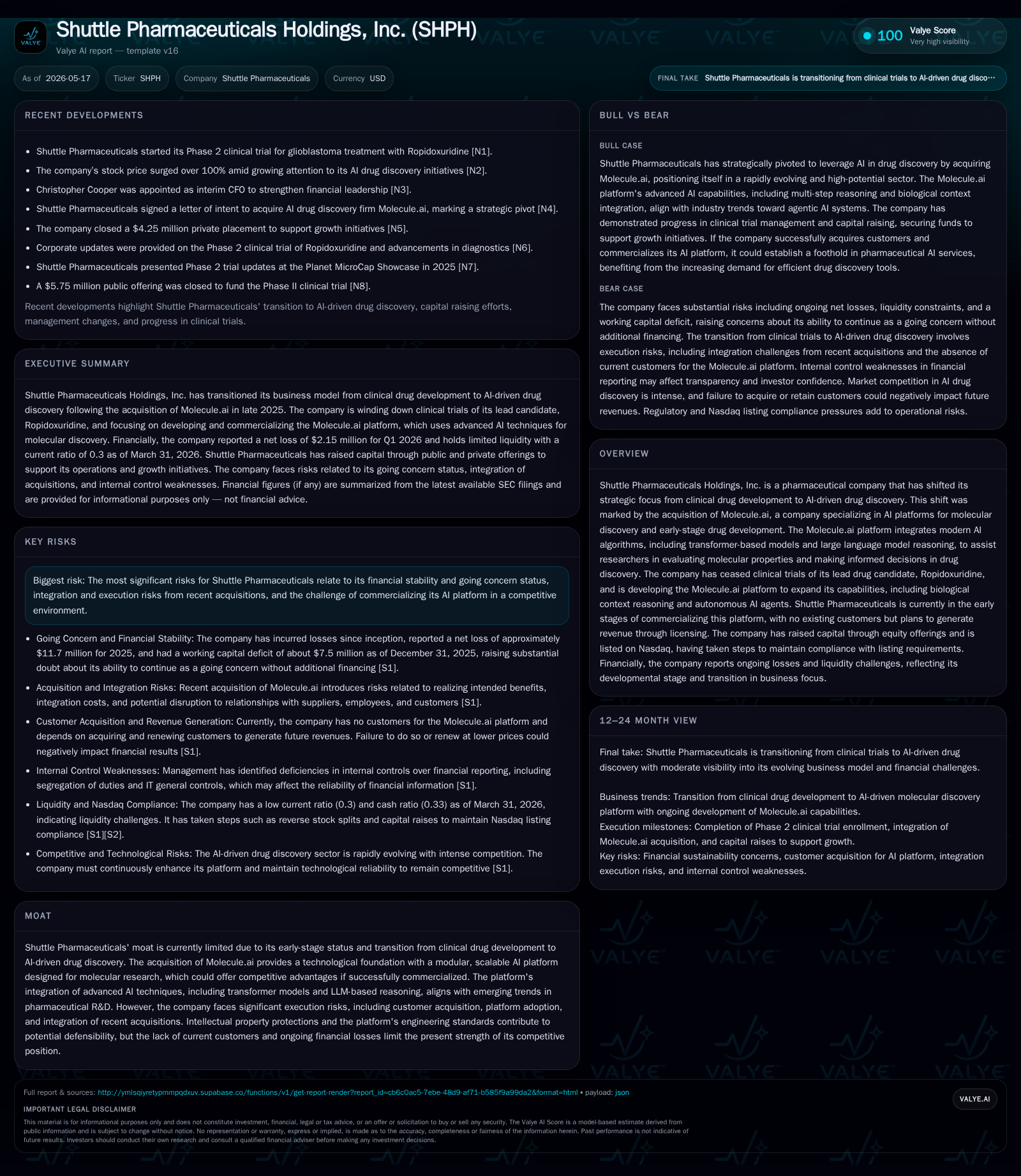
Shuttle Pharmaceuticals Holdings, Inc. has ceased clinical development of its lead drug candidate and pivoted to commercializing the Molecule.ai platform, an AI-powered solution for early-stage molecular research. The latest quarterly report highlights ongoing liquidity challenges with a current ratio below 0.3 and no revenues, underscoring reliance on funding events secured earlier in 2026. While the Molecule.ai platform integrates advanced AI technologies tailored for pharmaceutical R&D, the company faces significant hurdles in customer acquisition, platform adoption, and financial sustainability. Market entry is at an early stage with meaningful milestones pending and structural risks tied to the company's going concern status.
Recent Operating Update
In its May 15, 2026 quarterly filing (10-Q), Shuttle Pharmaceuticals disclosed that it remains pre-revenue with continued operating losses exceeding $11 million in fiscal year 2025 [F1]. The company holds approximately $1.1 million in cash and equivalents as of March 31, 2026 against current liabilities above $8.3 million, resulting in a precarious current ratio around 0.3 [F1]. These metrics reinforce Shuttle’s dependence on external financing for operational continuity.
Further operational updates highlight that the firm has ceased clinical trials of its former lead product candidate, Ropidoxuridine [S1], marking a strategic pivot away from direct drug development. Instead, Shuttle is focusing on commercializing the Molecule.ai platform acquired late in 2025 [S1], which aims to serve early-stage pharmaceutical researchers through AI-augmented molecular discovery capabilities.
Recent event filings show the company undertook an $11 million private investment in public equity (PIPE) transaction concurrent with amendments to finalized agreements governing key acquisition obligations for Molecule.ai [S3]. The funding appears critical to sustaining development and marketing efforts for its AI platform.
Business Model
Shuttle Pharmaceuticals’ new business model centers on licensing access to Molecule.ai’s software-as-a-service platform for molecular property prediction, cross-molecular evaluations, and AI-driven scientific interpretation focused on early drug discovery phases [S1],[S5]. Researchers pay subscription or license fees for this platform to enhance decision-making during lead optimization and compound selection.
Revenue mechanics depend principally on: acquiring multiple research institutions or biotech/pharma collaborators as customers; securing recurring license renewals; and potentially scaling usage volume via enhanced platform functionalities. Pricing power will likely hinge on demonstrated predictive accuracy, ease of integration via APIs, interpretability of AI-generated insights, and operational reliability aligned with regulated biomedical environments [S1].
The discontinuation of traditional clinical-stage product development signals a full transition away from product sales or royalties. Instead, Shuttle now bets on recurring revenues from software licensing combined with possible future expansions into autonomous AI agent workflows that reduce manual researcher burden [S26]. This also implies margins could improve relative to prior R&D-heavy clinical operations if commercial traction is attained.
Industry Structure and Competitive Position
The pharmaceutical R&D landscape is increasingly embracing computational approaches combining artificial intelligence with molecular modeling to shorten timelines and reduce experimental costs. Shuttle’s Molecule.ai platform positions itself amid a highly competitive field populated also by established bioinformatics firms, large tech entrants adapting general-purpose LLMs to drug discovery, and niche startups focused on specific modalities such as chemical-protein interaction prediction or biological context reasoning.
Molecule.ai’s moat currently derives from its design philosophy: modular AI infrastructure built specifically for molecular research requiring reproducibility, traceability, and interoperability—critical features in pharma regulatory settings [S26]. Its combination of transformer-based models with structured reasoning modules leveraging LLM capabilities distinguishes it technologically.
However, the company’s competitive position is nascent due to lack of current customers or proven revenue streams [S1]. Market acceptance will depend heavily on successful proof-of-concept deployments demonstrating predictive value versus established computational chemistry tools. Customer switching costs will be low until deep integrations occur, heightening risks of churn or pricing pressure.
Growth Drivers
Key growth drivers hinge on ramping commercial adoption:
- Customer Acquisition: Signing early adopters among pharmaceutical companies or research institutions willing to pilot Molecule.ai’s offerings.
- Platform Expansion: Enhancing features such as biological context reasoning using curated genomic data promises more comprehensive end-to-end discovery support [S26].
- Autonomous Agents: Developing multi-tool automated workflows that plan experiments iteratively could differentiate in reducing manual labor and accelerating cycles [S26].
- Strategic Partnerships: Collaborations with established pharma or biotech entities could provide validation pathways and channel access.
- AI Technology Advances: Continued improvements in model architectures may increase predictive accuracy driving demand.
Given the absence of existing customers at present [S1], measurable KPIs such as contract signings, retention rates upon renewal periods, user engagement metrics post-launch, backlog orders or pipeline bookings would prove vital indicators once disclosed.
Risks and Watchpoints
The primary risks constraining growth include:
- Financial Viability: With working capital deficits exceeding $7 million at year-end 2025 [S1] and a thin cash runway indicated by Q1 balance sheet metrics [F1], ongoing capital raises are essential but dilutive.
- Going Concern Doubts: The company’s consolidated financials express substantial doubt about persistence as going concern within one year absent financing [S1],[S8].
- Execution Risk: Integrating Molecule.ai technology and scaling commercial operations demand substantial managerial capacity with only two full-time employees reported [S6].
- Customer Adoption: No revenues currently mean unproven market acceptance; failure to acquire or retain customers directly threatens future revenue prospects [S1].
- Competitive Pressure: Rapid innovation in AI-driven molecular platforms globally may outpace Shuttle’s offerings or erode pricing power.
- Internal Controls Weaknesses: Management acknowledges deficiencies that may affect reliable financial reporting creating operational risk [S1].
- Nasdaq Compliance: Historic notifications regarding stockholders’ equity shortfalls were temporarily resolved but reveal underlying financial fragility exposure to delisting risk remains [S1],[S12].
What To Watch Next
Several milestones will clarify Shuttle Pharmaceuticals’ trajectory:
- Commercial launch dates for Molecule.ai modules beyond initial offering including biological context reasoning enhancements.
- Progress reports on customer acquisitions or licensing agreements signaling real-world uptake.
- Updates regarding cash runway extensions or further financings following the recent $11 million PIPE transaction [S3].
- Regulatory disclosures related to integration milestones possibly triggering milestone shares or warrants issuance tied to acquisition agreement terms [S3],[S15].
- Potential announcements about partnerships or collaboration agreements validating platform utility.
- Improvements or remediation actions addressing internal control weaknesses flagged by management.
Monitoring quarterly burn rates alongside non-GAAP metrics like adjusted EBITDA post-commercialization initiation would aid judgment around sustainable growth pace.
Latest Financial Snapshot
Latest financial snapshot
(Source: [F1])
The most recent quarter shows significant liquidity strain with liabilities far exceeding assets short-term. The absence of revenues paired with sustained losses underlines dependency on capital markets support rather than operational cash flows currently.
Disclaimer
This analysis is intended for informational purposes only without providing investment recommendations or advice. It synthesizes publicly available filings up to May 17, 2026 and does not incorporate non-public information or forecast future stock price movements.
Disclaimer: This is research-only, informational analysis and not investment advice. It may include AI-generated interpretation and general industry context. Always verify important details using primary sources.

Comments