
Sherwin-Williams Leverages Store Expansion and Acquisitions to Offset Raw Material Pressure
Recent Q2 2026 results highlight Sherwin-Williams’ pricing power and growth through strategic acquisitions amid cost challenges.
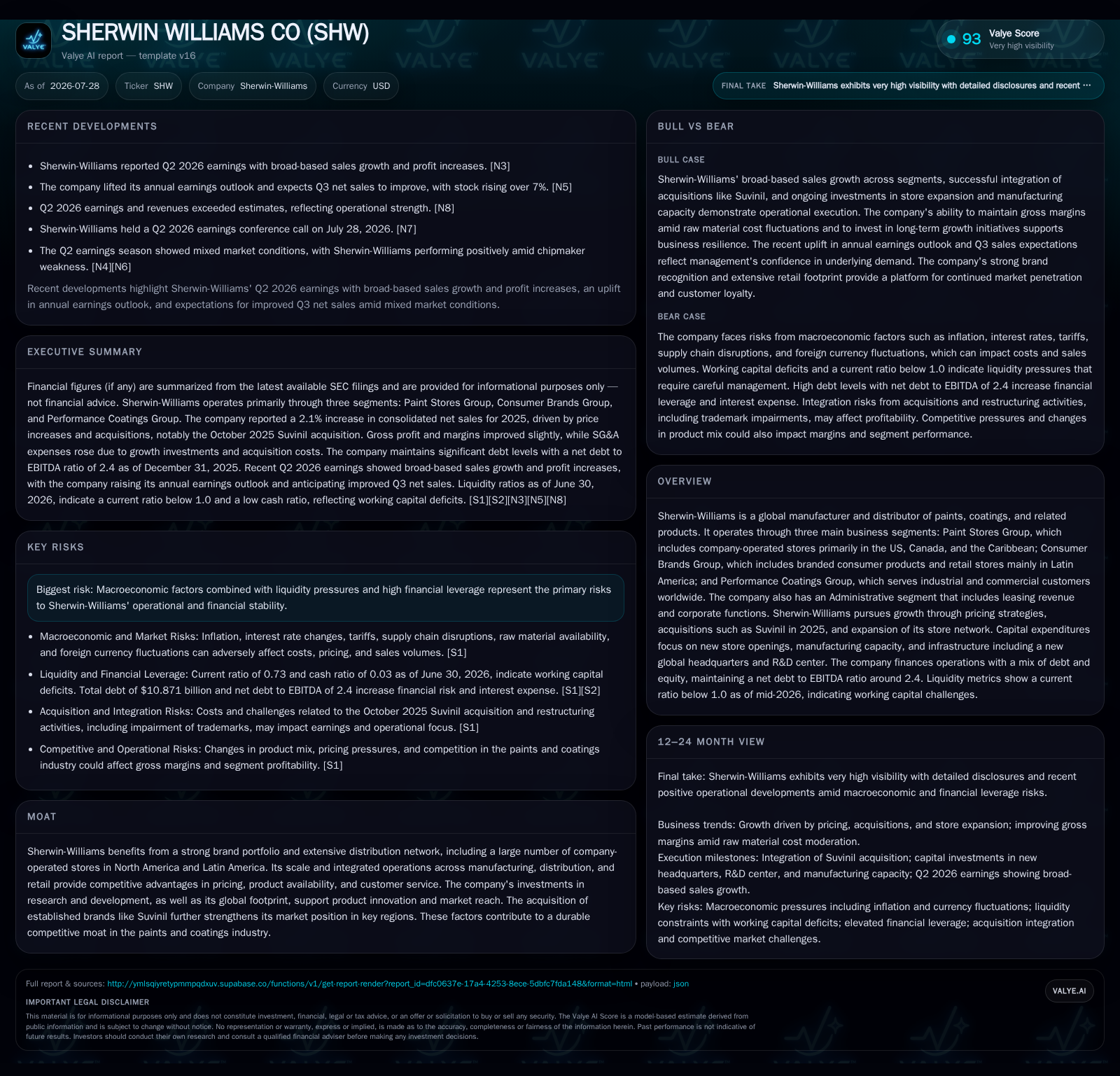
In Q2 2026, Sherwin-Williams demonstrated resilient sales growth driven by broad-based demand and effective pricing strategies. Expansion of its retail footprint, notably in North America and Latin America through the acquisition of Suvinil, underpins revenue growth despite ongoing raw material cost inflation. The company’s integrated model spanning manufacturing, distribution, and retail confers competitive advantages compared to peers like PPG and AkzoNobel. However, high leverage and macroeconomic volatility remain material risks. Capital expenditure is focused on facility upgrades and new store openings, with a targeted reduction in spend for 2026 relative to 2025. Monitoring same-store sales growth and margin trends will be critical as price increases absorb commodity inflation pressures.
Recent Operating Update
Sherwin-Williams reported strong second-quarter 2026 results on July 28, 2026, demonstrating resilient net sales growth driven by broad-based demand and effective pricing strategies that offset ongoing raw material cost inflation [S2][N2]. The Paint Stores Group, which operates a proprietary network of approximately 4,853 stores primarily across the United States, Canada, and the Caribbean, sustained momentum through same-store sales growth and a net addition of 80 stores in 2025, underscoring the strategic value of its retail footprint [S1]. The Consumer Brands Group contributed significantly following the October 2025 acquisition of Suvinil, a leading Brazilian paint brand, which added about $165 million in net sales despite unfavorable foreign currency translation effects in Latin America [S1]. Meanwhile, the Performance Coatings segment experienced flat sales, impacted by product mix shifts and branch closures, reflecting the segment’s sensitivity to commercial construction cycles and industrial demand.
Capital expenditures peaked in 2025 due to investments in new store openings, the completion of Sherwin-Williams’ global headquarters, and a new research and development center. Management anticipates a moderation in capital intensity for 2026, shifting focus toward operational efficiencies and maintenance capital [S1][S19]. This transition aligns with the company’s strategy to optimize capacity utilization and support margin expansion amid cost pressures.
Business Model Analysis
Sherwin-Williams operates a vertically integrated business model within the paints and coatings industry, encompassing raw material procurement, formulation, manufacturing, distribution, and retail. The company’s revenue is generated primarily through the sale of architectural coatings, industrial coatings, and related specialty chemical products [S1]. It serves a diverse customer base including professional contractors, industrial clients, and retail DIY consumers. The Paint Stores Group’s company-operated retail stores provide direct access to end customers, enabling Sherwin-Williams to control pricing, product assortment, and customer service quality, which are critical competitive differentiators in the architectural coatings market
Pricing strategies are central to revenue generation, with regular price adjustments implemented to counterbalance volatility in raw material costs such as pigments, resins, and solvents. The company’s R&D centers focus on product innovation, including low-VOC and environmentally compliant formulations, which support premium pricing and meet evolving regulatory standards. The Consumer Brands Group extends Sherwin-Williams’ geographic reach, particularly in Latin America, through brands like Suvinil, broadening the product portfolio and customer base.
Margins are influenced by raw material price fluctuations and product mix. Capacity utilization at manufacturing facilities and inventory management are key operational levers to mitigate margin pressure. Store expansion, targeting approximately 2% annual growth in store count, drives volume growth and enhances market penetration. Inorganic growth through acquisitions complements organic expansion by adding regional brands and specialized coatings products.
Industry Structure and Competitive Position
Sherwin-Williams competes in a consolidated global paints and coatings industry alongside major peers such as PPG Industries, AkzoNobel, and RPM International. Unlike many competitors that rely heavily on wholesale distribution or third-party retailers, Sherwin-Williams’ extensive proprietary retail network provides a durable competitive moat by fostering strong customer relationships and enabling tailored service offerings.
Competition centers on pricing discipline amid raw material inflation, rapid product innovation—especially in sustainable and low-emission coatings—geographic expansion, and supply chain efficiency balancing inventory turnover with fill rates. The company’s recent investments in manufacturing capacity and R&D support responsiveness to market demand and regulatory changes, particularly environmental compliance related to VOC emissions.
Peers are also advancing digital color matching technologies and eco-friendly product lines, intensifying the innovation race. Maintaining technological leadership while controlling operating costs is critical to Sherwin-Williams’ competitive positioning.
Growth Drivers
Sherwin-Williams’ growth is supported by several key drivers:
- Store Expansion: The Paint Stores Group’s net addition of approximately 80 stores in 2025 enhances market coverage, particularly in regions with dense professional contractor populations.
- Acquisitions: The acquisition of Suvinil in Latin America diversifies the product portfolio and strengthens regional market share, despite currency translation headwinds.
- Pricing Power: Disciplined price increases effectively offset raw material inflation, preserving gross margins.
- Product Innovation: R&D investments yield environmentally compliant coatings, enabling premium pricing and meeting regulatory demands.
- Industrial Demand: The Performance Coatings segment benefits from cyclical growth tied to commercial construction and industrial manufacturing sectors.
- Operational Efficiency: Capital expenditure prioritizes productivity improvements and maintenance, optimizing cost structures without compromising quality or compliance.
Risks and Watchpoints
Several risks could impact Sherwin-Williams’ operating performance:
- Raw Material Cost Volatility: Fluctuations in petrochemical-derived inputs can pressure gross margins if pricing adjustments lag behind cost increases.
- Macroeconomic Slowdowns: Reduced construction and industrial activity may soften demand, particularly in the Performance Coatings segment.
- Financial Leverage: As of June 30, 2026, Sherwin-Williams carried approximately $9.8 billion in total debt against $293 million in cash, resulting in a net debt position near $9.5 billion and a current ratio of about 0.73, indicating tight short-term liquidity and necessitating disciplined cash flow management [F1][S2].
- Litigation Exposure: Legacy lead-based paint litigation and environmental remediation cases pose contingent liabilities, though most have been resolved favorably; ongoing regulatory changes could increase compliance costs [S4][S5].
- Foreign Currency Risk: Latin American operations face currency translation risks that may affect reported revenues and profitability.
- Competitive Pricing Pressure: Regional competitors may engage in discounting, potentially eroding average selling prices.
- Integration Risks: Acquisitions require effective integration to realize synergies and avoid operational disruptions.
- Environmental Compliance Costs: Increasing regulatory requirements may necessitate additional capital investments or product reformulations.
What To Watch Next
Key indicators to monitor in upcoming quarters include:
- Same-store sales growth trends to assess organic demand sustainability versus acquisition-driven gains.
- Gross margin progression reflecting the effectiveness of pricing strategies and product mix optimization amid raw material inflation.
- Retail store network changes, including net openings or closures, signaling execution on expansion strategy.
- Capital expenditure levels and allocation between growth initiatives and maintenance, impacting free cash flow generation.
- Leverage ratios and covenant compliance metrics given the company’s elevated debt position.
- Progress in product innovation, particularly environmentally focused coatings gaining market acceptance.
- Updates on litigation or regulatory developments that could affect contingent liabilities or operational constraints.
Financial Profile Discussion
As of June 30, 2026, Sherwin-Williams held $293.5 million in cash and equivalents against $9.83 billion in total debt, resulting in a net debt position of approximately $9.53 billion and a current ratio of 0.73, indicating tight short-term liquidity [F1]. The company’s leverage necessitates ongoing strong cash flow generation, particularly as capital expenditures moderate from the elevated levels seen in 2025, which included significant investments in the new global headquarters and R&D center [S1][S19]. Interest expenses have increased moderately, consistent with recent debt issuances aimed at refinancing maturing obligations and stabilizing financing costs [S21]. Dividend payments continue with a payout ratio near 30% of net income, reflecting a balance between shareholder returns and debt reduction priorities [S11].
This financial profile supports operational flexibility but requires vigilant management amid external uncertainties such as commodity price volatility and macroeconomic fluctuations.
This analysis synthesizes Sherwin-Williams’ publicly filed disclosures as of mid-2026 combined with industry context within the paints and coatings sector. It does not constitute investment advice or forecasts.
Disclaimer: This is research-only, informational analysis and not investment advice. It may include AI-generated interpretation and general industry context. Always verify important details using primary sources.

Comments