
Selective Insurance Group (SIGI): Strategic Resilience and Underwriting Discipline in a Challenging Environment
Selective Insurance Group demonstrated robust Q4 performance despite intensifying catastrophe risks and industry headwinds.
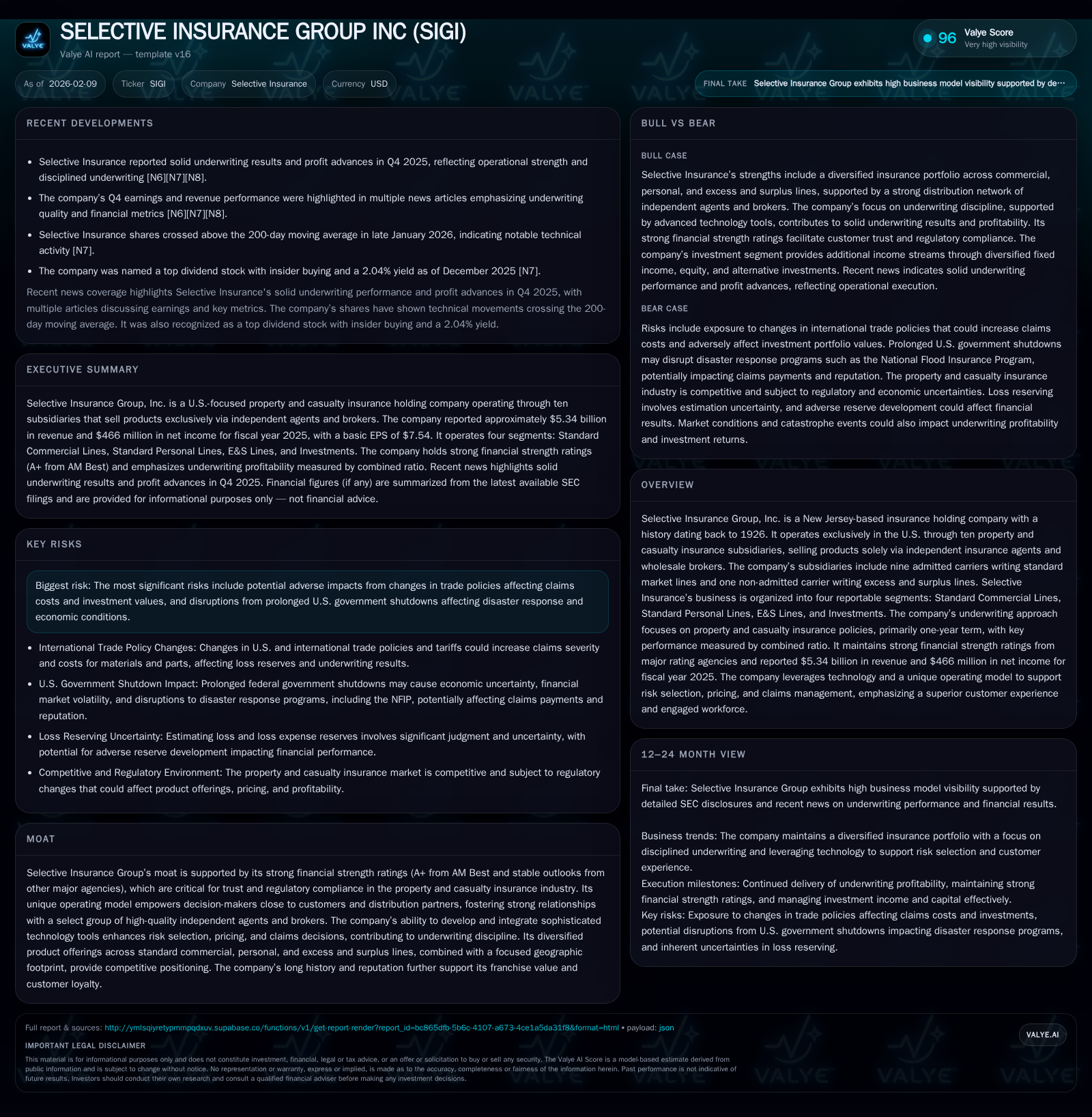
Selective Insurance Group Inc (SIGI) posted a strong Q4 earnings beat anchored by disciplined underwriting and steady revenue growth, underscoring the strength of its operating model amid increasing catastrophe exposures and macroeconomic uncertainties. Supported by an A+ AM Best rating and a focused independent agent distribution model, SIGI leverages technology-driven risk selection and claims management to maintain underwriting discipline. However, evolving climate-driven catastrophe patterns, trade policy shifts, and government shutdowns pose ongoing challenges to claims costs and investment returns.
Navigating Market Turbulence: SIGI’s Recent Earnings Momentum
Selective Insurance Group (SIGI) kicked off 2026 reporting on a note of resilience with a Q4 earnings beat that exceeded analyst expectations [N6][N7][N8]. The firm reported $5.34 billion in revenues for full-year 2025 alongside net income of $466 million [F1], reflecting steady operational control within a dynamic insurance market. This outcome is particularly notable given the increasing pressure from rising catastrophe events that have recently roiled the property and casualty insurance sector broadly.
The company’s ability to post solid underwriting results amid amplified severe weather patterns signals both robust risk management and strategic foresight. The importance of this achievement gains further context when juxtaposed with peer disclosures—Allstate, Chubb, and RNR also reported strong results but face intensifying claims cost volatility tied to climate-induced disasters [N1][N2][N4]. Against this backdrop, SIGI's Q4 momentum serves not only as validation of its focused business strategy but also as a testament to its underwriting discipline.
Strong Moat: Why Financial Strength Ratings Matter for Selective
Financial strength ratings form the bedrock of Selective Insurance Group’s competitive advantage. Its current "A+" rating from AM Best—with comparable standings from S&P (A) and Moody's (A2)—not only reflects creditworthiness but plays a critical role in customer acquisition and retention [S1]. Independent agent networks rely heavily on these ratings to mitigate their own exposure to errors or omissions when recommending carriers; similarly, customers often must adhere to minimum carrier rating requirements stipulated in mortgage or loan agreements.
This credit profile enables SIGI to access capital markets efficiently while fostering confidence among its distribution partners. The intertwined nature of financial strength perceptions with underwriting appetite allows SIGI room to price adequately for risks without compromising growth targets. In this way, these ratings are more than symbols; they are practical enablers of volume growth through premium inflows and operational flexibility.
Technology as an Underwriting Differentiator
Technology investments distinguish Selective within the P&C landscape. The firm integrates sophisticated analytical tools across its underwriting workflow—from risk selection through pricing to claims adjudication—helping frontline teams make data-driven decisions [S1]. This technological architecture acts as both a shield against adverse selection and an accelerator for efficient claim settlements.
By refining modeling techniques beyond traditional actuarial baseline assumptions, SIGI can better anticipate nuances in risk exposures including those emerging from shifting climate patterns. Moreover, embedding these tools close to customer interactions ensures responsiveness without sacrificing underwriting discipline. In an era where rapid data assimilation determines competitive positioning, Selective’s platform provides tangible benefits in mitigating loss volatility.
Distribution Power: The Independent Agent Model Advantage
Selective's exclusive focus on independent agents and wholesale brokers fosters concentrated yet deeply entrenched distribution relationships [S1]. This model contrasts with direct writer frameworks or overly broad agency networks prevalent in some competitors’ approaches.
Independent agents bring localized market insight and establish trust-based connections that underpin durable customer relationships. For SIGI, empowering these distributors translates into well-vetted business flow aligned with its underwriting appetite. The selective nature of these partnerships reduces churn risk and enables tailored service delivery—a franchise value that sustains competitive differentiation amid crowded markets.
Catastrophe Risk Exposure and Climate Change Implications
Natural catastrophes represent a prime vulnerability for Selective’s balance sheet [S1]. The firm enumerates primary exposures including hurricanes along the Eastern U.S., severe convective storms (hailstorms, tornadoes), wildfires, earthquakes, winter storms, and terrorism-related events.
Recent years have unveiled increased frequency and severity of such events globally—particularly smaller- to medium-scale catastrophes that insurers typically retain rather than cede through reinsurance. Climate change compounds this unpredictability by altering baseline assumptions embedded in catastrophe models; atmospheric warming modifies storm paths, intensity measures rise, precipitation patterns shift.
Moreover, factors like constrained labor availability for repairs post-event or surging costs due to demand spikes can inflate claims beyond initial estimates. Regulatory interpretations increasingly impact coverage scope while opportunistic fraud risks spike during surge periods—even robust model sophistication cannot fully eradicate such uncertainties. This exposes SIGI to loss cost escalation that may not reflect historical patterns precisely.
Investment Challenges Amid Macroeconomic Uncertainty
Complementing underwriting risks are pressures on investment income stemming from volatile macroeconomic environments including trade policy shifts [S2]. Changes in tariffs or international trade relations affect input costs directly tied to property damage repairs—for example materials used in reconstruction increase claims severity.
Simultaneously, evolving currency values or bond yield fluctuations influence fair value measurements on fixed income portfolios integral to insurers’ asset bases. Prolonged U.S. government shutdowns exacerbate volatility by restricting disaster response funding mechanisms such as those governed under the National Flood Insurance Program (NFIP), injecting uncertainty into claim settlement timing and magnitude.
This confluence requires SIGI not only to maintain agile asset-liability strategies but also to anticipate cascading impacts on pricing adequacy given inflationary pressures resistant to short-term corrections.
Competitive Pressures Within Property & Casualty Insurance
The broader P&C landscape shows intensified competition reflected in varying Q4 results from major players [N1][N4][N2]. Firms like Allstate have benefited from property-liability units bolstered by risk diversification but remain vulnerable to claim spikes attributable to extreme weather.
Compared with peers who balance direct-to-consumer channels against broker models, SIGI remains niche yet well insulated owing to its carefully guarded independent agent network strategy coupled with technological precision enhancing underwriting consistency.
While market share gains are incremental given segment saturation at large scale, Selective’s stable combined ratios amidst contemporaneous catastrophe surges illustrate superior risk-reward calibration relative to broader industry swings.
Balancing Risk and Reward: Lessons from 2025 Performance Metrics
Key performance indicators validate Selective’s tactical execution over 2025. Revenue grew steadily reaching $5.34 billion while net income attributable soared past $466 million [F1], underscoring resilient top-line expansion paired with effective expense control.
Crucially, combined ratio measurements reflect ongoing underwriting discipline despite multiple weather-related claim shocks documented throughout the year [N11]. Such metrics indicate selective risk acceptance aligning closely with anticipated loss emergence—the hallmark of effective catastrophe modeling melded with pragmatic pricing.
This financial health positions SIGI well for prospective capital deployment initiatives including potential reinvestment into technology or targeted geographic expansion within its footprint—all while maintaining dividend rhythms attractive for stakeholders focused on long-term value accrual rather than short-term volume pushes.
The Shadow of Trade Policies and Government Shutdowns
Finally, external political factors cast uncertain shadows. Trade policy recalibrations inject volatility into component costs essential for repair work after insured events; resultant inflation pressures complicate reserve adequacy calculations [S2]. More opaque yet equally impactful is the extended tenure of U.S. federal government shutdown starting October 2025 which constrains disaster relief logistics affecting recovery cadence post-catastrophe.
Disruptions extend into administrative realms such as NFIP payments whose delays could ripple through claims handling times potentially tarnishing customer satisfaction levels linked tightly to insurer reputations [S2]. Although management deploys contingency planning scenarios addressing these contingencies proactively, the unpredictable duration of these governmental impasses maintains them as material downside considerations overshadowing otherwise constructive operational narratives.
This analysis synthesizes publicly available disclosures including Selective Insurance Group’s latest 10-K filing alongside contemporaneous market news coverage spanning late 2025 through early 2026 periods [S1][S2][N6–N12]. The views expressed herein do not constitute investment advice but aim to provide grounded insight into SIGI’s strategic posture relative to evolving environmental risks affecting P&C insurers broadly.
Disclaimer: This is research-only, informational analysis and not investment advice. It may include AI-generated interpretation and general industry context. Always verify important details using primary sources.

Comments