
abrdn Silver ETF Trust's Remarkable Growth and Trading Dynamics in 2025
The abrdn Silver ETF Trust demonstrated striking financial expansion in 2025, driven by physical silver price dynamics and evolving investor engagement.
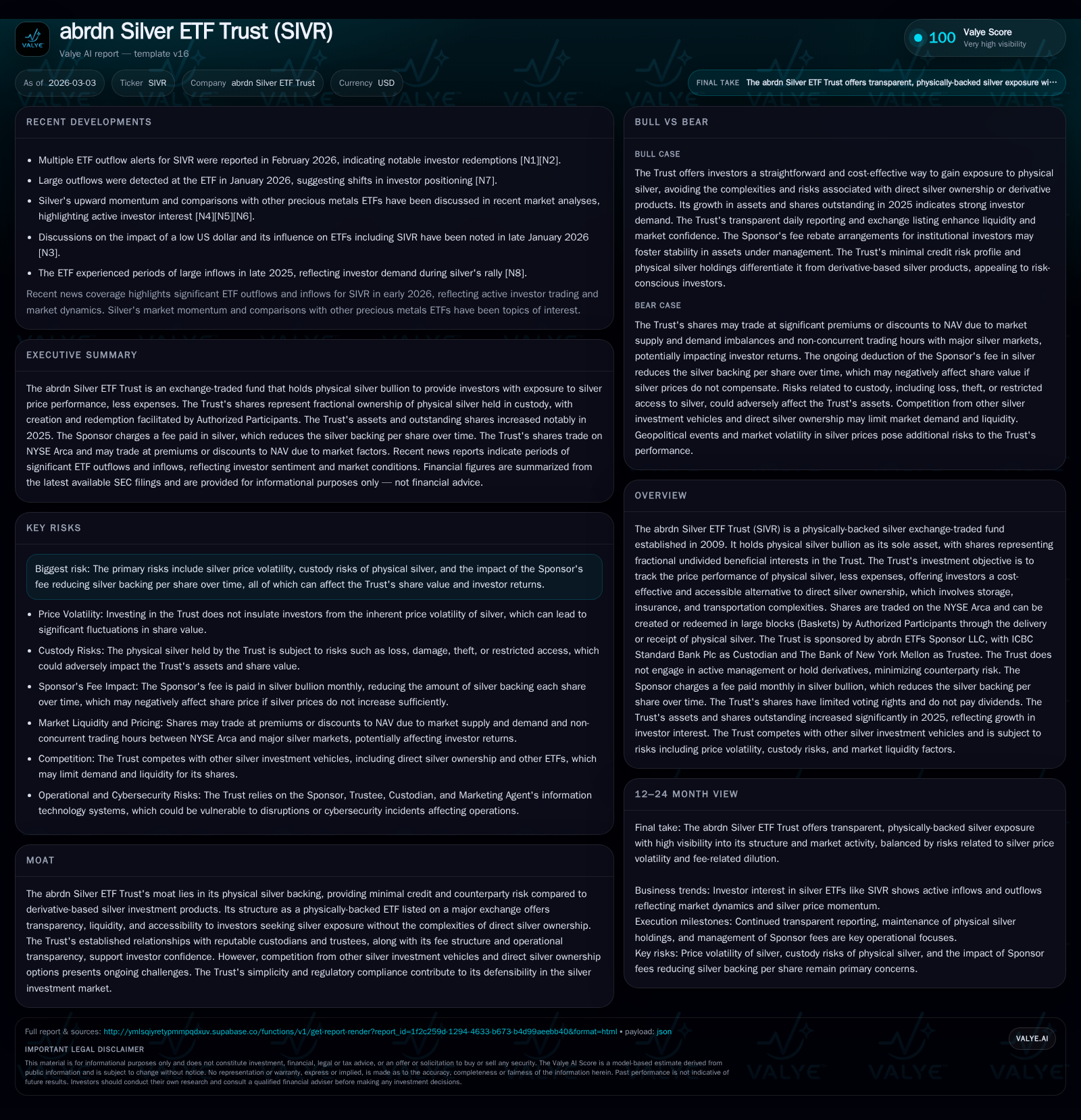
abrdn Silver ETF Trust (SIVR), a physically-backed silver ETF, surged in net income by over twelvefold in FY2025 while expanding shares outstanding by more than half. This growth primarily reflects silver price appreciation alongside active basket creations and redemptions facilitated by authorized participants. The Trust's structure leverages physical bullion custody, minimizing counterparty risk compared to derivatives-based alternatives, but remains exposed to silver price volatility and sponsor fees that gradually erode silver backing per share. Recent ETF outflows suggest short-term liquidity challenges amid broader market sentiment shifts, although industrial demand and macroeconomic factors continue to shape the medium-term outlook.
Historical Growth Fueled by Physical Silver Demand
The abrdn Silver ETF Trust showcased extraordinary financial growth in fiscal year 2025, with net income skyrocketing from $215 million in 2024 to approximately $2.84 billion, a staggering increase of roughly 1217.9% year-over-year [F1]. Concurrently, the number of shares outstanding rose significantly by 53.8%, expanding from 51.5 million to over 79.25 million shares as of December 31, 2025 [F1][S1]. This sharp rise in scale was not driven by active portfolio management or derivative trading—as the Trust strictly holds physical silver bullion—but mirrors robust silver price appreciation coupled with heightened investor interest manifesting in basket creations via Authorized Participants.
Unlike traditional investment vehicles, abrdn Silver ETF Trust's growth reflects direct exposure to the underlying commodity’s spot market moves rather than earnings-producing operations. The increases in shares outstanding symbolize sustained capital inflows into the Trust facilitated through the efficient mechanism of basket creations—large blocks of shares exchanged for corresponding allotments of physical metal owned by the Trust—enabling investors to gain seamless exposure to silver's price trajectory without direct bullion handling complexities.
Historical performance (annual)
| FY | Net ($bn) | Net YoY |
|---|---|---|
| 2025 | 2.8 | +1217.9% |
| 2024 | 0.2 | +1708.4% |
| 2023 | -0.0 | -313.1% |
| 2022 | 0.0 |
Source: SEC companyfacts cache [F1].
Capital returns and efficiency (annual)
| FY | ROE% |
|---|---|
| 2025 | 52.2 |
| 2024 | 15.1 |
| 2023 | -1.3 |
| 2022 | 0.6 |
Source: SEC companyfacts cache [F1].
Structural Advantages and Risks of Physical Silver Backing
At its core, SIVR benefits from a tangible moat based on holding physical silver bars with minimal credit or counterparty risk—a material advantage over derivatives-reliant competitors which carry inherent counterparty default possibilities [S1]. The Trust is fully collateralized by allocated silver bars stored under stringent custody agreements with ICBC Standard Bank Plc acting as custodian and The Bank of New York Mellon serving as Trustee ensuring robust safekeeping protocols compliant with LBMA standards [S6][S9].
This structure offers investors transparency: share value closely tracks the LBMA Silver Price benchmark minus expenses and Sponsor fees without leverage or complex derivatives.
However, direct exposure subjects shareholders to intense commodity price swings intrinsic to volatile precious metals markets affected by economic cycles, inflation expectations, interest rates and geopolitical uncertainty [S1][S3]. Custody risks exist but are mitigated through well-regarded global custodians and regulatory oversight [S24][S25]. The Sponsor collects an annual fee on assets (0.30% currently after waivers) payable in metal units withdrawn monthly; this reduces underlying silver per share if prices stagnate long term [S5][S16], posing a compounding drag.
Investor Behavior and Recent Fund Flows Impacting Outlook
Despite rapid asset base growth in 2025, recent reports highlight notable ETF outflows during January–February 2026 indicating short-term shifts in investor positioning or profit-taking within precious metals ETFs including SIVR [N1][N2]. These outflows suggest liquidity recalibration possibly triggered by changing macroeconomic factors such as U.S. dollar movements at multi-year lows causing speculative flows across commodities [N3], or evolving inflation narratives impacting real asset demand.
Such fund flow patterns warrant monitoring; frequent basket redemptions could impose redemption pressures impacting liquidity premiums/discounts relative to NAV despite the Trust’s physical backing and active Authorized Participant market-making mechanisms [N5].
Capital Allocation Mechanisms and Fee Impact on Share Value
The abrdn Silver ETF Trust does not engage in traditional corporate capital allocation: it pays no dividends nor conducts share buybacks typical for equity issuers seeking cash distributions or repurchases [S4][S5]. Capital returns derive exclusively from changes in physical silver valuation marked daily.
The Sponsor’s fee collected monthly at an annualized rate partially waived down to 0.30% is payable through transferring physical silver from the Trust’s holdings—effectively shrinking amount held per share over time if unmitigated by price appreciation or new basket creations [S5][S16]. This expense payment method is consistent with physically-backed commodity trusts where cash payment is impractical without liquidating assets.
Investors must consider this gradual shrinkage when evaluating holding periods since total return depends fully on silver price performance exceeding this fee drag.
Interpreting Financial Metrics: Net Income Surge and ROE Analysis
The Trust’s FY2025 net income reached $2.84 billion versus $215 million in FY2024 based on accounting treatment equating increased metal valuation minus accrued expenses—rather than operational profit generation—in line with passive commodity exposure mechanics [F1]. Correspondingly equity ballooned proportionally with asset value to $5.43 billion at year-end.
Calculating return on equity (ROE) using these figures produces an outsized ~52.2%, representing potent valuation gains leveraged against equity invested rather than profit from ongoing business activities [F1]. This ratio underscores that operational leverage stems dominantly from raw asset appreciation versus typical company earnings dynamics.
Future Outlook: Price Volatility, Industrial Demand, and Macro Drivers
Going forward SIVR’s performance will hinge critically on underlying silver market dynamics including global economic trends influencing industrial demand for electronics manufacturing and solar photovoltaic applications which account for substantial incremental supply-demand balance beyond investment demand alone [S1][N4].
Monetary policy affecting real yields shapes precious metal attractiveness as an inflation hedge—heightened inflation expectations typically buoying demand—and geopolitical disruptions could introduce episodic volatility influencing bullion flows [S3][N4]. Given these variables’ unpredictability combined with silver’s dual role as industrial input and investment vehicle implies potential for significant NAV fluctuations requiring investor vigilance.
Monitoring Key Milestones: NAV Trends & Basket Creation/Redemption Activity
Key operational metrics include NAV movements reflecting daily LBMA Silver Price updates less accrued fees plus monitoring volume/frequency of basket creations/redemptions executed via Authorized Participants who facilitate primary market liquidity for institutional buyers/sellers—registering how robust demand or redemption pressure shapes supply-demand equilibrium within secondary trading venues [S6][S9][N5].
Tracking basket creation vs redemption trends provides insight into net inflows/outflows influencing overall trust size while NAV premiums/discounts indicate temporary pricing inefficiencies exploitable by sophisticated traders.
Sector-Specific Considerations: Custody Protocols & Authorized Participants’ Role
Physically-backed ETFs like SIVR rely critically on impeccable custody arrangements; ICBC Standard Bank Plc serves as custodian holding allocated bars per agreed protocols validated periodically alongside Trustee oversight via The Bank of New York Mellon ensuring integrity across bullion transfers underpinning shareholder interests [S6][S9]. Authorized Participants—typically large banks or broker-dealers registered with DTC—are entrusted entities authorized to create/redeem baskets exchanging physical metal for shares maintaining tight linkage between share count and underlying asset pool enabling continuous arbitrage bridging spot prices with market quotes ensuring liquidity efficiency [S16][S18].
This analysis synthesizes verified data drawn exclusively from company filings ([F1],[S#]) and sector-specific news ([N#]) without extrapolation beyond documented facts. The abrdn Silver ETF Trust embodies a specialized vehicle marrying physical precious metal ownership benefits with public exchange accessibility presenting unique advantages balanced against distinct risks inherent in volatile commodity markets and fee structures intrinsic to physically-backed funds.
Disclaimer: This is research-only, informational analysis and not investment advice. It may include AI-generated interpretation and general industry context. Always verify important details using primary sources.

Comments