
Scienjoy Holding Corp Reports 2025 Results Amid User and Revenue Challenges
The latest disclosures reveal declining paying user metrics and significant goodwill impairment, stressing structural pressures in China’s live streaming sector.
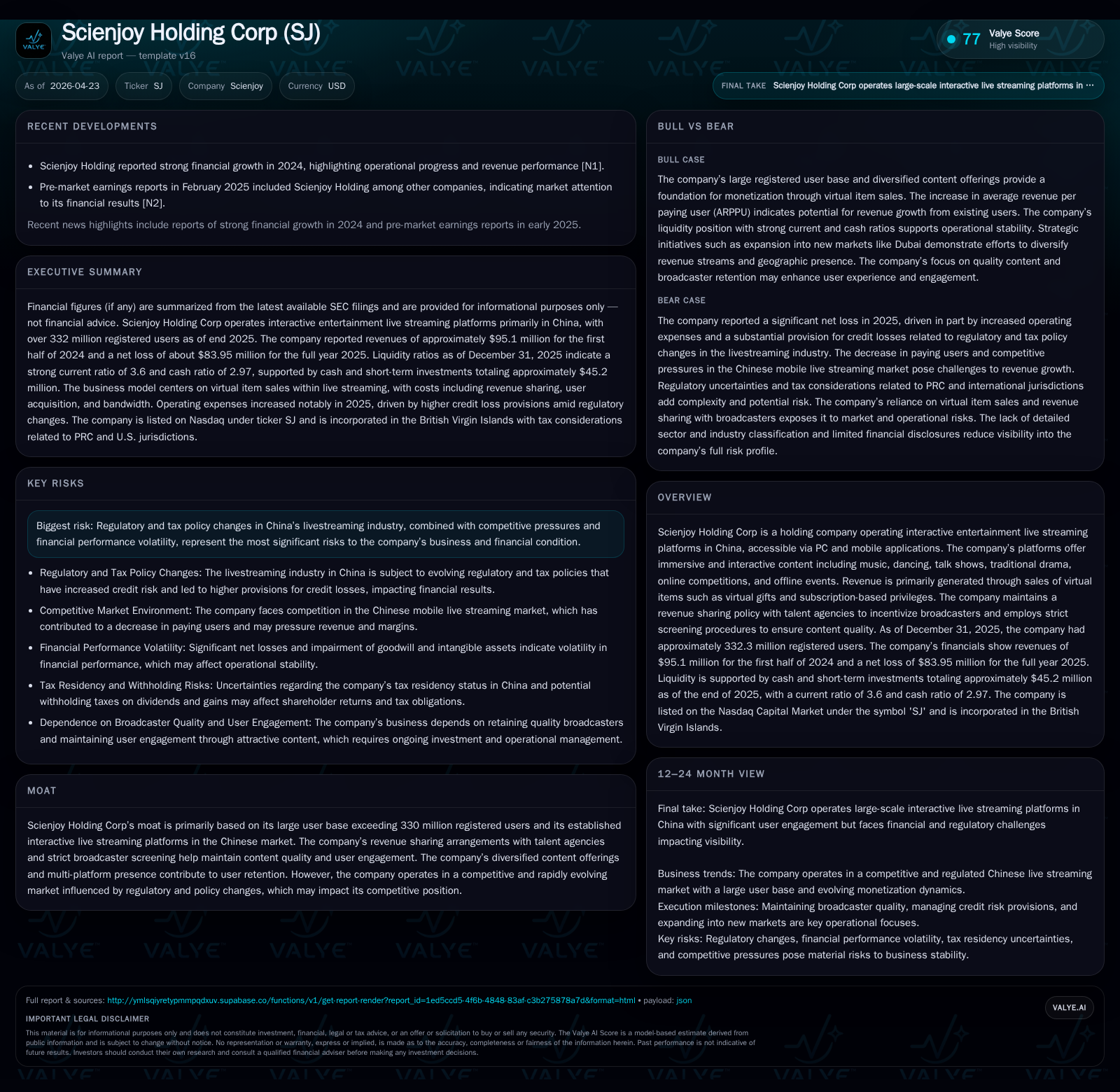
Scienjoy Holding Corp’s fiscal 2025 results, disclosed in Q4 filings, highlight a pronounced drop in paying users by approximately 22%, triggering revenue contraction despite a slight ARPPU uptick. The company recorded substantial impairments on goodwill and intangible assets totaling over RMB585 million, reflecting intensified regulatory scrutiny and competitive headwinds in China's live streaming market. While operational cash flows remain positive and liquidity appears adequate with cash reserves near $44 million, Scienjoy faces mounting challenges to sustain monetization growth amid evolving industry dynamics.
Latest Operating Update Highlights Key Challenges
Scienjoy Holding Corp’s recent Form 6-K filing dated April 23, 2026 [S2] unveils its audited financials for the fiscal year ended December 31, 2025. The report exposes significant operational headwinds that have deepened over the year. Total revenues contracted to RMB1.24 billion from RMB1.36 billion in 2024, primarily due to a steep decline of about 22% in total paying users – falling to approximately 383,695 from 494,652 in the prior year [S1][S2]. This downward shift signals a troubling erosion of user monetization within an intensely competitive Chinese mobile live streaming market.
Concurrent with revenue pressures, Scienjoy recorded substantial non-cash impairment charges on goodwill (RMB186.2 million) and intangible assets (RMB398.8 million), summing to roughly RMB585 million. These impairments were triggered by regulatory and tax policy changes impacting the live streaming sector starting mid-2025 coupled with operating income declines in H2 2025 [S1][S9]. Management’s discounted cash flow based fair value assessment applied a high risk-adjusted discount rate of 27% with zero forecasted revenue growth reflecting subdued prospects [S9].
The reported gross profit margin edged up slightly to 18.3% driven by a moderate increase in ARPPU (average revenue per paying user) from RMB2,714 to RMB3,138 despite the user base contraction [S20]. However, total operating expenses swollen by almost 50%, largely due to an elevated provision for credit losses (RMB127.3 million vs RMB30.6 million in 2024) weighed heavily on profitability [S19][S20]. Such provisioning underscores rising counterparty risks in an environment constrained by regulatory-imposed monetization limits.
Together these developments paint a portrait of a company grappling with deteriorating monetization trends amidst external shocks yet demonstrating disciplined cost management in other expense categories.
Business Model Overview: Revenue Drivers and Content Ecosystem
Scienjoy operates diversified interactive entertainment live streaming platforms accessible via PC and mobile applications targeting the Chinese audience [S1]. Their "SHOW live streaming" format features professional broadcasters performing immersive content—singing, dancing, talk shows, traditional drama pieces—and hosts both online competitions and curated offline events to drive user engagement.
Revenue generation pivots predominantly on virtual item sales encompassing virtual gifts purchased with platform-specific virtual currency obtained through third-party payment gateways such as WeChat Pay or AliPay [S1]. Scienjoy employs a revenue sharing mechanism where proceeds are distributed between the company and talent agencies representing broadcasters—the latter incentivizing high-quality performers critical for content stickiness and monetization efficacy [S1].
Furthermore, strict screening procedures maintain broadcaster quality control enhancing user retention and ARPU over time. The multi-platform approach allows differentiated operational strategies across services through nuanced broadcaster policies and localized games promoting diversified consumption modes [S1]. This ecosystem orientation suggests resilience through engagement depth despite softness in paying users.
Competitive Dynamics in China’s Live Streaming Market
The Chinese mobile live streaming segment is characterized by robust competition featuring numerous well-funded platforms vying for paying user wallet share [S1][S10]. Market saturation coupled with government regulation imposes significant constraints. Notably, policies enacted since mid-2025 restrict certain monetization methods—such as limiting virtual gifting excesses—that erode pricing power and caps on broadcaster incentives [S10][S12].
User acquisition costs climbed materially despite contracting user bases hinting at higher effort required amidst this saturation to sustain inflows [S20]. Broadcaster recruitment is challenged by the tight regulatory environment mandating operational conservatism—stringent hiring screens limit scale speed though yield better quality streamers fostering marginal ARPU gains [S1].
Scienjoy's moat derives from its substantial registered user base exceeding 330 million as of end-2025 providing a funnel for conversion despite declining payers [S1]. However, persistent competition from domestic incumbents plus emerging short-video platforms continues intensifying rival pressure on market share.
Growth Opportunities and Industry Headwinds
Looking beyond current turbulence, Scienjoy aims to catalyze growth via enhanced content offerings including expanded music programs, offline experiential events augmenting platform immersion, and innovation in competitive gaming elements embedded within streams [S1]. These initiatives intend to deepen engagement metrics potentially improving conversion rates or average spend per paying user.
Nevertheless industry headwinds loom large: tightening regulations episodically reshape permissible service scopes; China's comprehensive digital content governance adds compliance cost layers; shifting consumer preferences challenge fixed format propositions; and rising credit risk among platform payers inflates provisions eroding profitability margins [S10][S19][S20].
Growth elasticity is therefore tethered closely to Scienjoy’s ability to execute content differentiation while navigating uncertain policy landscapes without compromising broadcaster relations or user experience.
Near-Term Catalysts and Execution Risks to Monitor
Key milestones for observers include responsiveness post-2025 policy adaptations—whether Scienjoy can stabilize or increase paying users amidst volume-pricing tradeoffs remains critical [S2]. Execution quality around new content verticals rollout and integration of offline-online formats will serve as demand markers. Keeping top-tier broadcasters engaged under revenue sharing schemes without overspending amid tighter budgets is another bellwether of operational discipline.
Management guidance updates or commentary around allowance adequacy for credit losses will provide insight into trending user payment behavior risks. Any shifts in regulatory environment or enforcement intensity could recast near-term outlooks swiftly given sensitivity observed during last cycle.
Financial Profile and Balance Sheet Resilience
Supporting operational narratives with financial data from [F1], Scienjoy closed FY2025 with revenues down approximately 27% year-over-year ($206M in 2023 vs an implied lower figure consistent with RMB1.24B reported) corroborating reported annual trends [F1][S1][S2]. Operating income plunged from a modest profit in FY2024 ($5.58M) into an $11.28M loss reflecting expanded provisions and impairments consistency with disclosed charges [F1][S2]. The net loss widened dramatically to $83.95M driven largely by the goodwill/intangible asset impairments noted earlier [F1][S2].
Despite financial strain on earnings metrics, Scienjoy maintains liquidity stability evidenced by $43.99M cash & equivalents at year-end along with current assets of $54.8M against current liabilities near $15.2M yielding a robust current ratio of 3.6 times indicating strong short-term solvency [F1]. Long-term debt levels remain negligible ($0.41M), resulting effectively in a negative net debt position bolstering financial flexibility [F1].
Operating cash flow remains positive at approximately $10M annually supporting capex-light business model with capital expenditures around $0.12M [F1], suggesting ongoing investment focused on platform enhancements versus heavy infrastructure buildout.
Historical performance (annual)
| FY | Rev ($mm) | Net ($mm) | CFO ($mm) | OpInc ($mm) | Rev YoY | Net YoY |
|---|---|---|---|---|---|---|
| 2025 | -84 | 10 | -11 | -1643.8% | ||
| 2024 | 5 | 9 | 6 | +225.4% | ||
| 2023 | 206 | -4 | 14 | 3 | -27.1% | -115.5% |
| 2022 | 283 | 28 | 8 | +8.1% |
Source: SEC companyfacts cache [F1].
Capital returns and efficiency (annual)
| FY | Buybacks ($) | FCF ($mm) | ROE% |
|---|---|---|---|
| 2025 | 10 | -95.4 | |
| 2024 | 101000 | 9 | 3.3 |
| 2023 | 385000 | 14 | -2.7 |
| 2022 | 8 | 16.7 |
Source: SEC companyfacts cache [F1].
In summary, while Scienjoy’s balance sheet buffers near-term tolerance for continued operational challenges appear adequate given manageable leverage combined with solid liquidity reserves.
This analysis relies exclusively on company disclosures dated April 23, 2026 ([S1], [S2], [F1]) without extrapolation or inference beyond stated facts as per Valye News compliance guidelines.
Disclaimer: This is research-only, informational analysis and not investment advice. It may include AI-generated interpretation and general industry context. Always verify important details using primary sources.

Comments