
SKYWEST's Capacity Contracts and Pilot Supply Define Q2 2026 Operating Dynamics
SkyWest maintains its footprint as the largest U.S. regional carrier, navigating pilot market pressures and contract-dependent revenues amid elevated operating costs.
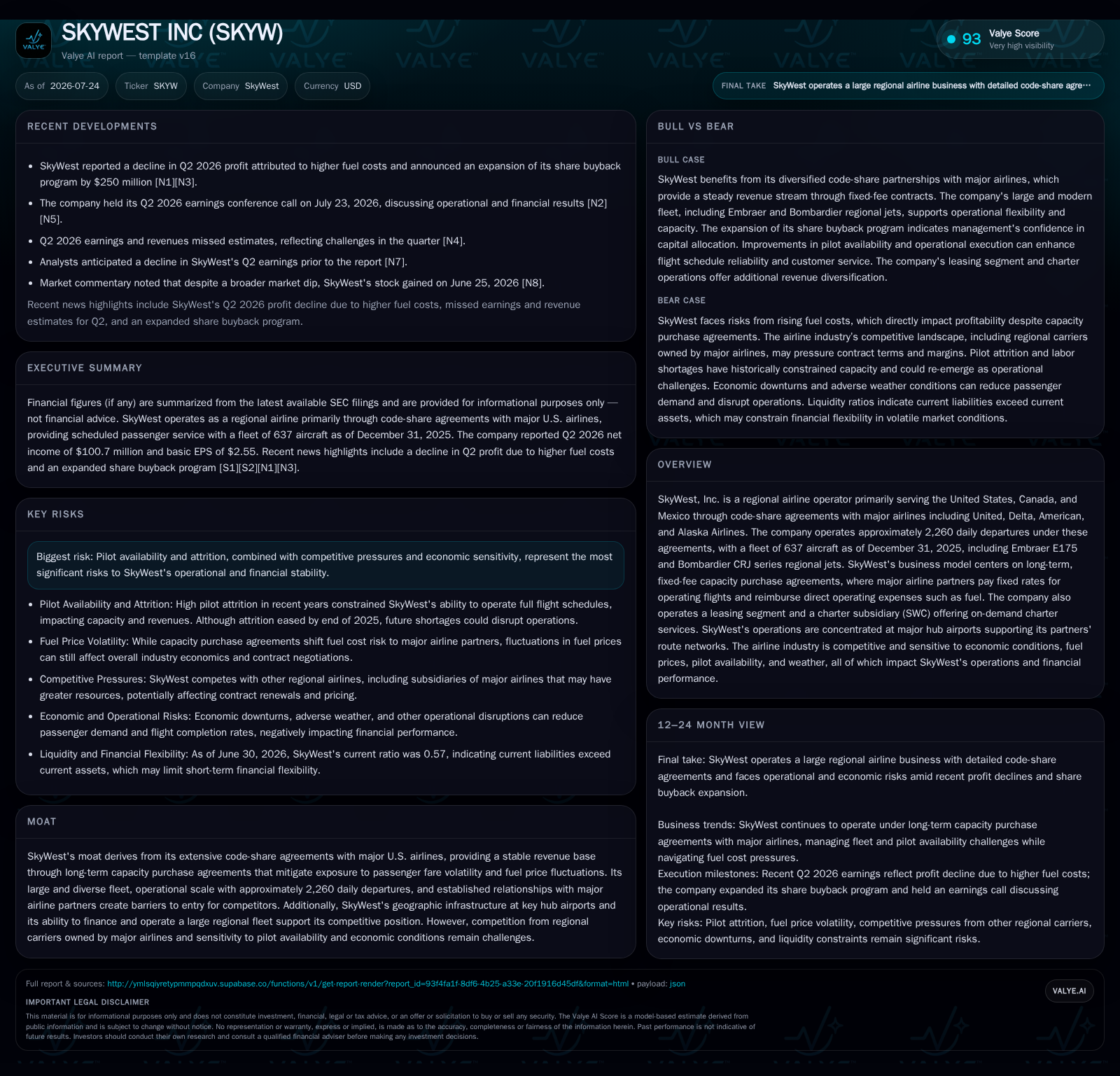
SkyWest's Q2 2026 results reflect ongoing challenges from higher fuel expenses and pilot availability constraints that have historically influenced its flight completions and block hours. Its business model centers on fixed-fee capacity purchase agreements with major U.S. airlines, which provide stable payouts insulated from fare volatility but expose SkyWest to operational risks tied to partner schedules and capacity limits. While the company expanded its share repurchase authorization, liquidity remains constrained by significant debt used for fleet financing. The regional airline industry’s competitive landscape is shaped by major carriers’ scope clauses, pilot labor tightness, and the capital-intensive nature of modernizing fleets with Embraer E175 and Bombardier CRJ jets.
Recent Operating Update: Q2 2026 Earnings Snapshot
SkyWest’s Q2 2026 results reflected ongoing operational pressures primarily driven by elevated jet fuel costs that outpaced reimbursements from its major airline partners under fixed-fee capacity purchase agreements (CPAs). Despite maintaining approximately 2,260 daily departures aligned with partner requests, SkyWest reported a decline in operating income and net profit due to inflationary cost dynamics, particularly fuel expenses and maintenance delays linked to third-party supplier constraints [S2][N2][N8]. The company announced an incremental $250 million increase in its share repurchase authorization, raising total buyback capacity to around $313 million, signaling management’s confidence in the stability of contracted cash flows despite margin headwinds [S16][N8].
Operationally, SkyWest restored full schedule completion relative to partner requests after overcoming pilot attrition impacts experienced in prior years; however, pilot supply remains a critical watchpoint given its direct influence on block hours flown and daily departures, key operational KPIs under its CPA model [S12]. The company continues to manage risks from maintenance turnaround times affected by global supply chain disruptions and technician shortages, which could constrain fleet utilization and on-time performance metrics essential to contract renewals.
Business Model: Fixed-Fee Capacity Purchase Agreements Drive Contract-Dependent Revenue
SkyWest’s revenue generation is anchored in long-term CPAs with four major U.S. airlines—United, Delta, American, and Alaska Airlines—that provide fixed payments based primarily on completed flights, block hours flown, and the number of aircraft deployed under contract [S1]. These agreements separate variable operating expenses such as fuel costs, which are reimbursed by partners, insulating SkyWest’s top line from passenger fare volatility but exposing it to risks related to fuel price fluctuations and partner-driven schedule adjustments.
Unlike mainline carriers that sell tickets directly to consumers, SkyWest operates as a subcontractor within the airline value chain, focusing on reliable execution of contracted flying schedules predominantly from major hub airports supporting partners' broader route networks, including Chicago O’Hare, Dallas/Fort Worth, Denver, and Salt Lake City [S1]. This model provides high revenue visibility but ties growth potential closely to partner network expansion strategies and utilization mandates.
Additional revenue streams arise from SkyWest’s aircraft leasing business and its charter subsidiary, SkyWest Charters (SWC), which offers on-demand and commuter air services [S1][S15]. While these segments diversify revenue sources, they remain smaller contributors compared to the core CPA-driven scheduled flying operations
Industry Structure and Competitive Positioning
The U.S. regional airline sector is characterized by heavy reliance on CPAs with major network carriers who impose scope clauses limiting the number and size of regional aircraft they operate to comply with pilot labor agreements. These scope clauses constrain fleet growth opportunities for independent operators like SkyWest despite its scale advantage as the largest independently owned regional airline with a fleet of 637 aircraft, including 487 in scheduled service [S1]. The fleet is predominantly composed of Embraer E175 regional jets and Bombardier CRJ700/900 series aircraft, tailored to meet partner-specific route and capacity requirements.
Competition arises from other independent regional carriers such as Republic Airways and Mesa Air Group, which also compete for CPA renewals, as well as from regional subsidiaries owned by major airlines—including Endeavor Air (Delta), Envoy, PSA, and Piedmont (American), and Horizon Air (Alaska)—which may benefit from preferential contracting due to parent company backing [S15]. SkyWest competes on operational reliability metrics including on-time performance, flight completion rates, cost efficiency per block hour, pilot staffing levels under union-regulated scope clauses, and geographic infrastructure enabling rapid deployment across multiple hubs.
Growth Drivers: Fleet Modernization and Network Expansion
Sustained demand for regional feeder connectivity supports steady growth potential for SkyWest as major carriers extend network reach into secondary and tertiary markets requiring smaller capacity jets [S1][S10]. The introduction of new-generation Embraer E175 aircraft, which offer improved fuel efficiency and lower direct operating costs per block hour compared to older CRJ models, enhances unit economics under CPAs that reimburse fuel pass-throughs. This fleet modernization aligns with environmental initiatives, including collaborative efforts with partners to increase sustainable aviation fuel usage.
SkyWest has firm purchase commitments for 69 new E175 jets totaling over $2 billion in capital expenditure obligations, reflecting a strategic modernization effort that promises efficiency gains if financed effectively amid interest rate variability [S4]. Parallel growth opportunities exist in scaling the charter subsidiary SWC as a commuter air carrier under recent Department of Transportation authorization, targeting regulatory niche markets beyond fixed contract flying [S15].
Risks and Watchpoints
Pilot labor market tightness remains a paramount risk; although attrition stabilized post-pandemic allowing full scheduled operations restoration by late 2025, future cyclical or structural shortages could again constrain flight completions, directly impacting revenue recognition tied to completed block hours rather than ticket sales [S12][S28]. Monitoring pilot staffing levels and attrition rates is critical to assessing operational capacity.
Fuel price volatility transmits rapidly through operating expense reimbursements but creates margin unpredictability when sudden spikes outpace adjustment timing under CPAs, affecting operating income [S1][S8]. Additionally, reliance on third-party maintenance providers exposes SkyWest to risks of delayed spare parts deliveries and technician shortages, which may reduce aircraft availability, increase maintenance turnaround times, and lead to flight cancellations or schedule compression, thereby impacting customer satisfaction and contract renewal prospects.
Regulatory developments around safety certifications, environmental mandates, and potential restrictions on smaller aircraft operations at certain airports could impose additional operational constraints or cost burdens [S8][S28]. Contract renewal uncertainty also poses risks, as major partners might internalize regional flying or award contracts to competitors, a persistent threat given scope clause complexities limiting externally contracted fleet sizes [S29].
Financially, as of June 30, 2026, SkyWest reported cash and equivalents of approximately $81 million against total debt of about $2.31 billion, resulting in net debt of roughly $2.22 billion, reflecting the capital-intensive nature of aircraft financing and fleet modernization [F1]. Current assets of approximately $1.02 billion versus current liabilities near $1.80 billion yield a current ratio of 0.57, indicating tight short-term liquidity positioning typical in the industry [F1]. While the expanded share repurchase authorization underscores management’s confidence in cash flow resilience from contracted revenues, capital markets conditions or partner financial distress could constrain refinancing options [S26][N8].
Key Metrics and Monitoring Points
Operational KPIs to monitor include daily departures, block hours flown, and on-time performance, which collectively indicate execution fidelity against partner schedules and pilot availability. Quarterly updates on contract renewals or amendments, particularly with Alaska Airlines whose CPA extends into the early 2030s but includes early termination provisions tied to performance, warrant close attention for partnership stability [S1].
Tracking progress on E175 aircraft deliveries and associated capital expenditures is essential to assess fleet modernization impact on operating efficiency and leverage ratios. Developments in SWC’s transition toward commuter air carrier status may signal incremental growth avenues if regulatory and market conditions prove favorable [S15]. Fuel price trends remain a critical variable due to their direct influence on reimbursement timing and operating margin volatility.
Financial Profile Summary
As of June 30, 2026, SkyWest held approximately $81 million in cash and equivalents against $2.31 billion in total debt, resulting in net debt of about $2.22 billion, consistent with the capital-intensive aircraft financing typical of regional airlines [F1]. The current ratio of 0.57 reflects tight liquidity, emphasizing the importance of cash flow management amid ongoing capital expenditures and debt servicing obligations [F1].
The recent $250 million increase in share repurchase authorization to over $300 million total reflects management’s confidence in the stability of cash flows derived from fixed-fee CPAs despite margin pressures from fuel and maintenance costs [S26][N8]. Future capital allocation decisions will require balancing debt servicing, fleet investment, and shareholder returns amid macroeconomic uncertainties.
This analysis is based exclusively on publicly disclosed information as cited and aims to provide a detailed overview of SkyWest Inc’s operating dynamics within the regional airline industry context. It does not constitute investment advice or forecasts.
Disclaimer: This is research-only, informational analysis and not investment advice. It may include AI-generated interpretation and general industry context. Always verify important details using primary sources.

Comments