
SLM Corp’s Q1 2026 Growth Driven by Private Education Loan Origination and Strategic Funding Initiatives
Sallie Mae’s latest quarter highlights robust loan originations and evolving capital strategies amid regulatory shifts in private education lending.
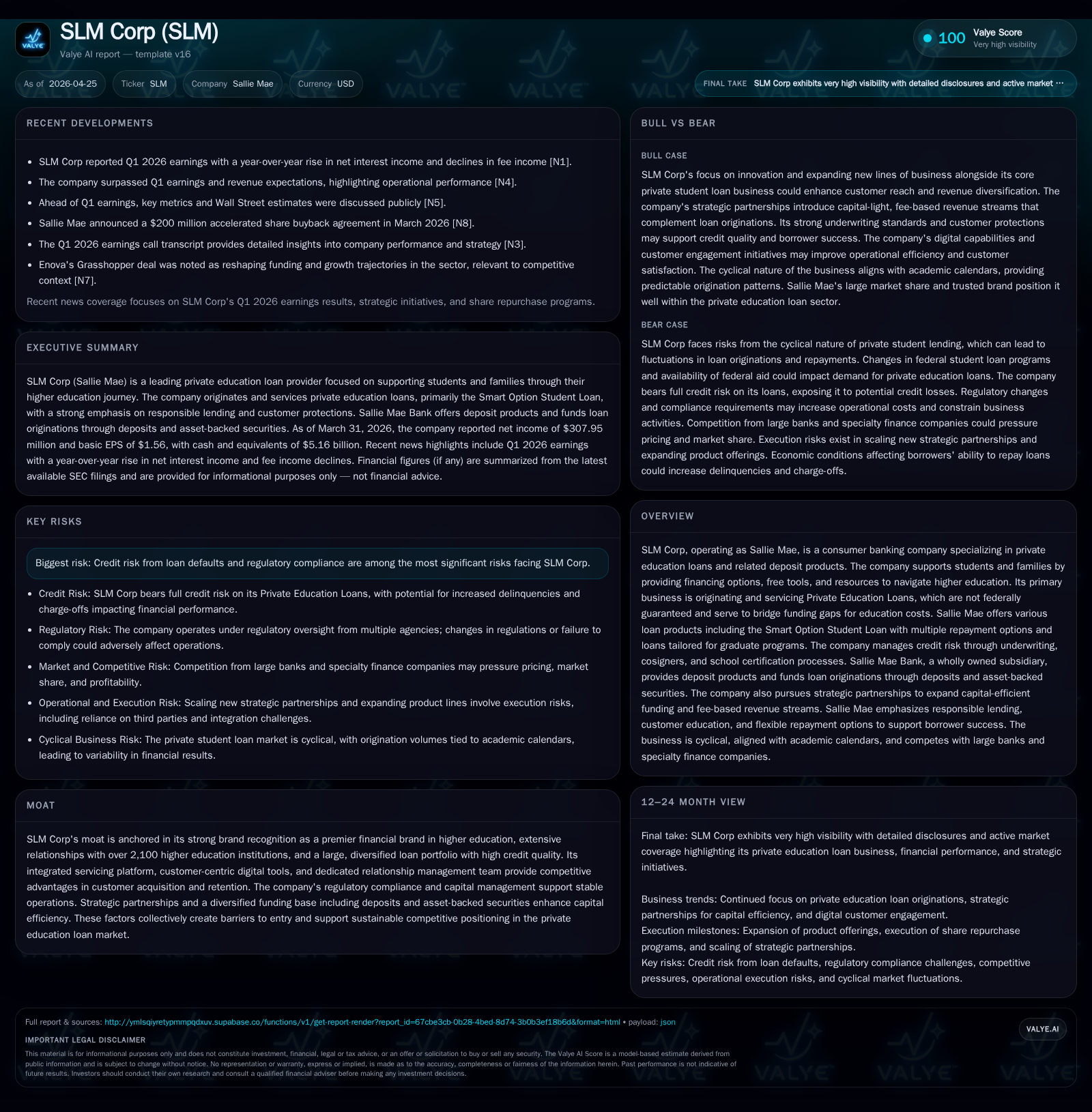
In its Q1 2026 filing, SLM Corp demonstrated sustained momentum in private education loan originations, supplemented by strategic partnerships aimed at enhancing capital efficiency. The company’s differentiated product offerings and strong institutional relationships underpin its competitive positioning, while evolving federal student loan policies and regulatory risks present ongoing challenges. Investor focus should remain on execution of new funding models, credit performance trends, and regulatory developments impacting the student loan industry.
Recent Operating Update
SLM Corp’s Q1 2026 financial results, filed April 23, 2026 [S2], exhibit continued strength in its private education lending business alongside strategic realignment toward scalable funding partnerships [S3]. The company reported a year-over-year rise in net interest income driven by increased originations of Private Education Loans. However, fee income declined somewhat compared to prior periods [N1][N2]. This dichotomy suggests that while core lending volumes are expanding—benefitting from the Smart Option Student Loan product suite—the traditional fee-based services face pressure from changing customer behaviors or competitive factors.
The quarter also marked further progress integrating strategic partnerships introduced in 2025. These arrangements allow SLM to originate loans with reduced capital deployment by transferring risk while retaining servicing and program management fees [S1][S6]. This capital-light approach serves to extend Sallie Mae’s lending capacity without proportionately increasing balance sheet leverage.
Business Model and Strategic Position
SLM Corp operates primarily as a consumer banking entity specializing in Private Education Loans—non-federally guaranteed loans designed to fill gaps in college funding unmet by federal aid or family resources. Originations target both undergraduate and graduate student segments, offering loans with tailored product features such as fixed or variable rates, multiple repayment schedules including interest-only or fixed payments during schooling, and borrower protections like forgiveness upon death or permanent disability [S1][S13][S16].
The company differentiates through several pillars:
- High Credit Quality: Average FICO at origination hovers around 755 with over 92% of loans cosigned, mitigating default risk.
- Institutional Relationships: Direct ties to more than 2,100 institutions establish trusted distribution channels managed by the industry’s largest relationship team.
- Integrated Servicing Platform: Technology investments have created a self-service capable platform that improves operational efficiency and customer experience [S11].
- Deposit Banking: Sallie Mae Bank funds a portion of originated loans via deposits alongside asset-backed securities issuance creating a diversified funding base.
The company manages credit risk rigorously through underwriting standards incorporating school certifications and credit scoring frameworks while encouraging responsible borrowing practices through borrower education [S8][S13].
Industry Structure and Competitive Landscape
Private education lending remains cyclical but is structurally supported by three main drivers: enrollment levels, college cost inflation, and federal government aid availability. Following federal legislative changes (notably H.R.1 enacted July 2025), federal loan limits have tightened with capped graduate borrowing amounts and new repayment assistance plans altering the competitive dynamics [S27]. These shifts create both headwinds and opportunities for private lenders like SLM who can offer alternative financing solutions where government aid recedes.
SLM holds a premium position due to brand recognition (the ‘Sallie Mae’ name carries high awareness), wide institutional footprint enabling direct campus marketing efforts, and scale advantages in servicing technology and customer engagement tools. However, competition remains intense not only from other private lenders but also from fintech entrants innovating in digital loan origination and servicing models.
Integration of AI technologies is underway but introduces risks related to regulatory compliance frameworks still evolving at federal and state levels [S21][S18]. Moreover, ongoing adherence to consumer protection laws is vital given heightened scrutiny over student loan practices.
Growth Drivers and Constraints
Growth opportunities reside in expanding loan originations by capturing unmet demand as federal restrictions tighten borrower eligibility for government-subsidized loans [S24][N3]. Furthermore, strategic partnerships facilitate scaling origination without commensurate increases in balance-sheet risk or capital intensity allowing SLM to increase fee-based revenues from servicing and program management.
Product innovation targeted at specific graduate programs (law school, MBA, medical fields) including recent launches such as airline career loans reflect an adaptive approach to evolving market segments [S16].
Constraints lie chiefly in credit risk exposure exacerbated during economic downturns when delinquency rates could rise beyond current levels (~4% delinquency; ~3% annual default) despite strong underwriting standards [S8]. Regulatory uncertainties post-H.R.1 could result in operational cost escalations or limited product flexibility. The company must also navigate reputational risks tied to public perceptions of the student loan sector alongside technological cybersecurity threats inherent in a highly digital business model [S17][S12].
What to Watch Next
Key milestones include tracking the pace of adoption for strategic partnership funding models which will influence earnings mix between net interest income versus fee income segments. Monitoring credit quality trends such as delinquency rates amidst macroeconomic conditions will be critical for assessing risk trajectory.
Regulatory developments around consumer protection rules pertaining specifically to private student loans will bear watching given their potential impact on compliance costs and operational constraints [S7][S27]. Additionally, management commentary on share repurchases under the $500 million program announced for 2026 will provide insight into capital allocation priorities [S28].
Enhanced digital engagement metrics post-AI implementation phases will serve as indicators of successful technology integration affecting customer experience efficiency gains.
Financial Profile Summary
Historical performance (annual)
|
| FY | Net ($mm) | CFO ($mm) | Net YoY |
|---|---|---|---|
| 2025 | 745 | -399 | +22.4% |
| 2024 | 608 | -329 | +261.1% |
| 2023 | 168 | -145 | +318.6% |
| 2022 | -77 | 5 |
Source: SEC companyfacts cache [F1].
Capital returns and efficiency (annual)
|
| FY | Buybacks ($mm) |
|---|---|
| 2025 | 369 |
| 2024 | 248 |
| 2023 | 350 |
| 2022 | 713 |
Source: SEC companyfacts cache [F1].
As of March 31, 2026, SLM Corp held approximately $5.16 billion in cash and equivalents against roughly $5.67 billion total debt resulting in modest net debt near $513 million—a manageable leverage profile considering asset-backed securities diversify funding risk [F1][S2].
The company has sustained profitability improvements evidenced by a reported net income increase of over 22% year-over-year for FY 2025 reaching $745 million with robust return on equity above 30%, signaling effective capital utilization [F1]. Operating cash flows remain negative—a characteristic typical for banks relying on loan originations—but are consistent with historical patterns.
Capital returns through share repurchases remain active with $368 million deployed during FY2025 under existing repurchase authorizations [F1][S10][S28]. Dividend sustainability depends on regulatory capital distributions from the Bank subsidiary which has maintained an ‘Outstanding’ CRA rating enhancing deposit-taking ability crucial for funding operations.
Overall liquidity appears solid supported by deposit growth tide ($21.5 billion total deposits reported end-2025) combined with disciplined asset-backed securities issuance ensuring balanced funding sources [S6][S15].
This analysis reflects publicly disclosed information up to April 25, 2026. It does not provide investment advice but offers an informed perspective on SLM Corp's current operational standing within the private education loan industry framework based on SEC filings and recent earnings commentary.
Disclaimer: This is research-only, informational analysis and not investment advice. It may include AI-generated interpretation and general industry context. Always verify important details using primary sources.

Comments