
SolarMax Technology Pursues Commercial Battery Energy Storage Amid Financial Challenges
The company's latest quarterly filing reveals a strategic pivot toward large-scale commercial battery energy storage projects against a backdrop of significant financial distress.
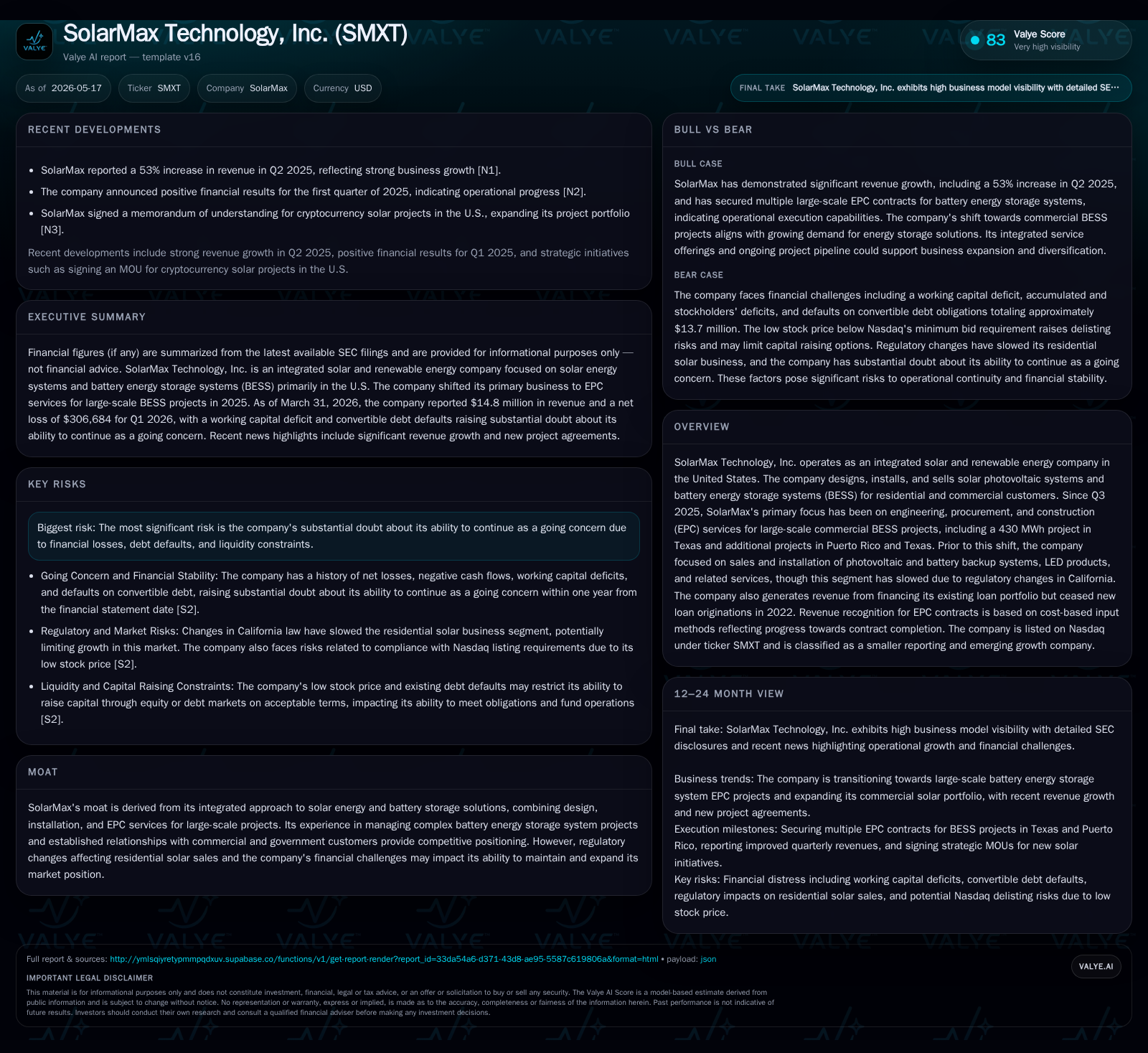
SolarMax Technology is shifting its operational focus to engineering, procurement, and construction (EPC) of commercial battery energy storage system (BESS) projects following slowed residential solar sales caused by regulatory changes. The Q1 2026 filing underscores serious liquidity pressures, including substantial debt defaults and a working capital deficit, raising going concern doubts. Despite this, management plans to leverage its EPC expertise and expand its commercial customer base in the United States. Key near-term milestones include negotiating debt exchanges and executing major BESS contracts in Texas and Puerto Rico.
Latest Quarterly Developments Highlight Debt Restructuring Efforts and Cash Constraints
SolarMax Technology’s Q1 2026 10-Q presents a critical update revealing acute financial pressures alongside strategic operational shifts [S2]. The company reported approximately $4.3 million in cash and cash equivalents against current liabilities exceeding $98 million, resulting in a working capital deficit near $17.6 million [F1]. This includes $13.7 million in convertible notes already in default since 2023, exposing the firm to acceleration risk absent successful restructuring [S2]. Management acknowledges substantial doubt regarding its ability to continue as a going concern due to recurring operating losses, negative cash flow from operations, and these marked liquidity constraints.
While SolarMax anticipates that existing cash reserves combined with expected operational cash flow will cover working capital needs over the coming year—excluding challenged debt—the narrow margin leaves the company vulnerable unless debt exchange agreements are secured [S2]. To counterbalance financial headwinds, management is prioritizing expansion of its commercial EPC footprint across the United States as an operational hedge against weakened segments [S2].
SolarMax’s Integrated Business Model Anchored in EPC and Renewable Systems Solutions
Historically engaged in residential solar photovoltaic (PV) system sales and installation alongside battery backup systems and LED products, SolarMax pivoted since Q3 2025 toward large-scale engineering, procurement, and construction (EPC) services for commercial battery energy storage systems (BESS), [S1]. The company’s shift reflects regulatory pressures dampening residential solar adoption particularly in California.
SolarMax designs and installs integrated solar PV arrays coupled with BESS solutions. Its business model now predominantly generates revenue via EPC contracts recognized by cost-based input methods aligned with percentage-of-completion accounting standards typical of multi-phase construction projects [S2], [S1]. This model implies revenue depends heavily on contract milestones achieved, cost management precision, and timely project delivery. Margins under EPC can be more stable if properly managed compared to more transactional residential sales.
Financing activities historically contributed revenue through interest on loan portfolios originated before 2022; however, no new loans have been issued since then reflecting a strategic retreat from consumer financing due to capital constraints [S15]
Industry Environment: Competitive Dynamics and Regulatory Impacts on Residential Solar
California’s evolving regulatory landscape has imposed restrictions curtailing residential solar sales growth, steering companies like SolarMax towards more structured commercial markets for BESS deployment, [S1]. The commercial BESS sector demands higher technical sophistication due to large deployments (e.g., hundreds of megawatt-hours), often tied to utility-scale or distributed energy resource integration with performance guarantees.
SolarMax faces competition from specialized turnkey providers capable of managing complex battery integration projects across jurisdictions such as Texas and Puerto Rico where it currently operates major projects. Differentiation requires robust engineering capabilities, supply chain coordination for battery packs and inverter systems, rigorous quality controls including warranty management, and compliance with safety regulations.
Customer adoption drivers include commercial clients’ growing demand for grid resilience, renewable integration mandates, and incentives supporting decarbonization efforts. Switching costs are elevated given customized systems design and installation complexity but also heighten execution risk if projects falter.
Shift Toward Commercial-Scale Battery Energy Storage Projects as Growth Pivot
The strategic redirection emphasizes large-scale BESS EPC work exemplified by projects like the 430 MWh battery installation underway in Texas plus additional undertakings in Puerto Rico, [S2]. These contracts provide opportunity for improved revenue visibility through multi-year execution horizons supported by long-term agreements with commercial or governmental entities.
EPC engagement enables SolarMax to capture end-to-end value—from initial engineering feasibility studies through procurement logistics, system assembly, testing, commissioning, and warranty services—potentially unlocking enhanced margins relative to diminished residential segment returns. The company seeks to leverage established expertise gained internationally (notably China operations until 2021) in delivering sophisticated battery projects adapted now for U.S. market nuances [S15]
Key growth levers include increasing the megawatt capacity under active contracts (backlog buildup), expanding geographic reach beyond traditional strongholds into emerging regional markets driven by grid modernization investments, enhancing customer relationships particularly among institutional clients sensitive to renewables mandates and resilience incentives.
Key Risks: Liquidity Pressures, Going Concern Doubts, and Regulatory Uncertainties
SolarMax’s most pressing challenge is its tenuous financial position detailed extensively in the Q1 filing [S2]. The company’s accrued losses have entrenched an accumulated deficit exceeding $110 million alongside a stockholders’ deficit nearing $11.4 million. Current liabilities dwarf current assets producing a current ratio of approximately 0.82—below the standard threshold indicating liquidity stress [F1]. Repeated defaults on convertible notes amplify refinancing risk with creditor rights potentially accelerating repayment demands absent consensual restructuring.
Nasdaq’s minimum bid price rule violation adds pressure through listing compliance risk which could impair access to equity capital markets or necessitate onerous reverse stock splits potentially dilutive or detrimental to shareholder confidence [S2],. Regulatory uncertainty remains relevant not only from residential solar policy but also evolving tariff regimes affecting imported components critical for supply chains.
Management must navigate these risks strategically while pursuing growth opportunities; failure to refinance or raise sufficient capital could imperil ongoing operations or trigger insolvency scenarios.
Catalysts and Milestones to Monitor in SolarMax’s Strategic Repositioning
Several near-term indicators will serve as critical barometers for SolarMax’s turnaround prospects:
- Success or setback in exchanging short-term convertible debt maturing within twelve months into extended five-year notes will materially influence liquidity runway [S2], [S7].
- Progress on the outstanding BESS EPC contracts including milestone completions on the flagship Texas 430 MWh project plus ancillary Puerto Rico installations signifies operational execution capabilities.
- Expansion efforts targeting new commercial customers across U.S. regions beyond legacy markets could reveal effective sales execution amid competitive pressures.
- Any regulatory modifications reversing restrictive residential solar policies or introducing fresh incentives for battery storage deployment could re-open earlier revenue channels or enlarge TAM (total addressable market).
- Additional equity raises or asset monetizations would provide liquidity relief but depend intensely on investor appetite constrained by Nasdaq status.
Monitoring these factors over upcoming quarters is essential for assessing viability against substantial solvency threats documented internally.
Brief Financial Snapshot: Liquidity Status and Debt Service Challenges
At March 31, 2026, SolarMax maintained roughly $4.3 million in cash—the principal buffer against immediate obligations—amidst current liabilities approaching $98 million yielding a negative working capital position around $17.6 million [F1], [S2]. Convertible debt outstanding includes roughly $13.7 million face value secured notes declared in default exposing acceleration risk absent restructuring agreements [S2]. Operating cash flows remain negative highlighting ongoing cash burn demands necessary to fund EPC project execution despite growth focus.
Although management expresses confidence that anticipated operating cash generation combined with incremental equity proceeds raised totaling about $1.1 million will cover working capital needs excluding certain debt maturities [S7], restricted flexibility remains acute given Nasdaq-imposed fundraising constraints following share price declines below threshold levels [S2]. Failure either to consummate debt exchanges or access supplemental capital on viable terms may force drastic remedial actions threatening strategic continuity.
Disclaimer: This analysis is based solely on disclosed SEC filings through May 17, 2026,
Disclaimer: This is research-only, informational analysis and not investment advice. It may include AI-generated interpretation and general industry context. Always verify important details using primary sources.

Comments