
Spire Global Inc: Navigating Satellite Data Services Amid Capital Intensity and Competitive Pressures
Spire Global continues expanding its satellite constellation and data partnerships but faces persistent losses and market challenges in the space-powered weather intelligence sector.
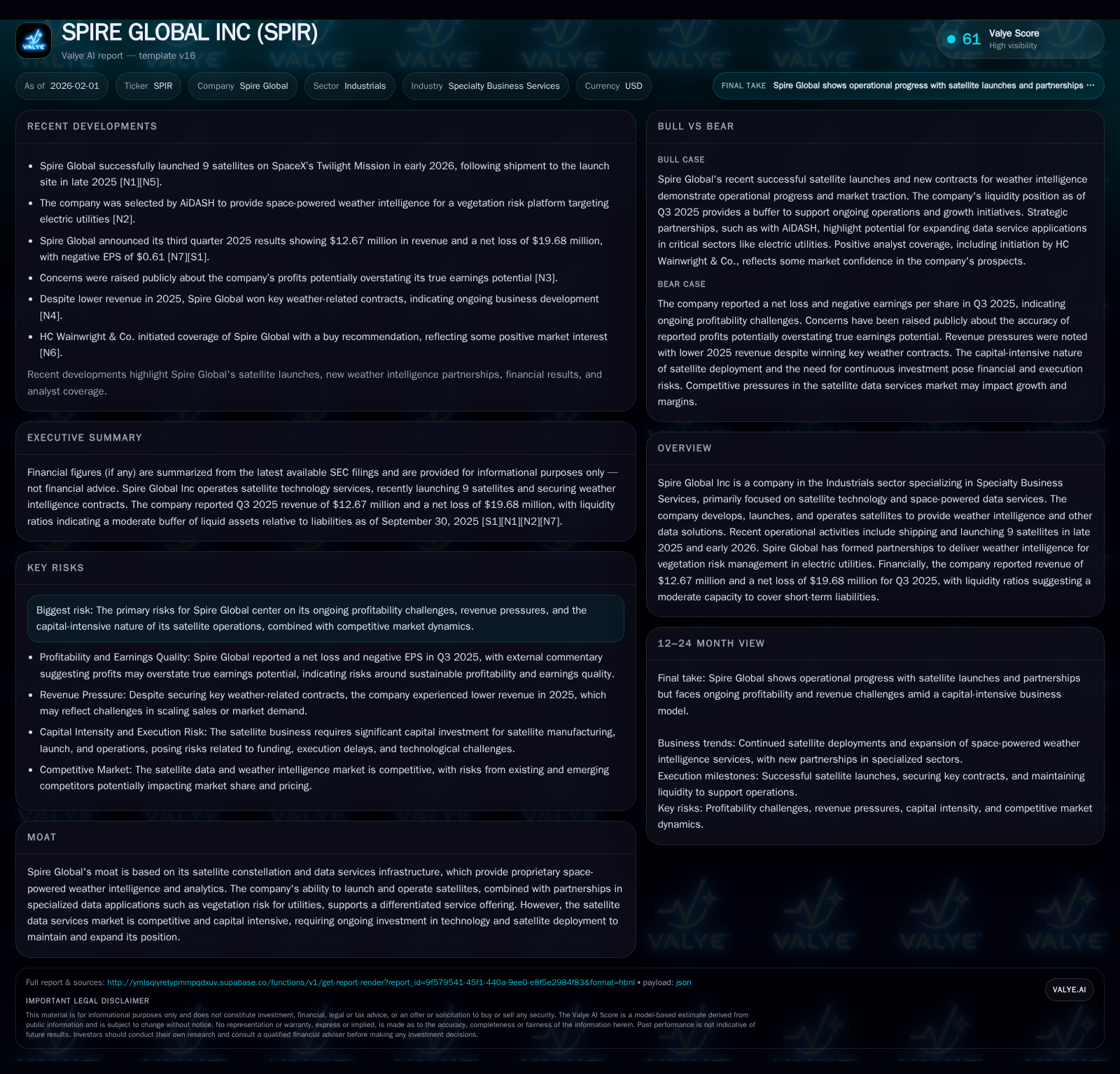
Spire Global is progressing operationally with recent satellite launches and strategic partnerships that enhance its specialized weather intelligence offerings. However, financial results reveal ongoing losses and modest revenue growth, highlighting the capital-intensive nature of satellite operations. The company’s competitive positioning relies on its growing constellation and proprietary data analytics, but sustaining differentiation requires continued investment and innovation amid a crowded market. Key risks include profitability challenges, market competition, and the need for efficient capital deployment.
What Changed Recently
Spire Global has made significant operational strides by shipping nine satellites to the launch site in late 2025 and successfully deploying them on a SpaceX mission in early 2026. This incremental increase in its satellite constellation is a critical step toward enhancing its earth observation and weather intelligence capabilities [N4][N6]. Complementing hardware expansion, the company announced a strategic partnership with AiDASH to integrate space-powered weather data into vegetation risk management platforms tailored for electric utilities. This highlights a deliberate move to deepen vertical-specific applications and embed its data services into high-value industrial workflows [N7].
Despite these operational advances, financial results for Q3 2025 showed revenue of $12.67 million against a net loss of $19.68 million, underscoring ongoing challenges in scaling the business profitably. Commentary in recent analysis points to Spire’s revenue contraction relative to expectations, and scrutiny over earnings quality, suggesting that headline profitability metrics may not fully capture underlying financial health [N1][N2][N3]. Liquidity measures from the latest SEC disclosures reveal a current ratio of approximately 1.9 with $20.3 million in cash and equivalents, indicating moderate capacity to meet near-term liabilities but limited cash runway given capital expenditure needs [S3].
Business Model as a System
Spire Global operates at the intersection of satellite hardware manufacturing, constellation deployment, and data-as-a-service (DaaS) delivery. The core system involves designing, building, and launching a proprietary constellation of small satellites equipped with sensors to collect weather, maritime, and atmospheric data globally. This constellation generates a continuous stream of raw data, which Spire processes through proprietary analytics platforms to produce actionable insights.
Revenue generation primarily derives from selling these insights via subscription models and enterprise contracts to clients in sectors such as shipping, aviation, agriculture, and utilities. For example, the partnership with AiDASH leverages this system by embedding Spire’s weather intelligence into a vegetation risk platform, helping electric utilities manage outage risks proactively. This illustrates a vertical integration approach, where space-based data feeds specialized B2B use cases.
Key operational activities include satellite manufacturing logistics, launch coordination (often via third parties like SpaceX), ground station network management, data processing infrastructure, and ongoing product development to refine analytics capabilities. The business is capital intensive and requires significant upfront investment in satellite deployment, with a lag before monetization from new assets is realized. Maintaining and upgrading the constellation is crucial to preserving data quality and service differentiation.
While the company does not publicly disclose detailed segment revenue or customer concentration, its SEC filings acknowledge risk factors related to rapid technological change, reliance on launch providers, and competitive intensity, emphasizing the fragile balance between growth and operational execution [S3].
Industry Map & Competitive Battlefield
The satellite data services industry is characterized by a diverse competitive landscape including legacy aerospace firms, emerging NewSpace companies, and data analytics startups. Competitors range from large satellite operators offering broad earth observation data to niche players specializing in weather intelligence or maritime tracking.
Spire’s competitive moat is centered on its proprietary constellation, which supports differentiated data products, and its ability to integrate satellite data with vertical software platforms. This positions it uniquely compared to pure-play analytics firms that lack direct data ownership. However, the market is highly capital intensive with substantial barriers to entry in satellite deployment but relatively low barriers in analytics software, inviting competition from cloud-native and AI-driven alternatives.
Customer needs are increasingly sophisticated, demanding high-accuracy, real-time data streams and actionable insights tailored to industry-specific workflows. Spire’s strategic partnerships in utilities and shipping align with this trend, aiming to increase customer stickiness and create multi-year subscription revenue. Yet, established aerospace players and new entrants with deeper pockets or broader datasets represent ongoing competitive threats.
The regulatory environment, dependence on launch providers, and satellite congestion risks also shape the competitive dynamics. Efficient constellation management and innovation in sensor technology will be critical for Spire to maintain relevance.
Where the Economics Become Real
Unit economics in Spire’s business are driven by the capital and operational costs of building and maintaining the satellite constellation balanced against subscription revenue per customer and customer lifetime value. The fixed costs include satellite manufacturing, launch fees, ground stations, and R&D, while variable costs relate to data processing and customer support.
The recent addition of nine satellites expands capacity to collect and monetize data but also raises near-term depreciation and operational costs. The time lag between satellite launch and revenue recognition for new data services can strain cash flows. Achieving scale to spread fixed costs over a growing subscriber base is essential for margin improvement.
Revenue per customer depends on the sophistication of the data product and the vertical market served; specialized applications like vegetation risk management may command premium pricing but require longer sales cycles and integration efforts. Customer acquisition costs and retention rates will materially affect the long-term unit economics.
Liquidity constraints limit the company’s ability to rapidly expand the constellation or invest heavily in marketing, potentially slowing growth. The net losses reported reflect the ongoing investment phase typical of satellite data firms but highlight the challenge of transitioning to sustainable profitability.
Diligence Questions / Disconfirming Signals
- What is the ramp-up timeline from satellite launch to meaningful revenue contribution, and how consistent has this been historically?
- How diversified is the customer base, and what are retention and churn rates across key verticals?
- To what extent do recent partnerships like AiDASH translate into contracted revenue versus pilot or proof-of-concept engagements?
- Are there any delays or operational risks related to satellite manufacturing or launch schedules that could impact capacity growth?
- How does Spire’s pricing compare to competitors offering similar data services, and what is its pricing power in key segments?
- What is the trajectory of gross margins as scale increases, and what are the main cost levers for improvement?
- Are there any signs of customer concentration risk or dependence on a limited number of large contracts?
- How vulnerable is the satellite constellation to space weather, collision risk, or regulatory changes?
- What are the company’s plans for next-generation satellites or sensor upgrades to maintain technological edge?
Conclusion
Spire Global sits at a complex intersection of space-based hardware and data services, with recent operational milestones underscoring its growth trajectory. The strategic focus on vertical-specific applications and partnerships indicates a maturing go-to-market approach. However, the financial snapshot reveals a company still grappling with the capital intensity and competitive pressures inherent in satellite data services. Sustained investment, customer diversification, and margin expansion remain critical challenges. Monitoring satellite deployment execution, revenue ramp, and partnership monetization will be key to understanding Spire’s evolving position in this dynamic industry.
This report is based on publicly available information as of early 2026 and does not constitute investment advice. All financial figures are sourced from company disclosures and industry news. The analysis reflects current understanding and may evolve as new data emerges.
Disclaimer: This is research-only, informational analysis and not investment advice. It may include AI-generated interpretation and general industry context. Always verify important details using primary sources.

Comments