
Spruce Power Struggles with Leadership Shifts and Liquidity Weakness in Renewable Solar Assets
Recent executive turnover and liquidity pressures challenge Spruce Power’s ability to capitalize on its residential solar contracts.
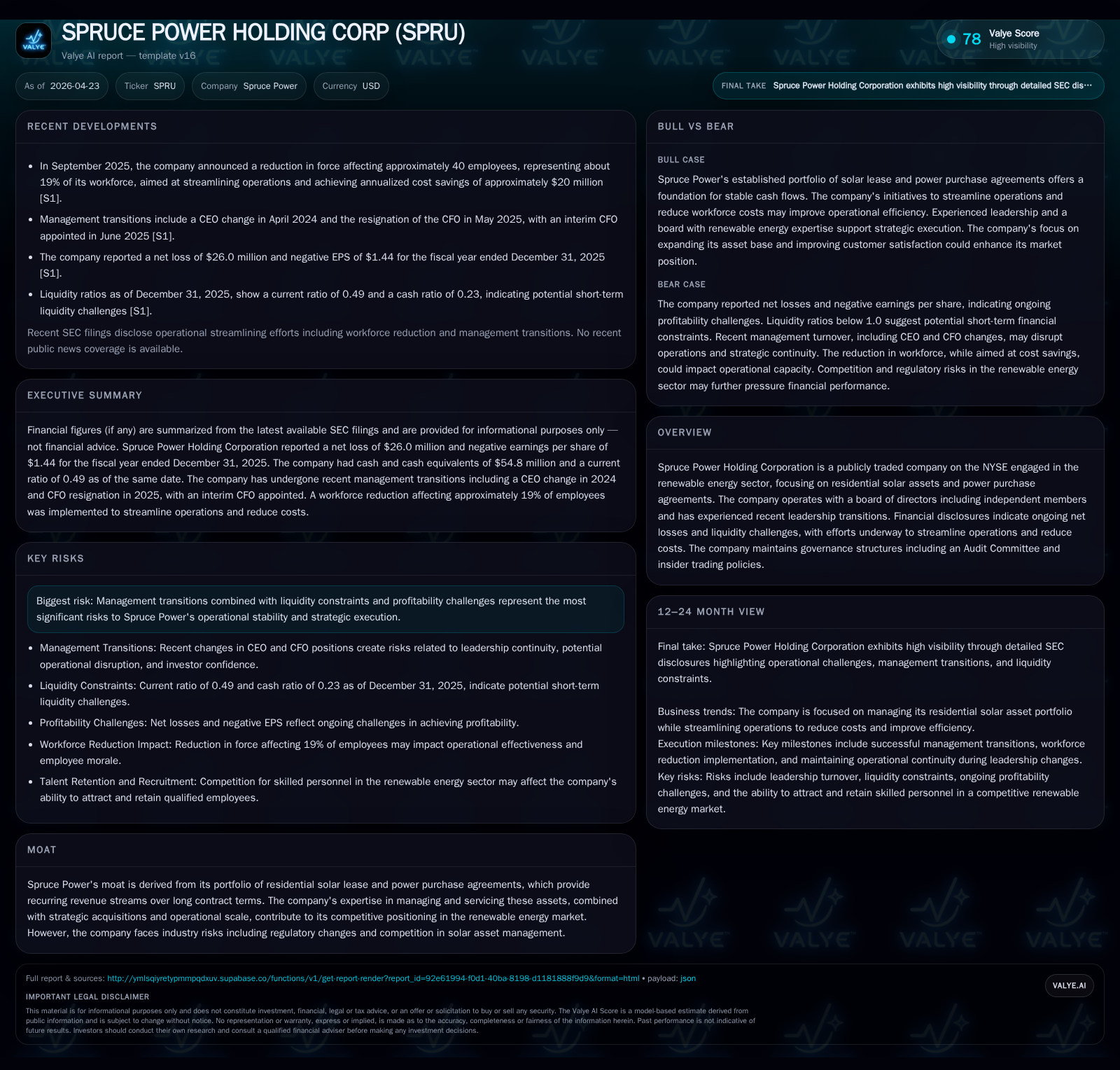
Spruce Power Holding Corporation faces operational headwinds marked by ongoing senior management transitions, particularly in its CFO role, and a strained liquidity position with a sub-1 current ratio. The company’s business model relies on long-term residential solar lease and power purchase agreements that generate recurring revenue streams, but it remains pressured by net losses and cash flow constraints. Competitive pressures in solar asset management and regulatory risks further complicate growth prospects. Key upcoming milestones include securing permanent CFO leadership and successful execution of cost-control initiatives.
Recent Operating Update: Leadership and Timing Challenges
The company’s latest quarterly report dated November 13, 2025 [S2] reveals persistent senior management turnover that has clouded operational stability. Since the CEO transition completed in April 2024, Spruce Power experienced the resignation of its CFO effective May 14, 2025, followed by the appointment of Thomas James Cimino as Interim CFO starting June 5, 2025 [S2][S24]. While Mr. Cimino was confirmed as full-time CFO by December 1, 2025 [S24], uncertainties remain regarding leadership continuity as the company continues actively searching for an ideal long-term fit.
Governance dynamics also add complexity; an April 3, 2026 event filing [S3] details the company granting further extensions to shareholder proposal submission deadlines ahead of the 2026 annual meeting. These procedural delays suggest active engagement but also underscore tensions around strategic direction amidst shareholder scrutiny.
Such executive churn diverts focus from managing day-to-day operations and could impair confidence among investors and customers. The risk is explicitly noted in recent filings highlighting potential material adverse effects on business operations stemming from these leadership transitions [S2][S14].
Business Model and Asset-Based Revenue Streams
Spruce Power’s core business involves ownership and management of a portfolio of residential solar assets primarily under long-term power purchase agreements (PPAs) and leases [S1]. These contracts typically span multiple years, generating recurring revenue streams from customers’ electric payment flows.
The company’s competitive moat is tied to scale in portfolio size—ownership of thousands of contracts spreads fixed servicing costs—and its expertise in collections, customer service, and technical maintenance enabling stable adjusted gross collections [S1][S6]. Overhead expenses relate mainly to portfolio servicing rather than capital-intensive operations; accordingly, capital expenditure requirements are modest relative to asset base ($221K in FY2025 per [F1]).
This asset-light but management-intensive model supports operating income generation ($17.9M in FY2025) even while net losses persist due to interest expense on sizable debt load and non-cash charges [F1]. The strategy focuses on maintaining contract performance metrics such as customer satisfaction ratings alongside technology platform upgrades to improve operational resilience over time [S6].
Competitive Dynamics in Residential Solar Power Contracts
The residential solar asset industry is marked by fragmented competition spanning pure-play asset owners like Spruce Power to vertically integrated installers offering bundled solutions. Regulatory environments materially influence economics through tax incentives, contract enforceability rules, and grid interconnection policies.
Spruce's positioning depends on executing efficient portfolio technology build-outs and minimizing churn via contractual lock-ins and switching costs inherent in PPAs [S1]. However, margins remain tight as financing costs, regulatory compliance expenses, and competitive pressure to offer attractive pricing challenge profitability.
Switching costs are meaningful but not impermeable; customers can buy out or prepay contracts early [S6], which adds variability to cash flows. Contractual scale allows Spruce some leverage over servicing costs but does require continual reinvestment in collection processes and customer engagement aimed at sustaining adjusted gross collections throughout the lifecycle.
Growth Opportunities Balanced Against Structural Risks
Spruce Power targets growth through incremental additions to owned systems/contracts—a key corporate performance measure includes scaling systems owned to upwards of 90,000 units by stretch targets within the strategic plan [S1]. Acquisitions or secondary market purchases supplement organic expansion.
However, these ambitions confront several constraints: pricing volatility for energy offset benefits affects customer renewal incentives; regulatory shifts could alter contract structures or tax credit availability; liquidity limitations inhibit aggressive capital deployment; leadership instability raises doubts about strategic consistency [S1][S2][F1].
Cost control efforts are underway following a September 24, 2025 workforce reduction impacting around 40 employees (~19% of workforce), aiming for annualized savings near $20 million [S16]. These measures highlight the imperative to recalibrate operational efficiency amid revenue pressures.
Risks stemming from continued management turnover compound these challenges since retention difficulties could disrupt execution timelines or increase employee attrition beyond targeted cuts [S2][S14].
Key Indicators to Monitor for Strategic Execution
Investors should closely track milestones linked to leadership stabilization—particularly any developments related to filling or extending the interim CFO role—and the company's ability to execute shareholder governance processes by the April 30, 2026 deadline for proposals [S3]. These events will signal organizational coherence or fragility.
Operational KPIs including adjusted gross collections performance across the PPA lease portfolio, customer care satisfaction scores, contract buyout/prepayment rates, and technological platform enhancements remain critical barometers for measuring business health given their direct impact on recurring revenue predictability [S6].
Progress against cost reduction targets post workforce trimming is another tangible metric influencing margin recovery prospects. Delays or shortfalls here could exacerbate liquidity constraints already evident from balance sheet indicators.
Financial Position and Cash Flow Constraints
At fiscal year-end December 31, 2025—as per companyfacts data—the firm held approximately $54.8 million in cash equivalents against total debt nearing $695.5 million; net debt thus stands around $640.7 million reflecting significant leverage burdening financial flexibility [F1]. Operating income showed recovery with $17.9 million earned in FY2025 after multiyear losses ranging between -$50 million to -$60 million but was insufficient to offset financing costs leading to a net loss of $26 million last year [F1]. Operating cash flow remained negative at nearly -$3.5 million while capital expenditures were contained at $221K signaling minimal reinvestment requirements within existing portfolio upkeep levels.
The negative free cash flow (-$3.75 million) coupled with sizeable debt implies tight liquidity requiring careful management of working capital cycles and possible refinancing activity if market conditions deteriorate or strategic initiatives require funding beyond internal resources.
Historical performance (annual)
| FY | Net ($mm) | CFO ($mm) | OpInc ($mm) | Capex ($) | Net YoY |
|---|---|---|---|---|---|
| 2025 | -26 | -4 | 18 | 221000 | +63.1% |
| 2024 | -70 | -42 | -50 | 354000 | -7.1% |
| 2023 | -66 | -34 | -37 | 499000 | +29.9% |
| 2022 | -94 | -60 |
Source: SEC companyfacts cache [F1].
Capital returns and efficiency (annual)
| FY | FCF ($mm) |
|---|---|
| 2025 | -4 |
| 2024 | -42 |
| 2023 | -34 |
| 2022 |
Source: SEC companyfacts cache [F1].
Note: Latest revenue data post-2022 is unavailable in provided tags.
Overall, the financial snapshot warrants caution given sustained net losses despite recent operating improvements coupled with significant leverage constraining runway for expansion without bolstering liquidity or improving profitability trajectories substantially.
This analysis aims solely to assess recent operational developments alongside structural business features without offering investment recommendations or price forecasts.
Disclaimer: This is research-only, informational analysis and not investment advice. It may include AI-generated interpretation and general industry context. Always verify important details using primary sources.

Comments