
SunPower Inc's Strategic Pivot with Monolith Panels Amid Solar Market Challenges
SunPower advances its solar technology portfolio and market presence through strategic partnerships and product innovation while navigating profitability and liquidity pressures.
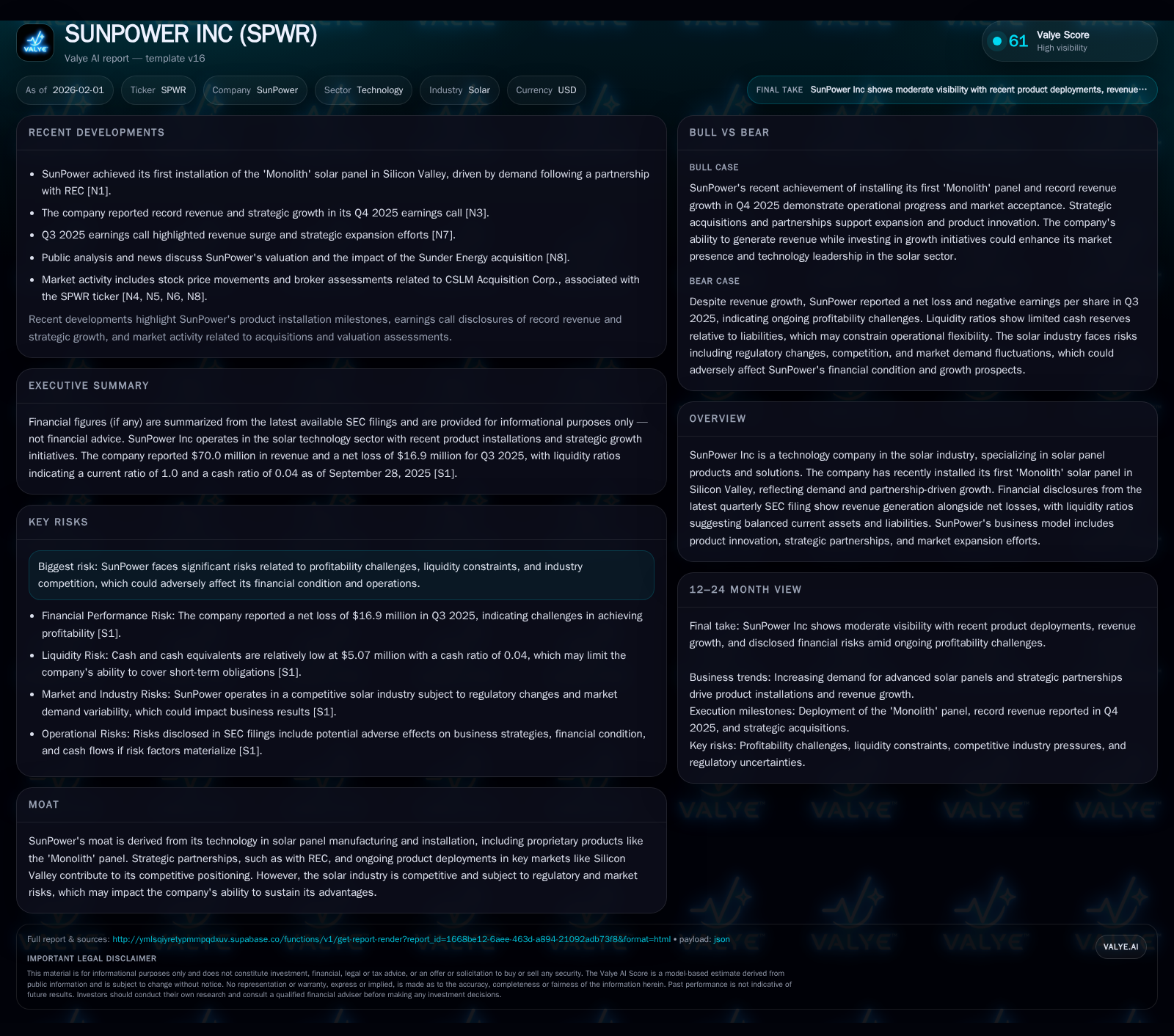
SunPower Inc recently installed its first Monolith solar panel in Silicon Valley, underscoring demand growth and the impact of its partnership with REC. Despite record revenues reported in recent quarters, the company continues to grapple with net losses and a razor-thin liquidity buffer. SunPower's business model hinges on proprietary solar technology, strategic alliances, and expanding installation footprints, yet faces significant competitive and regulatory headwinds. The sustainability of its growth depends on operational execution, cost management, and market dynamics within the evolving solar industry.
What Changed Recently
SunPower has marked a notable milestone with the installation of its first Monolith solar panel in Silicon Valley, a technology touted for higher efficiency and durability developed in cooperation with REC. This deployment follows strategic collaboration announced earlier, aiming to capture premium market segments and deepen foothold in key geographic areas [N4]. Concurrently, SunPower reported record revenues in Q3 and Q4 of 2025, reflecting successful commercial traction and expanded project pipelines [N1][N2][N3]. However, the company continues to report net losses and maintains a current ratio hovering around 1, indicating near parity between current assets and liabilities, underscoring ongoing liquidity concerns [S1].
These developments illustrate SunPower's transition from technology development to commercial scale deployment, with a sharpened focus on strategic partnerships to bolster market presence and product validation. The Monolith panel launch is emblematic of this shift, aiming to differentiate SunPower's offering in a commoditized and competitive solar panel market.
Business Model as a System
SunPower operates as an integrated solar technology company, designing, manufacturing, and installing high-efficiency solar panels and energy solutions. Its product portfolio centers on proprietary solar modules, including the recently introduced Monolith panel, which leverages advanced materials and manufacturing processes to improve energy yield and reliability. This vertical integration allows some control over quality and innovation but introduces complexity and capital intensity.
Revenue streams are primarily derived from the sale and installation of solar panels and systems to residential, commercial, and utility-scale customers. Service offerings may include system design, maintenance, and financing solutions, although specific service components are not detailed in public filings. The company's go-to-market strategy heavily depends on strategic partnerships—most notably with REC—which provide access to complementary technologies, distribution channels, and market opportunities [N4].
Operationally, SunPower must manage supply chain logistics for raw materials and components, maintain production capacity aligned with demand, and coordinate installation services across diverse geographies. The incentive structure aligns product innovation with scaling deployments to improve unit economics over time. However, sustaining this system requires balancing R&D expenditure, capital investment in manufacturing, and sales and marketing costs against fluctuating market demand and pricing pressures.
Industry Map & Competitive Battlefield
The solar industry is characterized by rapid technological innovation, commoditization of standard modules, and intensifying price competition. Key competitors include vertically integrated incumbents, specialized panel manufacturers, and new entrants focused on cost leadership or niche technologies. Market dynamics are heavily influenced by governmental policies, subsidies, and regulatory frameworks promoting renewable energy adoption.
SunPower distinguishes itself through proprietary technology such as the Monolith panel and strategic alliances, which aim to create a technological moat in panel efficiency and durability. Nonetheless, competitors often operate at larger scales with lower cost structures, pressuring margins. The industry also faces supply chain challenges for polysilicon, wafers, and other components, which can constrain output and increase costs.
The competitive landscape includes firms vertically integrating downstream services such as installation and financing, creating end-to-end solutions for customers. SunPower's partnerships may serve to bridge gaps in these capabilities, but dependency on external entities introduces execution risk. Market growth is robust in regions with supportive policies, though the uneven global regulatory environment can create demand volatility.
Where the Economics Become Real
SunPower’s unit economics hinge on the cost of manufacturing panels, installation expenses, and the price realization per watt of capacity sold. While proprietary products like Monolith may command premium pricing, cost containment remains critical to moving toward profitability. Reported net losses suggest that current margins are insufficient to cover fixed costs and investment in innovation.
The near 1:1 current ratio indicates limited liquidity buffer, raising concerns about the company's ability to absorb shocks or invest aggressively without external financing. Cash and equivalents stand at approximately $5.1 million against current liabilities of roughly $115.1 million, reflecting tight working capital management [S1].
Operational bottlenecks include securing raw materials amid global supply constraints and scaling new technology manufacturing without quality or yield losses. Installation services require logistical coordination and skilled labor, which can be cost-intensive. Profitability is sensitive to pricing competition, tariff impacts, and shifts in subsidy regimes.
Margins are also affected by sales and marketing efforts to grow market share amid commoditization, necessitating sustained investment. Over time, economies of scale, improved manufacturing efficiencies, and technology maturation may drive cost reductions and margin expansion.
Diligence Questions / Disconfirming Signals
Key areas for further scrutiny include the scalability of the Monolith panel technology and its adoption rate beyond initial installations. Questions remain about how quickly SunPower can transition from pilot deployments to volume production while controlling costs.
The sustainability of revenue growth in the face of ongoing net losses warrants examination, particularly regarding customer concentration, contract structures, and receivables management.
Liquidity constraints pose risks to operational flexibility; it is critical to understand SunPower's access to capital markets or alternative financing to bridge cash flow gaps.
Strategic partnerships, while beneficial, may introduce dependencies that could impair agility if partner priorities shift or if integration challenges arise.
Competitive responses—especially price undercutting or technological advances from rivals—could erode SunPower’s differentiation and market share.
Regulatory shifts, such as changes in tax credits or import tariffs, could materially impact project economics and demand volatility.
Lastly, supply chain resilience and raw material cost volatility remain potential bottlenecks affecting production schedules and margin stability.
This analysis is based on publicly available information as of early 2026 and does not constitute investment advice. It reflects current observable facts and industry context but is subject to change with market developments and company disclosures.
Disclaimer: This is research-only, informational analysis and not investment advice. It may include AI-generated interpretation and general industry context. Always verify important details using primary sources.

Comments