
Presidio Property Trust Faces Refinancing Pressures While Managing Portfolio Optimization
The company's latest quarterly report reveals refinancing challenges that intersect with its specialized commercial and model home property strategy, impacting near-term financial flexibility.
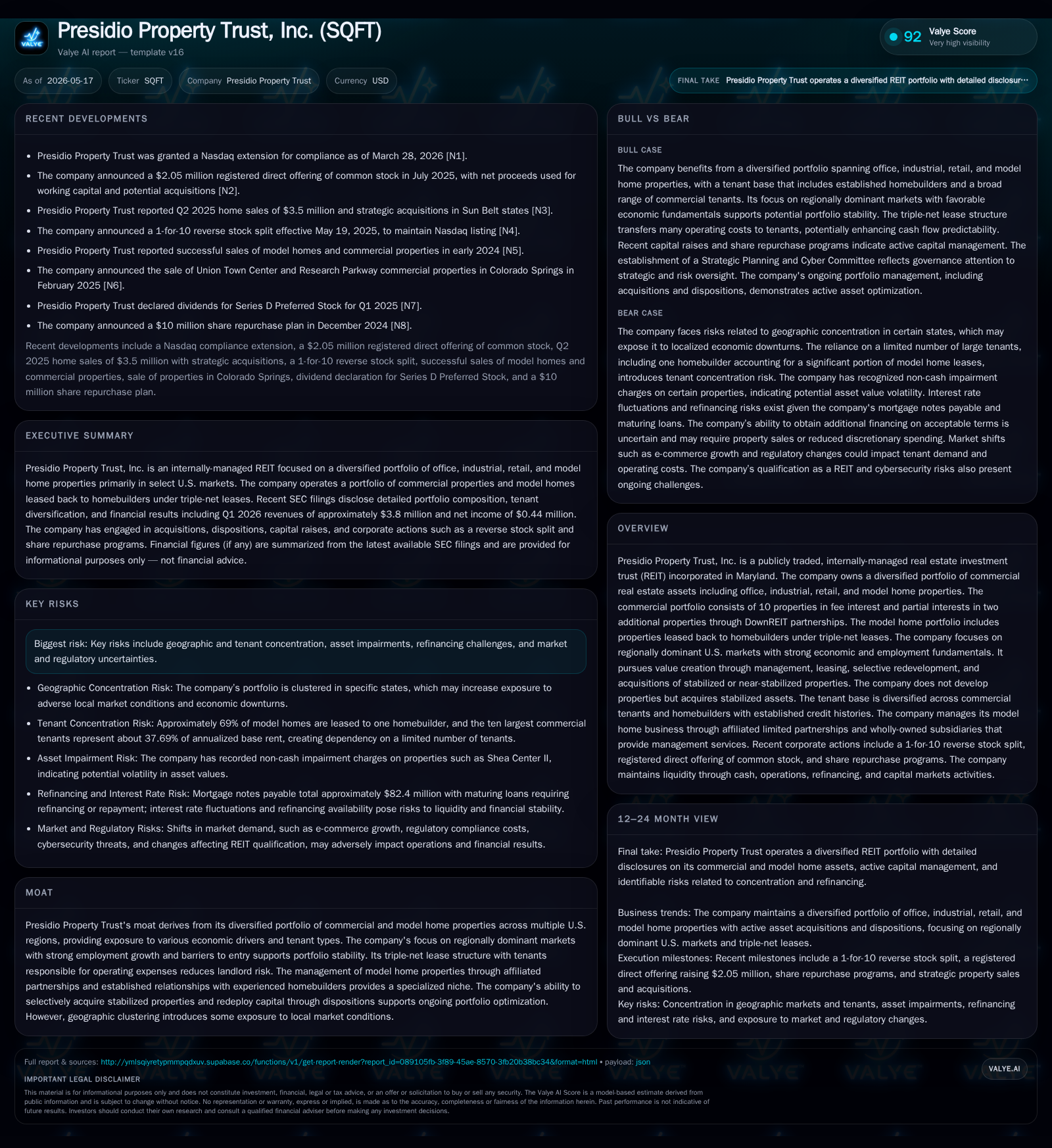
Presidio Property Trust, an internally managed REIT focused on diversified commercial and model home real estate assets, disclosed a default notice related to its Shea Center II mortgage loan in early 2026, introducing material refinancing uncertainty. Despite this, the company continues optimizing its portfolio through selective acquisitions and dispositions, including the sale of Dakota Center, aiming to enhance operating cash flow. The triple-net lease structure with tenants shifts inflation and operating cost risks away from the landlord, supporting stable revenues amid sector headwinds. Going forward, Presidio’s growth hinges on successful refinancing, leasing renewals, and capital recycling in a constrained financing environment.
Latest Operating Developments: Refinancing Default Implications
Presidio Property Trust’s most pressing near-term development surfaced in January 2026 when Wells Fargo Bank issued a default notice concerning the $17.7 million promissory note linked to the Shea Center II property loan [S2]. This default arose from failure to repay by the maturity date of January 5, 2026. The consequence was the initiation of receivership over that asset — effectively removing control from Presidio while settling the non-recourse obligation. This event sharply constrains liquidity and capital flexibility in the immediate term because no assurance exists that additional financing will be available on acceptable terms to support operations or refinance existing debt [S2][S13]. The company signaled intentions to closely monitor accrued dividends on its Series D Preferred Stock on a quarterly basis in light of these pressures and paused dividend payments accordingly [S2].
To partially alleviate financial stress, Presidio completed the sale of Dakota Center on January 14, 2026 for roughly $4.7 million net proceeds. This transaction generated a net gain of $3.4 million and reduced property-level debt exposure since the related non-recourse mortgage was settled with those proceeds [S2][S20]. Despite these liquidity maneuvers, management disclosed ongoing negotiations with lenders aimed at restructuring or refinancing other maturing loans to prevent further losses or forced sales [S19]. These repayment hurdles substantially limit near-term discretionary spending on acquisitions or capital projects.
Business Model Overview: Diversified Real Estate Focus and Lease Structures
Presidio operates as an internally managed REIT owning a diversified portfolio primarily composed of fee interest in offices, industrial sites, retail spaces alongside a distinctive segment of residential "model home" properties leased back to homebuilders under triple-net arrangements [S1]. As of recent disclosures, the company holds ten commercial properties comprising seven office buildings and one industrial asset totaling approximately 639k rentable square feet concentrated across Colorado, North Dakota, California, Maryland, and Texas [S1]. In addition to these fee interests, proprietary stakes exist in two further commercial assets through DownREIT partnerships that provide put/call options converting partnership interests into common stock within specified timelines.
A critical feature anchoring Presidio's business model is its triple-net lease structure especially prevalent among model home properties — where tenants assume responsibility for all property-related expenses such as taxes, insurance, and maintenance costs. This arrangement effectively transfers inflationary risks tied to operating cost increases onto tenants while providing Presidio more predictable rental income streams insulated against direct operational cost volatility [S1]. Although this reduces landlord risk exposure materially, it introduces sensitivity to tenants’ own economic health as sharp upticks in expenses beyond revenue growth could impair their capacity to meet rent obligations.
The model homes portfolio extends over four states—predominantly Texas (approximately 86% of model home sq ft) with ancillary holdings in Alabama, Arizona, and Tennessee—and includes around eighty residences leased mostly (69%) to one primary homebuilder partner under triple-net agreements facilitating steady income flow but concentrated counterparty risk [S1]
Industry Positioning: Portfolio Niche and Competitor Benchmarks
Within the broader REIT landscape that commonly differentiates along multi-tenant diversified holdings versus single-tenant specialized leases sectors, Presidio's hybrid focus straddles both paradigms by maintaining a multi-tenant commercial base supplemented by its sizable modeled-home triple-net niche [S1]. The average remaining lease term on its commercial properties spans roughly three years—a cadence typical of office/industrial REITs balancing renewals against market re-leasing risk—while tenant diversification limits reliance on any individual lessee (top tenant contribution at under 7% of annual base rent) although top ten tenants aggregate near 38%, reflecting moderate concentration risk [S1].
Geographically, the firm’s footprint centers on five core U.S. states rather than widespread national dispersion—this regional clustering affords operational focus but subjects portfolio performance somewhat more heavily to local economic cycles and regulatory environments than more broadly spread peers occupying national gateway markets. This exposure carries potential volatility particularly tied to employment trends within those dominant metro areas servicing their tenant base.
The combined positioning yields certain strategic advantages: steady income streams cushioned by triple-net lease pass-throughs mitigating landlord operating expense risk; paired with regional economic fundamentals encompassing office demand drivers plus housing construction activity influencing model home lease utilization dynamics. However inherent trade-offs persist regarding tenant concentration within model homes (single large builder) and refinancing dependencies given size thresholds limiting scale economies relative to larger institutional REIT mandates.
Growth Prospects: Asset Redevelopment and Selective Acquisitions
Management articulates capital deployment centered on enhancing portfolio quality through acquisition of stabilized or near-stabilized commercial real estate assets while eschewing ground-up development which often entails speculative execution risk [S1]. Value creation occurs primarily via active leasing management—including renewals aimed at preserving occupancy rates—and selective redevelopment initiatives targeting underperforming assets that may yield improved cash flow potential.
Recent disposition activity includes selling Dakota Center which both improves cash flow metrics by exiting an asset exerting negative or breakeven cash performance last year while consolidating scale around higher-return opportunities [S6][S20]. Such recycling of capital aligns with disciplined financial stewardship necessary amidst refinancing constraints highlighted earlier.
Acquisition pace reflected slowdown with no new purchases during Q1 2026 contrasting prior periods where moderate additions principally involved acquiring model homes financed partially through mortgage notes underpinning steady rental income generation [S20]. Future growth catalysis depends substantially upon unlocking fresh liquidity either through successful loan refinancings or accretive asset sales enabling reinvestment into higher yielding holdings.
While abstaining from development limits upside leverage from new supply-demand mismatches favoring landlords amid tight commercial real estate inventories generally observed elsewhere in the sector (analysis), it reduces exposure to project completion delays or cost inflation shocks—a conservative posture appropriate under current credit market uncertainties.
Risk Factors: Refinancing Constraints and Tenant Concentration
Key risks crystallize prominently around refinancing challenges following the Shea Center II loan maturity default evidenced in early 2026; without timely extensions or capital injections managing upcoming debt maturities grows increasingly onerous [S2][S19][F1]. Cash flow adequacy remains vulnerable if operating receipts falter or forced distress sales emerge under duress.
Tenant risk concentrated unusually within model home properties due to heavy reliance (69%) on a single builder counterpart imposes business cycle sensitivity tied to new home construction demand—a sector historically cyclical with susceptibility toward macroeconomic headwinds such as rising interest rates or supply chain disruptions impacting housing starts volumes (analysis).
Geographic concentration risk is another material watchpoint stemming from predominance within five U.S. states conferring potential negative impacts from localized economic downturns or adverse regulatory developments disproportionate relative to more nationally diversified portfolios.
Dividend payment flexibility has diminished as Board decisions delay Series D Preferred Stock dividends suspension reflecting prudent cash conservation measures; accruals remain off-balance sheet but impact earnings per share calculations potentially dilutive in stressed conditions [S2][S13].Overall operating results also face risk from inflationary pressure cascading through tenants’ expenses potentially impeding rent collection despite triple-net leases shielding landlord directly.[S1]
Monitoring Indicators: Dividends, Lease Renewals, and Capital Access
Critical developments warranting close attention comprise timing and extent of preferred dividend reinstatements signaling Board’s confidence level regarding liquidity improvements alongside transparency on ongoing negotiation progress toward refinancings or restructurings leveraging creditor engagement frameworks presented commercially hazardous by current market conditions for mid-sized REIT credits [S13][S2]
Lease renewal success rates reflect core revenue stability prospects given average remaining lease duration near three years; heightened tenant attrition could foreshadow cascading income drops prompting accelerated repositioning efforts.
Asset disposition pace coupled with acquisition pipeline evolution serves as barometers toward maintaining portfolio scale while adjusting composition toward higher performing segments within operational tolerance bands amid limited external capital availability.
Quarterly updates will likely incorporate updated guidance related to funding availability assumptions tightening relative discretionary expenditure caps across leasing commissions, tenant improvements budgets renewing stakeholder visibility about underlying fundamentals.
Financial Health Snapshot: Debt Profile and Liquidity Status
As of March 31, 2026 quarter end reported total debt approximated $82.4 million comprising $58.5 million fixed-rate mortgage notes secured against seven commercial properties excluding debt-free assets like 300 N.P., reflecting weighted average interest rates circa 5.78% aligning with mid-market REIT borrowing spreads last reported period respectively [S2][F1]
Principal repayments continued including a modest $7.7 million paydown over Q1 reducing outstanding balances despite maturity disruptions surrounding Shea Center II now transitioned into receivership absolving company responsibility yet tightening overall leverage ratios concomitant with unavoidable asset disposals.[S2] Cash & equivalents stood around $5.2 million providing cushion albeit thin relative short-term obligations amid uncertain capital market reception jeopardizing refreshed financing avenues.[S9] No other major loans mature through next twelvemonth horizon besides expiring model home notes anticipated refinanced or retired via planned sales illustrating staggered liability structures yet reinforcing dependency on capital markets accessibility under current regime constraints. Current leverage versus estimated market value runs around 72% for commercial properties while model home pledged mortgages stand close to 55%, emphasizing balance sheet gearing profiles necessitating vigilant debt service management amid volatile external funding climate.
Disclaimer: This is research-only, informational analysis and not investment advice. It may include AI-generated interpretation and general industry context. Always verify important details using primary sources.

Comments