
Strata Critical Medical’s Shift to Integrated Organ Logistics and Clinical Services Accelerates Profit Turnaround
Strata Critical Medical leverages an asset-light model and clinical acquisitions to refocus on organ transplant logistics and services.
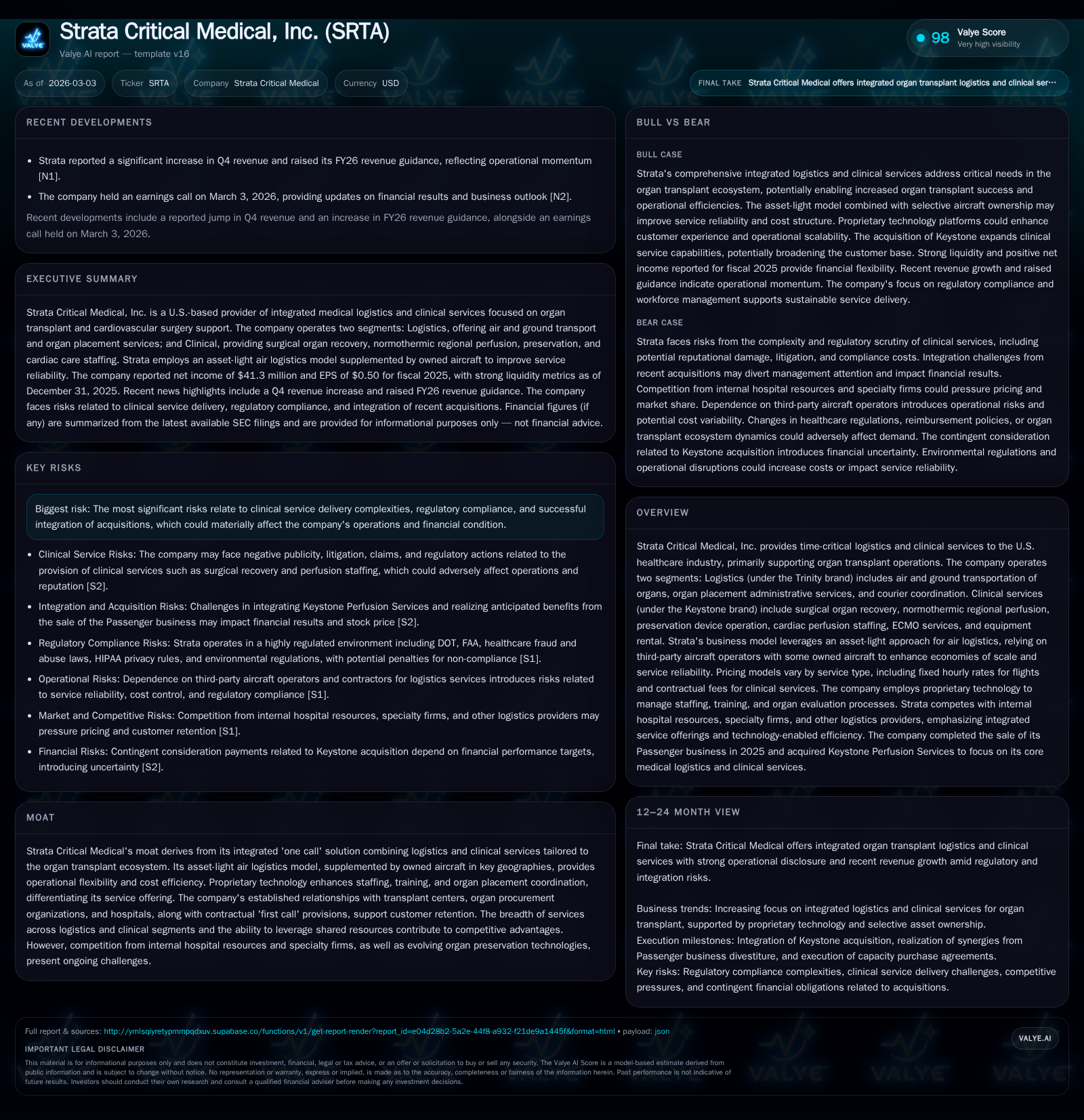
Strata Critical Medical, formerly Blade Air Mobility, exited its passenger business in 2025 to concentrate exclusively on time-critical logistics and medical services for the U.S. transplant ecosystem. Operating two segments—Logistics under Trinity and Clinical under Keystone—the company offers an integrated 'one call' solution combining air and ground transport with surgical organ recovery and perfusion technologies. Despite ongoing operating losses, Strata reported a net income of $41.3 million in FY2025 driven by revenue growth and operational efficiencies following its strategic pivot. The asset-light model supplemented by owned aircraft enhances cost control, while proprietary technology and established customer contracts create competitive moats. Key risks include regulatory compliance, clinical complexity, and integration execution.
Company Background and Strategic Refocus
Strata Critical Medical, Inc., formerly Blade Air Mobility, has strategically pivoted from urban air mobility to focus on specialized services within the U.S. transplant ecosystem [S1][S21]. The company divested its passenger segment in August 2025 to concentrate solely on time-critical logistics and clinical services that support organ transplantation—a sector requiring both operational precision and medical expertise.
Currently, Strata operates two main segments: Logistics under the Trinity brand delivering air and ground transportation of organs, staff, equipment, blood samples, and tissue samples; and Clinical under the Keystone brand providing surgical organ recovery, normothermic regional perfusion (NRP), preservation device operation, among other services [S1][S17][S21]. Customers are healthcare entities including transplant centers, organ procurement organizations (OPOs), hospitals, or related businesses.
Historical Performance Analysis
Strata’s financial performance shows significant improvement in FY2025 amid its transition:
Historical performance (annual)
| FY | Net ($mm) | CFO ($mm) | OpInc ($mm) | Capex ($mm) | Net YoY |
|---|---|---|---|---|---|
| 2025 | 41 | -49 | -22 | 10 | +251.4% |
| 2024 | -27 | -3 | -34 | 31 | +51.3% |
| 2023 | -56 | -32 | -68 | 2 | -105.7% |
| 2022 | -27 | -37 | -54 | 1 |
Source: SEC companyfacts cache [F1].
Capital returns and efficiency (annual)
| FY | Buybacks ($) | FCF ($mm) | ROE% |
|---|---|---|---|
| 2025 | 0 | -59 | 14.8 |
| 2024 | 244000 | -33 | -12.3 |
| 2023 | -34 | -23.9 | |
| 2022 | -38 | -9.9 |
Source: SEC companyfacts cache [F1].
While operating losses persist albeit reduced by over one-third year-over-year in FY2025 compared to FY2024, net income swung positive largely due to non-operating items or other factors reported in filings [F1]. Operating cash flow was significantly negative reflecting operational dynamics including working capital changes or investments in growth initiatives.
Capital expenditures declined sharply from $30.9 million in FY2024 to $9.6 million in FY2025 following prior investments likely related to the legacy passenger business exit and fleet expansion [F1].
Equity increased due to retained earnings alongside potential capital raises or conversion activities supporting balance sheet strength.
Business Model and Competitive Moat
Strata’s core value proposition lies in delivering an integrated “one call” solution combining logistics with specialized clinical services that many competitors cannot match at scale [S4][S17][S21]. The asset-light air logistics model extensively utilizes third-party aircraft operated under fixed hourly rate agreements complemented by roughly ten strategically located owned planes enhancing economies of scale where ownership is preferred or required [S17][S18].
The Trinity brand provides tailored air transport primarily via fixed-wing aircraft dedicated per organ shipment including support materials plus ground transport via a combination of owned vehicles near hubs or third-party providers ensuring broad U.S. coverage.
Keystone’s Clinical segment supports transplantation surgeries through staffed perfusionists and surgeons performing surgical procurement as well as advanced preservation techniques like NRP—which improves donor organ viability—and operation or rental of preservation devices widely used amid sector innovation [S1][S17].
Proprietary technologies underpin coordination tools for staffing management as well as "Trinity Organ Placement Services" (TOPS), streamlining complex matching between donor organs and recipients for improved efficiency [S4][S21]. This breadth across logistics-clinical verticals combined with scalable staffing solutions creates switching costs favoring Strata's integrated offering relative to competitors focused solely on either logistics or medical services.
Industry Landscape and Competition
The organ transplant industry operates within stringent federal frameworks governed chiefly by the National Organ Transplant Act via the Organ Procurement and Transplantation Network overseen by HRSA—regulation extends across OPO performance metrics influencing demand volumes for service providers like Strata [S14]. Competition arises primarily from transplant centers’ internal resources as well as smaller specialty firms focused narrowly on logistics or clinical services individually; some device manufacturers also bundle these offerings challenging parts of Strata’s value proposition [S4].
Strata competes on technical proficiency delivering experienced surgical practitioners with cost competitiveness versus internal hospital teams while leveraging comprehensive service scope to attract customers seeking streamlined processes powered by technology-enabled tracking & scheduling capabilities.
Risks Highlighted in SEC Filings
Risks include operational complexity inherent to surgical recovery and NRP requiring experienced licensed professionals; adverse patient outcomes could lead to litigation or reputational harm potentially affecting client retention [S8][S10]. Cybersecurity oversight is robustly managed given sensitive personal health information handled subject to HIPAA standards—with Board-level governance emphasizing quarterly risk reviews ensuring regulatory compliance amid evolving privacy laws [S1][S19].
Regulatory uncertainties impacting reimbursement policies or allocation procedures across OPTN might influence volume unpredictably. Additionally integrating Keystone successfully post-acquisition remains critical; failure to realize synergies could adversely affect financial results alongside managing costs after legacy passenger business divestiture [S8][N1].
Environmental regulations targeting aviation emissions may increase indirect costs imposed on third-party operators used by Strata's asset-light model which could pressure margins despite contractual protections [S22].
Capital Structure & Liquidity
In January 2026 Strata entered into a $30 million asset-based revolving credit facility secured by JPMorgan Chase Bank with terms allowing up to $20 million incremental capacity subject to conditions providing working capital flexibility for daily operations and investments [S6][S7][S16]. The facility includes customary covenants such as minimum fixed charge coverage ratios triggered under specific conditions.
As of December 31, 2025 the company held $31 million cash & equivalents alongside a strong current ratio above six indicating solid short-term liquidity cushions against operational needs or contingencies [F1][N2]. No share repurchases occurred during FY2025 consistent with prioritizing capital deployment towards growth initiatives rather than shareholder returns currently [F1].
Outlook Considerations
While explicit guidance beyond Q4 commentary lifting full year revenue expectations was not detailed in filings or calls [N1], monitoring organic volume growth within newly consolidated Clinical operations is essential given past integration risks. Core recurring revenue streams driven by “one call” contracts provide stability indicators while adoption rates of advanced preservation devices represent ancillary growth opportunities albeit increasing competitive intensity. Cash flow trajectory improvements will be key to sustaining net income profitability given persistent operating losses suggest continuing margin discipline efforts. Regulatory developments around OPTN policies or OPO certification standards warrant attention due to potential system-wide impacts cascading down to providers such as Strata.
This analysis is based solely on publicly available information cited herein without any investment recommendation. It provides an informed view on Strata Critical Medical’s operational evolution within its specialized healthcare logistics niche.
Disclaimer: This is research-only, informational analysis and not investment advice. It may include AI-generated interpretation and general industry context. Always verify important details using primary sources.

Comments