
SPACSphere Advances Toward Initial Business Combination with $160M Trust Capital
SPACSphere Acquisition Corp. completed its IPO in early 2026 and remains focused on sourcing an attractive business combination within its 15-month timeframe.
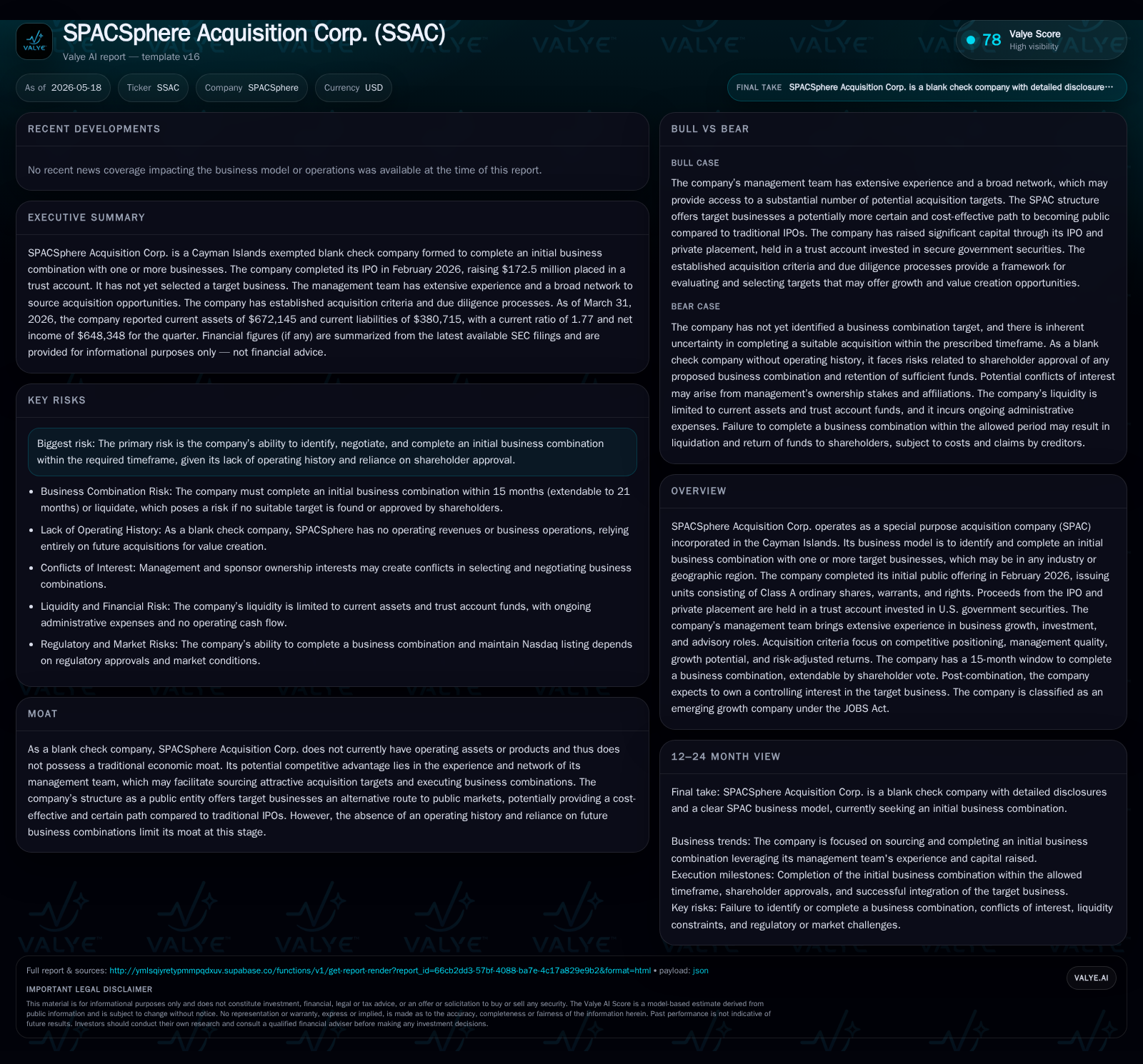
SPACSphere Acquisition Corp., a Cayman Islands-incorporated blank check company, recently filed its first quarterly report since its February 2026 public offering, reporting no operating income but maintaining substantial trust account balances earmarked for acquisition financing. With a management team that brings broad transactional experience and flexible capital deployment options—including equity, debt, or a mix—SPACSphere stands ready to pursue acquisitions without industry or geographic restrictions. However, the company's success hinges on executing its initial business combination within a relatively short window, navigating competition from other SPACs and investor interests amid regulatory and financial structuring complexities.
Recent Operating Update
SPACSphere Acquisition Corp. (SSAC) filed its first quarterly report on May 15, 2026 (Form 10-Q), covering the quarter ended March 31, 2026 [S2]. The filing reaffirms that the company has no operations or generated revenues to date as expected from a blank check company. It holds cash proceeds from its recent initial public offering (IPO) and private placement collectively amounting to over $160 million net of underwriting fees [S9], [F1]. These funds are segregated in a trust account invested predominantly in short-duration U.S. government treasury bills or eligible money market instruments [S9]. The current ratio stands at approximately 1.77 as of quarter-end [F1], reflective mainly of cash versus liabilities related to general administrative expenses.
No material changes have been disclosed since the annual report filing in March 2026 outlining continuing risk factors [S21]. These risks primarily revolve around the company's ability to secure an attractive initial business combination within a mandated timeframe.
Business Model
SSAC is structured as a Cayman Islands exempted special purpose acquisition company formed solely to identify and combine with one or more target businesses across any sector or geography [S1], [S8]. It does not conduct operations independently nor generate operating revenues before the consummation of the acquisition. Its revenue model post-acquisition will depend entirely on the acquired entity’s performance.
The company’s financial strategy revolves around utilizing capital raised through its IPO and private placements held in trust alongside potential new equity or debt financing to consummate its initial business combination. It can pay consideration wholly or partially in cash, shares, debt instruments, or combinations thereof [S1]. The sponsoring investors also arranged a private placement involving founder shares and restricted Class A ordinary shares subject to lock-up agreements expiring post-combination [S9].
The offering units initially included Class A ordinary shares coupled with warrants exercisable at $11.50 per share plus rights convertible into further shares upon merger completion—a structure designed to align investor incentives toward completing the business combination successfully [S1], [S9].
Management dedicates time variably toward deal sourcing, due diligence, structuring transactions, and preparing proxy materials while limiting pre-combination spending tightly to administrative functions [S18].
Industry Structure and Competitive Position
SSAC operates within the highly competitive blank check/ SPAC industry marked by numerous entities seeking to leverage public markets by acquiring private companies quickly relative to traditional IPO processes. The company’s advantage is largely dependent on its management’s experience and network, which it cites as extensive with access to thought leaders and expertise capable of identifying undervalued or high-growth prospects [S11], [S8]. This network spans operators, investors, advisors globally across industries enabling access to proprietary deal flow.
However, the SPAC space also features intense competition from other blank check vehicles with potentially greater capital resources or more specialized industry focuses (e.g., technology-driven SPACs vs. diversified). Additionally, competing private equity groups or strategic buyers may vie for identical targets based on scale or financing flexibility constraints inherent to SSAC’s capital structure [S20].
Financially constrained by available funds within the trust account and necessary cash for shareholder redemptions during transaction approval phases may also limit deal size unless supplemental financing is obtained—which carries typical SPAC debts or equity risk factors impacting post-combination capital structure [S27]
Growth Drivers
Growth for SSAC is not organic but contingent upon successful identification and closing of an initial business combination within the contractual timeframe—the principal growth inflection point.
Several factors underpinning target appeal include:
- Competitive positioning: Prefer targets with defensible market advantages via technology, brand strength, scale economies, talent retention.
- Experienced management: Preference for targets where incoming management teams demonstrate capacity for execution and talent recruitment.
- Inflection point opportunities: Targets exhibiting latent value unlockable through post-merger operational improvements or strategic shifts.
- Unrecognized valuation: Companies undervalued relative to peers presenting potential upside post-acquisition.
- Scalable platforms: Targets engaging sufficiently large markets with expansion potential organically or via add-on acquisitions.
- Risk-adjusted returns: The deal dynamics aim for compelling returns calibrated against inherent risks given investor expectations.
The management's seasoned background positions SSAC well for crafting value creation strategies post-acquisition including governance enhancements or initiating growth initiatives previously untapped by target businesses [S11], [S8].
Risks / Watchpoints / Growth Constraints
Primary risks identified remain consistent with those embedded in all blank check vehicles:
- Execution Risk: Ability to source suitable targets meeting investment criteria within a demanding timeline (15 months subject to extension).
- Liquidity Risk: Though currently well-funded from IPO proceeds held in trust (~$160M net), unforeseen redemptions or expenses could constrain capital available for acquisition consideration.
- Dilution Risk: New share issuances during acquisition funding could significantly dilute existing investors; additionally outstanding warrants and rights present dilution considerations affecting shareholder value perceptions [S10].
- Competitive Pressure: Rival SPACs or strategic buyers with superior capital resources may outbid SSAC on desirable targets.
- Regulatory Factors: Complexities associated with required financial disclosures and ongoing compliance obligations may limit potential targets capable of meeting SEC requirements timely post-merger disclosures [S6].
- Sponsor Indemnity Limitation: In event claims diminish trust assets below prescribed thresholds requiring sponsor indemnification; although coverage exists, enforceability depends on sponsor capacity posing contingent liability concerns [S18], [S20].
- Lack of Operational History: Present absence of revenues or operations until after business combination imposes reliance entirely on future deal execution success.
What to Watch Next
Key upcoming milestones indicative of SSAC’s progress include:
- Target identification announcements specifying sector/geography focus narrowing if any emerge.
- Signing definitive merger agreements disclosing terms including consideration mix (cash/equity/debt) alongside proposed governance structures.
- Completion of comprehensive due diligence deliverables outlined in filings covering legal/financial/operational reviews validating target suitability.
- Proxy materials filed with SEC detailing transaction rationale for shareholder vote.
- Shareholder vote results approving/disapproving the proposed initial business combination.
- Execution of any necessary financing arrangements complementing trust fund usage if transaction size exceeds available cash.
- Subsequent filings updating operational status post-business combination including revenue generation outlooks aligned with newly acquired asset base.
Financial Profile Brief
As of March 31, 2026, SSAC held current assets totaling approximately $672 thousand primarily comprising cash equivalents related to trust assets netted by deferred underwriting fees; meanwhile current liabilities stood near $381 thousand yielding a current ratio around 1.77 indicative of sufficient near-term liquidity relative to operational expenses reported historically [$110k loss pre-IPO] [F1]. The lack of operating income aligns with expectations for a pre-combination SPAC entity [F1], [S24]. No debt obligations are noted presently outside potential indebtedness arrangements planned concurrent with acquisition closings if needed [S27]. Expenses are largely confined to general administrative outlays necessary for SEC compliance and corporate maintenance until operational integration post-merger commences.
This analysis is based strictly on disclosed SEC filings including Form 10-Q (May 15, 2026), Form 10-K (March 27, 2026), and related exhibits as well as standardized companyfacts data current as of March 31, 2026. It does not constitute investment advice but serves as an independent industry-focused assessment.
Disclaimer: This is research-only, informational analysis and not investment advice. It may include AI-generated interpretation and general industry context. Always verify important details using primary sources.

Comments