
Sensata Technologies' Revenue Shift and Strategic Streamlining in 2025
A nuanced examination of Sensata's fiscal 2025 reveals contrasting revenue trends across segments, significant goodwill impairments, and a recalibrated capital allocation amid evolving market dynamics.
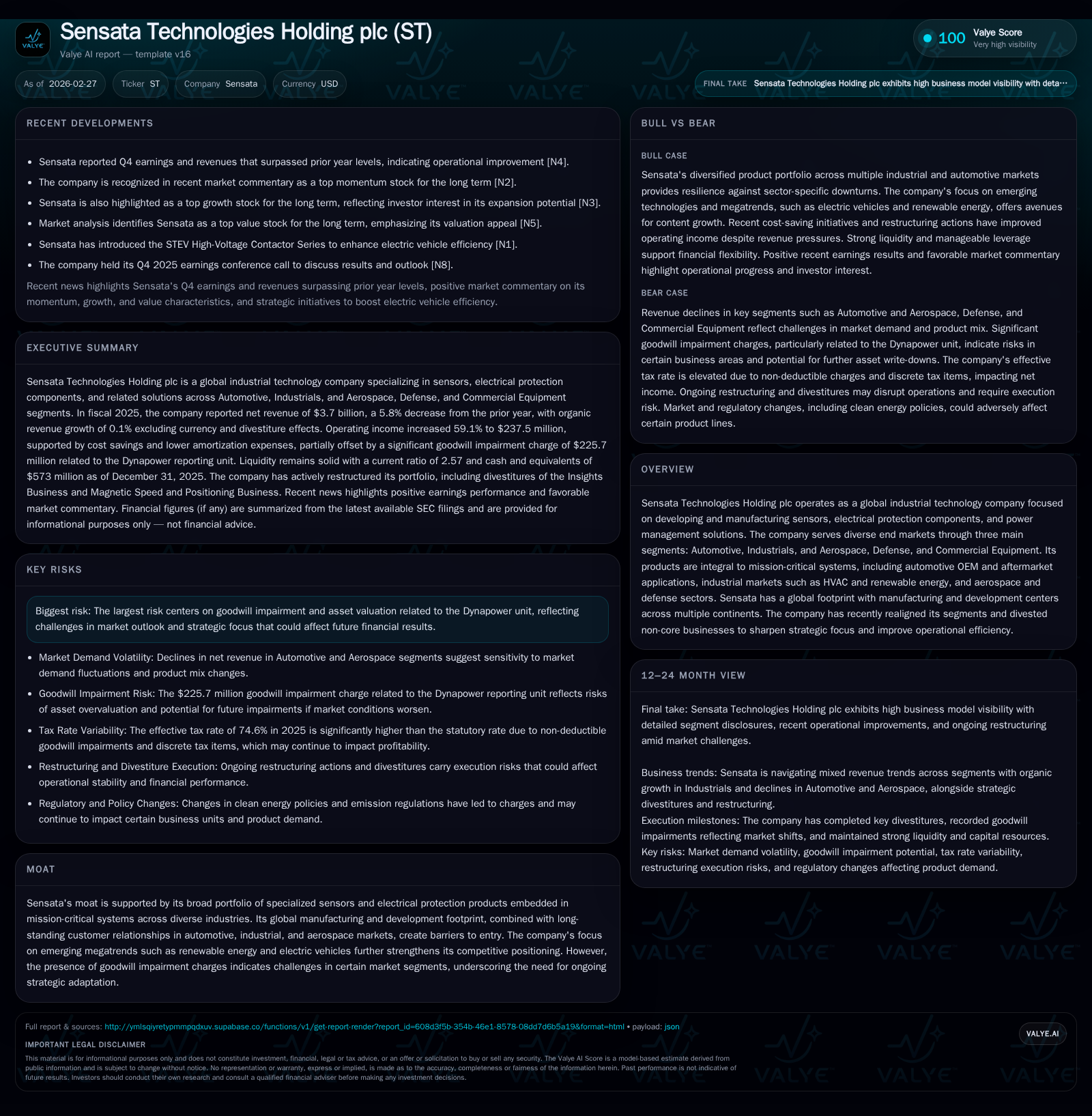
In 2025, Sensata Technologies experienced a 5.8% decline in net revenue mainly influenced by divestitures and segment-specific factors despite modest organic growth. The Automotive segment contracted due to product mix issues while Industrials posted strong organic gains from content growth. Significant non-cash goodwill impairment of $225.7 million related to the Dynapower unit affected operating income. The company strategically exited several non-core businesses, improving operational efficiency though offset by inflationary cost pressures. Robust operating cash flow supported sustained dividends and share repurchases even as net income dropped sharply. Looking forward, Sensata’s focus on EV sensor technology and renewable energy positions it for potential expansion amidst risks tied to Dynapower’s valuation.
Revenue Trends and Segment Performance in Fiscal 2025
Sensata’s fiscal year ended December 31, 2025, was marked by an overall net revenue decline of 5.8%, pulling back to approximately $3 billion from prior years largely due to divestitures that trimmed the top line by about 6.5%. On an organic basis—excluding the impacts of foreign exchange which added a modest +0.6%, and divestitures—the company recorded essentially flat revenue growth at +0.1%, signaling resilience below headline declines [S1].
Breaking down segment performance elucidates divergent trends: Automotive revenues fell by -3.8% driven by product mix challenges impacting markets served, with a -1.2% organic decline after adjusting for a +0.7% currency tailwind and -3.3% divestiture effect [S1]. This reflects ongoing OEM market uncertainties but also possibly heightened competition influencing sensor content growth timing.
Conversely, the Industrials segment demonstrated relative strength, growing revenues +5.1%, translating into robust +8.2% organic growth after accounting for a cyclical -3.4% drag from product lifecycle management actions (i.e., intentional pruning or transitions of technology platforms) combined with currency effects [S1]. This uplift was primarily attributed to increased sensor integration—the so-called "content growth" phenomenon—in industrial applications such as HVAC and renewable energy infrastructure.
The Aerospace, Defense, and Commercial Equipment segment faced headwinds, contracting by -6.4%, with an organic decline of -3.8% after currency (+0.6%) and divestiture (-3.2%) adjustments [S1]. Particularly affected was the commercial equipment market within this segment, consistent with broader industry cyclicality.
Impact of Divestitures and Goodwill Impairment on Operating Income
Strategic portfolio realignments drove Sensata’s exit from non-core units including the Insights Business (divested Q3 2024) and discontinuation of the Spear aerospace subsidiary in late 2024 [S1,N13]. These moves reduced amortization expense substantially—from $145.7M in 2024 down to $80.2M in 2025—reflecting lower intangible asset bases post-exit [S1].
Despite these cost rationalizations, operating income faced substantial pressure from a significant non-cash goodwill impairment charge of $225.7 million recorded in Q3 2025 tied primarily to the Dynapower reporting unit [S2,S1]. This impairment indicated that Dynapower's carrying values exceeded its fair value amid changing clean energy policies and emission regulations affecting its outlook.
Such impairment charges are accounting measures that do not affect operational cash flow but materially reduce reported profitability—critical for stakeholders parsing between earned vs recognized losses.
Shifts in Cost Structure: Inflation, R&D Reductions, and SG&A Efficiency
Cost of revenue as a percentage of sales edged up slightly to 70.7%, impacted by inflationary pressures on materials and logistics counterbalanced partially by lower expenses following divestitures [S1]. Research & development spending contracted markedly from $169M in 2024 to $133M in 2025, stemming largely from exiting businesses like Insights and internal restructure efficiencies [S1,S22].
Similarly, selling, general & administrative expenses declined roughly 9% driven by elimination of legacy costs associated with discontinued units; Trimmed SG&A expenses improved operational leverage but were insufficient alone to offset prior headwinds from larger restructuring charges experienced previously [S1,S22].
Strategic Refocus: Portfolio Realignment Toward Core Industries
Sensata's divestitures exemplify lifecycle management measures common among diversified industrial tech firms aiming to concentrate resources on segments showing the strongest long-term strategic fit—namely automotive electrification technologies, industrial sensing for renewables, plus aerospace/defense where niche integration opportunities persist [N13,S1].
By shedding lower-performing or non-aligned businesses such as Insights intelligence services business and Spear defense electronics - both strategic outliers relative to core sensor technology offerings—the company sharpens its operational focus while reducing complexity.
Capital Allocation Priorities: Cash Flow Strength and Shareholder Returns
Operating cash flows showed notable strength in fiscal 2025 at about $621 million—a ~12.7% rise over prior year—driven by disciplined working capital management amidst volatile macroeconomic conditions [F1,S14]. Capex was curtailed roughly 17%, cooling from nearly $158 million in FY24 to just over $131 million in FY25 reflecting more conservative investment pacing aligned with portfolio pruning strategy.
Sensata maintained consistent dividend payments totaling approximately $70 million annually over recent years while increasing share repurchase activity under the renewed September 2023 program ($120 million spent in FY25 vs ~$69 million prior year), reflecting confidence in free cash flow generation ability despite earnings volatility [F1,S14,S18,S20].
Approximate return on equity remains modest at ~1%, subdued largely by exceptional charges; however free cash flow supports ongoing capital returns even as operational earnings navigate cyclical pressures [F1].
Historical performance (annual)
| FY | Net ($mm) | CFO ($mm) | OpInc ($mm) | Capex ($mm) | Net YoY |
|---|---|---|---|---|---|
| 2025 | 31 | 622 | 238 | 131 | -75.6% |
| 2024 | 128 | 552 | 149 | 159 | +3386.7% |
| 2023 | -4 | 457 | 182 | 185 | -101.3% |
| 2022 | 311 | 461 | 670 | 150 |
Source: SEC companyfacts cache [F1].
Capital returns and efficiency (annual)
| FY | Div ($mm) | Buybacks ($mm) | FCF ($mm) |
|---|---|---|---|
| 2025 | 70 | 121 | 490 |
| 2024 | 72 | 69 | 393 |
| 2023 | 72 | 88 | 272 |
| 2022 | 51 | 292 | 311 |
Source: SEC companyfacts cache [F1].
*Direct annual revenue figures are not explicitly disclosed for recent years beyond FY2017; see narrative for detailed segment trends backed by SEC filings.
Growth Drivers Ahead: EV Technologies and Renewable Energy Opportunities
Sensata has positioned itself well for emerging megatrends underpinning future demand drivers: notable among these is its STEV High-Voltage Contactor series targeting electric vehicle platforms which promises improved efficiency gains vital for automotive OEMs navigating electrification transitions [N13].
Additionally, growing industrial adoption of renewable energy systems aligns with sensate technological integration needs for environmental monitoring and power management where Sensata retains competitive sensor capabilities developed globally across manufacturing sites [N7,N8,F1].
Absent formal forward guidance disclosures from management, these strategic bets signify directional priorities aligned with sector vernacular emphasizing "content growth" at electric vehicle systems level—increasing sensor counts per vehicle—and expansion into clean-tech sensing domains.
Market Risks Centered on Dynapower Unit and Potential Impairments
Key downside risks remain concentrated around the Dynapower reporting unit whose goodwill balance suffered substantial write-downs due to deteriorating fair value estimates triggered by regulatory uncertainty surrounding clean energy policies impacting demand projections [S1,N2,N3,S3].
This exposes Sensata to "fair value measurement sensitivity" risks inherent when intangible assets linked to acquired entities face market or policy volatility—a prevalent issue in green tech sectors undergoing rapid transformation.
Though no further impairments outside Dynapower are currently anticipated per management disclosures, sustained downside scenario development here could pressure future reported earnings.
What to Watch: Milestones, Earnings Releases, and Segment Developments
Upcoming quarterly earnings releases will be critical barometers revealing whether organic growth trends across Automotive electrification sensors or Industrial renewables portfolios continue solidifying or encounter disruption given ongoing geopolitical/regulatory uncertainties noted recently around energy emission rules affecting Dynapower’s market environment [N1,N10,N4,N3].
Investors will likely focus closely on order intake momentum within emerging EV platforms as well as any commentary regarding new business wins or setbacks within Aerospace/Defense customer segments post portfolio realignment moves.
Heightened scrutiny on operating margin developments resulting from inflation remediation efforts combined with evolving R&D investment trajectories may provide signals on Sensata’s preparedness for longer-term structural shifts required against backdrop of accelerated industry digitization needs.
Disclaimer: This analysis presents factual information based on Sensata Technologies Holding plc's publicly available financial statements ([F1],[S#]) and news sources ([N#]) without offering investment advice or price forecasts.
Disclaimer: This is research-only, informational analysis and not investment advice. It may include AI-generated interpretation and general industry context. Always verify important details using primary sources.

Comments