
STEM INC Q2 2026: Transition to AI-Enabled Software Drives Revenue Mix Shift Amid Liquidity Pressure
STEM INC's Q2 2026 results highlight a strategic shift from battery hardware sales to AI-driven software and services amid ongoing liquidity challenges.
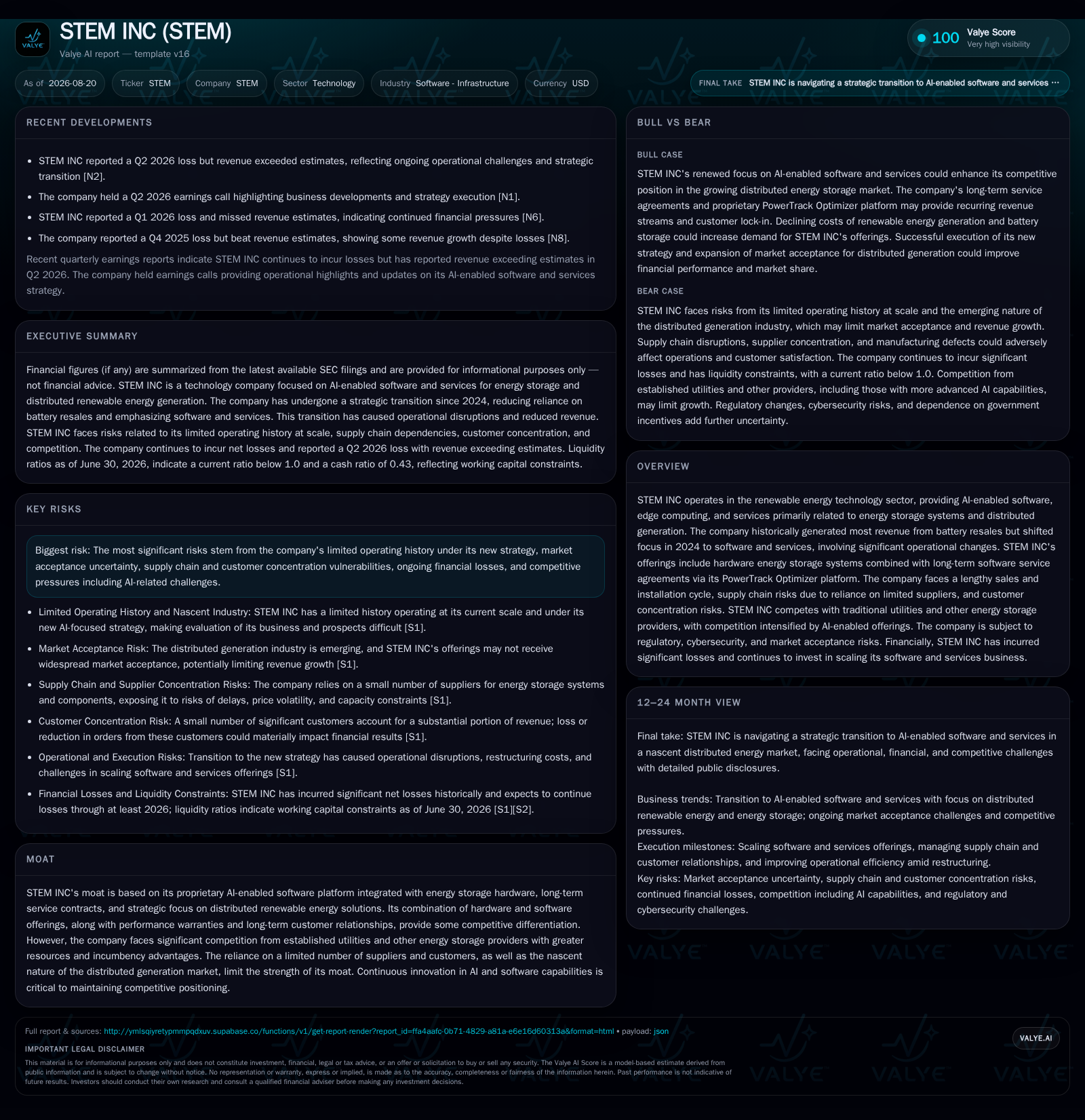
In Q2 2026, STEM INC continued its transition away from battery resales toward AI-enabled software and services, reflecting a structural change in its revenue mix. However, the company faces operational headwinds including lengthy sales cycles, supply chain dependencies, and customer concentration, which constrain near-term scaling. Financially, STEM INC reported a working capital deficit with a current ratio of 0.83 and cash reserves of $38.4 million as of June 30, 2026, underscoring liquidity pressures that require careful management. The strategic pivot offers potential for recurring revenue growth and margin improvement if operational challenges are addressed.
STEM INC reported in its Q2 2026 10-Q filing a continued strategic shift in its revenue mix, moving away from battery resales toward AI-enabled software and services, including offerings like the PowerTrack Optimizer platform and long-term service agreements [S2]. However, the company’s current ratio fell below 1.0 in the quarter, highlighting liquidity pressures during operational challenges such as lengthy sales and installation cycles, supply chain risks from supplier concentration, and customer concentration risks that may constrain near-term revenue scalability [S2].
Financially, STEM INC reported a current ratio of 0.83 as of June 30, 2026, indicating a working capital deficit where current liabilities of $107.5 million exceed current assets of $89.3 million [F1]. Cash and cash equivalents totaled $38.4 million at quarter-end, which provides some liquidity but remains constrained relative to ongoing operating losses and working capital needs [F1]. Customers, primarily distributed energy operators and utilities, are transitioning from purchasing energy storage hardware to subscribing to software-as-a-service (SaaS) offerings that optimize energy storage and grid management. This shift has the potential to increase recurring revenue streams and improve margin stability over time, as software and services typically have higher gross margins than hardware sales [S2].
However, the transition period has involved restructuring costs and operational disruptions, which have tempered margin improvements [S1][S2]. The lengthy sales and installation cycles characteristic of the energy storage industry delay revenue recognition and cash inflows, complicating the cash conversion cycle. Supply chain constraints and customer concentration further challenge the company's ability to scale its software platform efficiently.
Liquidity and Working Capital Analysis
STEM INC's working capital deficit, evidenced by a current ratio below 1.0, reflects the imbalance between current liabilities and assets as of June 30, 2026 [F1]. This shortfall may constrain operational flexibility and increase reliance on external financing or improved cash flow generation. The cash balance of $38.4 million offers a limited buffer against ongoing operating expenses and restructuring-related costs [F1].
The company's capital allocation continues to prioritize investments in AI-enabled platform development and supporting the software and services transition, which may exert additional pressure on liquidity in the near term [S1]. Monitoring improvements in working capital metrics and cash flow from operations will be critical to assessing financial stability going forward.
Risks and Industry Context
STEM INC operates in a sector characterized by long sales cycles, supply chain vulnerabilities, and competitive pressures from established utilities and energy storage providers. The company's reliance on a limited number of suppliers and customers heightens exposure to operational disruptions. Market acceptance of AI-enabled software platforms and the ability to retain customers through long-term service agreements are key factors influencing growth prospects.
The structural shift to software and services is expected to enhance recurring revenue potential and margin profiles, but cyclical factors such as supply chain delays and installation timing introduce variability [S1]. This would reduce reliance on hardware sales and alleviate liquidity constraints. Modest revenue growth and ongoing working capital deficits would reflect the continued impact of lengthy sales cycles, supply chain risks, and restructuring costs.
A downside scenario involves operational disruptions, supply chain issues, or customer losses that delay or derail the strategic pivot. Additionally, cash flow from operations and cash burn rates will provide insights into liquidity management. Customer contract renewals, new customer wins, and supply chain developments will also be critical indicators of operational progress and risk mitigation.
In summary, STEM INC's Q2 2026 results reveal a company in the midst of a fundamental business model transformation. While the shift toward AI-enabled software and services offers promising structural benefits, the near-term financial and operational challenges require vigilant management and successful execution to realize the strategic potential.
Disclaimer: This is research-only, informational analysis and not investment advice. It may include AI-generated interpretation and general industry context. Always verify important details using primary sources.

Comments