
Dissecting StepStone Group’s Financial Paradox Amidst Sectoral Ambiguity and Persistent Losses
StepStone Group Inc. displays solid top-line revenue yet sustains ongoing net losses with scarce disclosure on its industry or strategy.
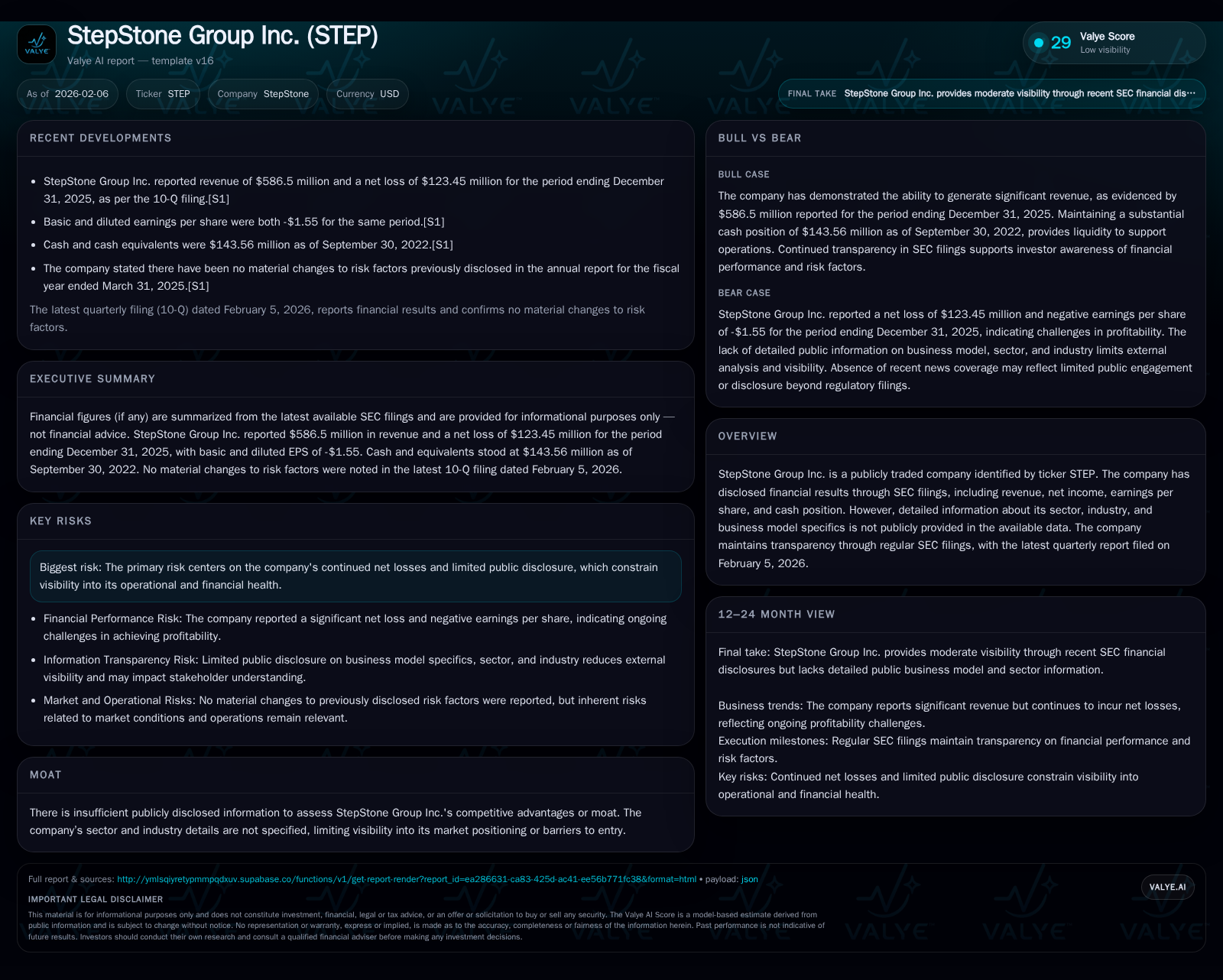
StepStone Group Inc. reported $586 million in revenue for fiscal year 2025 alongside a substantial net loss exceeding $120 million, highlighting a stark profitability dilemma. The absence of clear sector identification and detailed business model disclosures from their SEC filings compounds difficulties in evaluating competitive positioning or operational health. Although the company reported over $143 million in cash reserves as of September 2022, a lack of recent liquidity updates obfuscates the financial runway. Persistent risk factors remain unchanged without enhancement in transparency, raising questions on investor confidence and strategic clarity.
Unveiling StepStone’s Financial Profile
StepStone Group Inc.’s latest quarterly filing dated February 5, 2026 [S2] confirms a continuing narrative marked by scale and opacity. The company disclosed revenues totaling approximately $586 million for the period ending December 31, 2025 [F1], denoting meaningful commercial activity. However, juxtaposed against this top line is a net income loss surpassing $123 million for the same timeframe [F1], underscoring a persistent inability to convert revenue into profit.
Notably absent from the available disclosures is any direct mention of the company’s sector or industry classification. Such an omission significantly hampers efforts to contextualize these financials — obscuring whether StepStone operates in asset management, technology services, or an altogether different space. This foundational ambiguity forms the bedrock challenge inherent in analyzing StepStone’s financial profile.
Revenue Strength vs. Persistent Losses: The Profitability Puzzle
At first glance, StepStone’s near-$600 million revenue figure suggests a substantial operational footprint. Yet the concurrent six-figure net loss reflects inefficiencies or aggressive strategic trade-offs that have yet to manifest as earnings. Without public commentary detailing cost drivers, investment plans, or margin structures, this disconnect fosters more questions than answers.
Is the company deliberately prioritizing growth over profitability through heavy reinvestment? Or do structural cost issues plague its operations? In typical firms within well-defined sectors, such dynamics might be explained by ramping sales teams or product launches — here, however, absent transparency deepens interpretive challenges.
The Fog Surrounding StepStone’s Sector and Business Model
StepStone’s SEC filing as of early February 2026 reiterates no material change to previously articulated risk factors [S2], which also do not divulge any insight into business lines or competitive environment. This reticence effectively cloaks critical elements needed to evaluate if StepStone possesses any sustainable competitive advantages or moats.
Without clarity around how revenues are generated—be it recurring client contracts, platform fees, consulting services, or other channels—the company exists within a blurry horizon where traditional benchmarks and peer comparisons become untenable.
Liquidity Position: Adequate Cash but What Next?
The most recent publicly disclosed cash position dates back to September 30, 2022, when StepStone reported about $143.5 million in cash and equivalents on hand [F1]. This figure signals at least a moderate cushion to fund operational needs amid losses for some duration.
However, absence of subsequent liquidity disclosures leaves open key questions: Has this cash position been maintained, bolstered via financing activities, or diminished by operational burn? The lack of updated data complicates judgments about financial resilience or capital adequacy under prevailing market conditions.
Risk Factors in the Shadows: Unchanged Yet Unclear
The firm’s risk disclosures filed recently confirm no material updates compared to the annual report ending March 31, 2025 [S2]. While stability in declared risks suggests no new adverse developments detected internally, it also means existing uncertainties persist unmitigated.
Given ongoing net losses and sector unknowns, investors face an enduring veil over exposure to market fluctuations, competitive threats, regulatory shifts, or dependency on key clientele—all typical risk dimensions left unexplored due to sparse disclosure.
Transparency Challenges and What They Mean for Investors
StepStone fulfills mandatory SEC filing obligations with routine quarterly updates [S2], supplying reliable headline metrics such as revenue and net income [F1]. Yet these filings stop short of delivering granular narratives needed for sophisticated valuation analysis.
This incomplete transparency undermines confidence among buy-side participants who rely on detailed segment reporting, customer concentration insights, margin breakdowns, and forward guidance—none of which are present here. Consequently, valuation models remain handicapped by information scarcity rather than market-driven fundamentals.
Future Outlook Without a Crystal Ball
Projecting StepStone’s trajectory under current conditions is speculative at best. Their sizable revenue base offers meaningful operational scale but unresolved losses question path to sustainable profitability. Without disclosure on strategic priorities or business model evolution in forthcoming filings [S2], stakeholders must navigate an uncertain horizon.
Potential scenarios range from ongoing loss absorption with eventual margin improvement through operational leverage or strategic pivots—to prolonged loss-making leading to capital strain if fresh funding or turnaround initiatives falter. The wide latitude created by informational gaps necessitates cautious interpretation while awaiting clearer communication from management.
This report synthesizes available public data points to provide a nuanced view into StepStone Group Inc.'s complex financial standing amid pronounced information deficits. Readers should recognize inherent analytical limitations due to opaque disclosures and refrain from drawing definitive conclusions absent further transparency.
Disclaimer: This is research-only, informational analysis and not investment advice. It may include AI-generated interpretation and general industry context. Always verify important details using primary sources.

Comments