
StoneCo Strengthens Multi-Channel Ecosystem While Managing Credit Risks in Brazil’s SMB Fintech Sector
StoneCo's 2025 results reveal robust customer engagement and platform scale amid rising credit portfolio risks and macroeconomic headwinds.
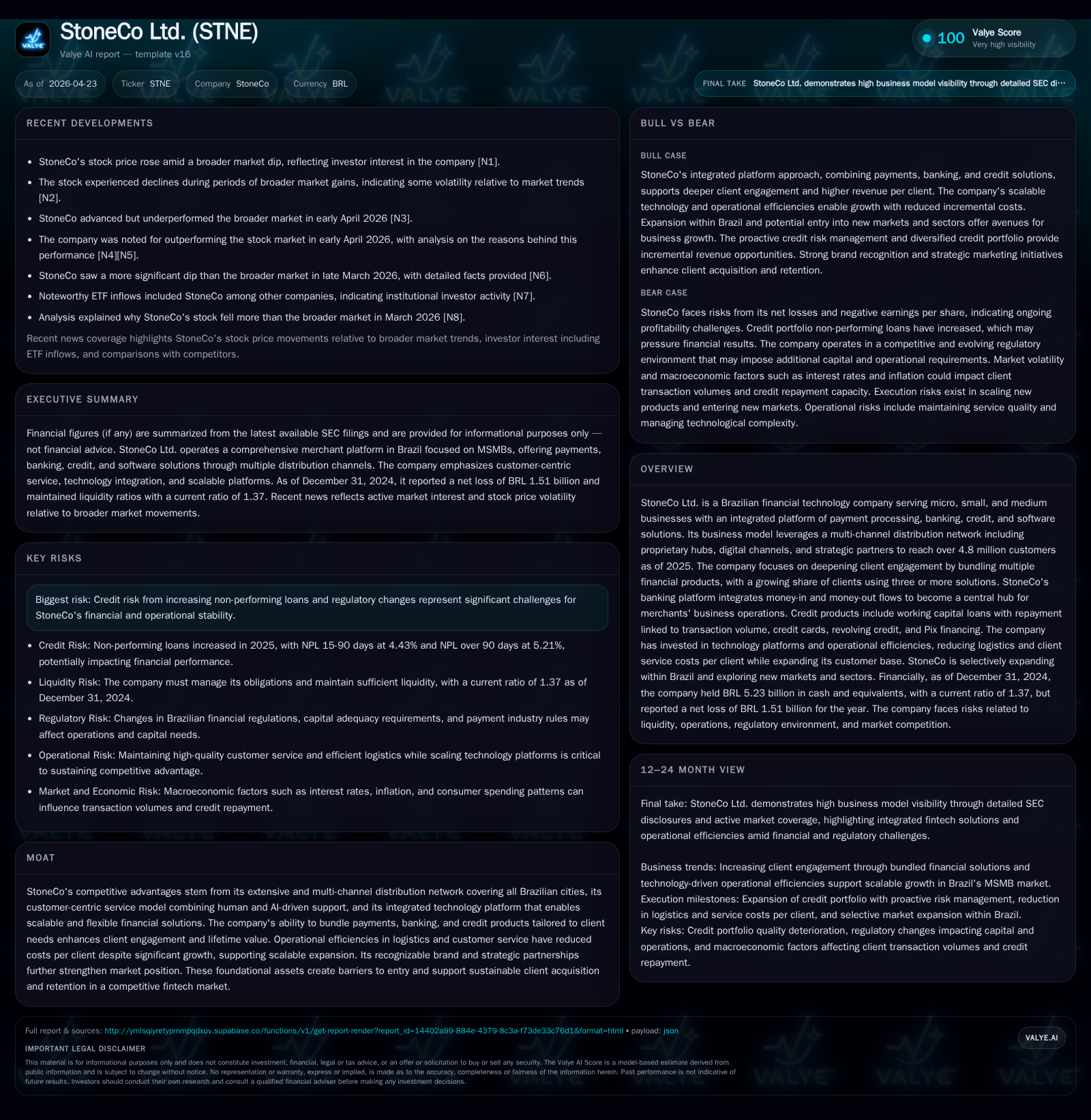
StoneCo Ltd., a leading Brazilian fintech serving over 4.8 million small and medium business clients, filed its latest quarterly and annual reports as of April 2026, showing expansion in its integrated payments, banking, and credit offerings. The company leverages a diversified distribution network including proprietary hubs, digital channels, and strategic partners to deepen client engagement through bundled financial services. While revenues and client base continue to grow across all Brazilian territories, rising non-performing loans and evolving regulation challenge its expanding credit portfolio. StoneCo emphasizes operational efficiency gains through technology and AI to reduce costs per client. Future growth depends on advancing cross-product integration, managing credit quality prudently, and selectively expanding its geographic and sector reach.
Recent Operating Update
StoneCo Ltd filed its latest quarterly disclosures via Form 6-K on April 23, 2026 ([S2], [S3]), synchronizing with the annual Form 20-F covering full-year 2025 results ([S1]). The filings confirm StoneCo’s ongoing expansion in Brazil’s micro, small & medium business (MSMB) fintech sector with an active customer base surpassing 4.8 million by end-2025—a key metric supporting scale economies in distribution and support networks.
Notably, the company reports continued deployment of its multi-channel go-to-market approach encompassing proprietary Stone Hubs (physical points of presence), franchised hubs expanding proximity reach, fully digital acquisition channels driven by traditional and digital media marketing, plus strategic partners like ISVs (independent software vendors), marketplaces, and e-commerce platforms ([S6], [S10]). This broad reach enables coverage of essentially all Brazilian cities including their economic activity underpinnings.
However, alongside growth comes heightened credit risk challenges: the consolidated credit portfolio nearly doubled in size during 2025 to R$2.8 billion (approximately $540 million USD equivalent), comprised mainly of working capital loans to merchants but also including credit cards for micro-merchants ([S4], [S17]). Non-performing loans have increased materially—from sub-3% NPLs in prior years to over 4.4% for short-term delinquencies (15-90 days) and beyond 5% for long-term (>90 days). Although StoneCo maintains strong collateralization and personal guarantees alongside sophisticated monitoring models that include internal/external data inputs and proactive client engagement to restructure obligations before defaults occur ([S4], [S17]), this area remains an operational constraint requiring cautious management given Brazil's volatile macroeconomic backdrop.
Business Model Insights
StoneCo operates a vertically integrated fintech platform tailored to Brazilian MSMBs that combines payment acceptance solutions with embedded financial services such as banking accounts, credit products, and software enabling merchant operations management ([S5], [S6], [S7]). Their core revenue driver remains transaction fees from electronic payment volumes processed across POS devices, e-commerce gateways, payment links, Pix QR codes (Brazil's instant payment method), and payroll payment services ([S7], [S11]).
Strategically important is their bundling approach: merchants increasingly use multiple StoneCo products—payment processing tightly linked with banking accounts for cash flow management and credit facilities repaid via transaction volume retention mechanisms—driving higher client lifetime value through ecosystem lock-in ([S6], [S10]).
Distribution channels are highly diversified:
- Proximity Channels: Proprietary Stone Hubs combined with franchised centers facilitate on-ground sales presence coupled with rapid delivery/setup (‘Green Angels’ deliver product within one business day for SMBs).
- Digital Channels: Efficiently scaled via targeted marketing driven CAC optimization.
- Strategic Partners: Leverage word-of-mouth referrals through member-get-member programs plus integration into partner ecosystems such as ISVs or marketplaces.
This tech-enabled distribution power enables broad market coverage including mature metropolitan areas plus tier-two/three cities where legacy incumbents often struggle to penetrate effectively ([S6]). Moreover, extensive customer support capabilities combining human agents aided by AI chatbots ensure rapid issue resolution (<5 sec call response times) promoting superior service ratings relative to competitors on Brazil's leading consumer platform Reclame Aqui ([S10]). These operational assets underpin StoneCo's moat by reinforcing customer retention through quality interactions along the entire user journey.
Industry Structure & Competitive Position
Brazilian MSMB payment processing is crowded but strongly fragmented between incumbents (such as Cielo) reliant on legacy tech stacks lacking full omnichannel integration versus digital-first players like StoneCo focusing on next-gen cloud-based platforms allowing advanced APIs for seamless multi-channel commerce ([S23]). This technological edge supports merchant demand for unified front-office/back-office operations across physical stores & online sales.
Additionally, regulatory reforms empowering new fintech licenses (e.g., Sociedade de Crédito Direto or SCD entities authorized to provide direct online lending) benefit StoneCo which has adapted quickly as a licensed financial institution operating within evolving Basel III-aligned capital frameworks specifically calibrated for fintech conglomerates ([S15], [S16]). StoneCo enjoys advantages through:
- Scale in client acquisition via multiple complementary channels,
- Deep domain expertise providing specialized support uncommon among newer entrants,
- Product mix blending payments + embedded finance + software solutions fostering powerful cross-selling synergies,
- Strong brand recognition bolstered by strategic acquisitions such as Reclame Aqui enhancing customer trust.
Growth Drivers & Constraints
Growth continues to be structurally driven by persistent underpenetration of modern financial technologies in Brazil's vast MSMB segment which contributes about one-quarter of GDP but lags comparable developed markets in software/financial product adoption (). StoneCo targets growth via:
- Expanding more deeply within existing territories noting virtually all markets grow irrespective of maturity level;
- Increasing product engagement encouraging multi-solution usage improving retention & monetization;
- Scaling platforms efficiently leveraging foundational assets like logistics networks reducing costs while serving more clients;
- Selective geographic expansion domestically plus potential international entry scenarios;
- Pursuing inorganic opportunities selectively to complement organic growth strategies ([S6], [S13], [S14]).
Nonetheless constraints remain impactful:
- Credit risk increases from rising apparently impaired loans can pressure provisions impacting profitability.
- Regulatory developments require careful compliance investments amid evolving consumer data protection laws (LGPD enforcement tightening) plus Central Bank scrutiny on liquidity & capital metrics.
- Pricing power can be challenged during economic slowdowns given strong competition although repricing agility has improved materially recently (, [S4], [S21]).
What to Watch Next
Key milestones include quarterly updates on:
- Credit portfolio performance metrics focusing on NPL trends & loss reserve adequacy,
- Client cross-sell ratios indicating ecosystem entrenchment,
- Cost metrics notably related to CAC trends plus logistics/customer support unit cost improvements,
- Regulatory developments impacting licensing requirements or capital structure conditions,
- Execution progress against geographic or product expansion initiatives including potential acquisitions announced,
- Management guidance adjustments reflecting macroeconomic conditions or competitive dynamics clearly stated during earnings calls or filings.
Financial Profile Summary
From the available financial snapshot ending December 2024 ([F1]):
- Net income was -R$1.51 billion reflecting significant investment phases combined with heightened credit provisioning.
- Shareholders' equity stood at around R$11.8 billion implying approximate negative ROE near -12.7%, signaling elevated pressure on profitability though this follows past swings from large investments.
- Cash & equivalents totaled approximately R$5.2 billion providing solid liquidity headroom.
- The current ratio was healthy at about 1.37 suggesting reasonable short-term asset coverage against liabilities.
Capital adequacy remains a top focus especially given classification as a Type 3 conglomerate subject to Basel III aligned requirements ([S24]). Capital allocation appears prudent with controlled share repurchases limited by Cayman Islands regulations ([S9], [S12]) while dividend payouts remain modest relative to retained earnings reflecting reinvestment priority.
Disclaimer: This analysis is based entirely on disclosed SEC filings as of April 23, 2026; no forward-looking statements or investment advice are provided herein.
Disclaimer: This is research-only, informational analysis and not investment advice. It may include AI-generated interpretation and general industry context. Always verify important details using primary sources.

Comments