
Strategic Education's Revenue and Regulatory Dynamics Reshape Growth Outlook
Strategic Education’s dual-university model leverages federal student aid amid evolving regulatory demands shaping its growth and capital deployment.
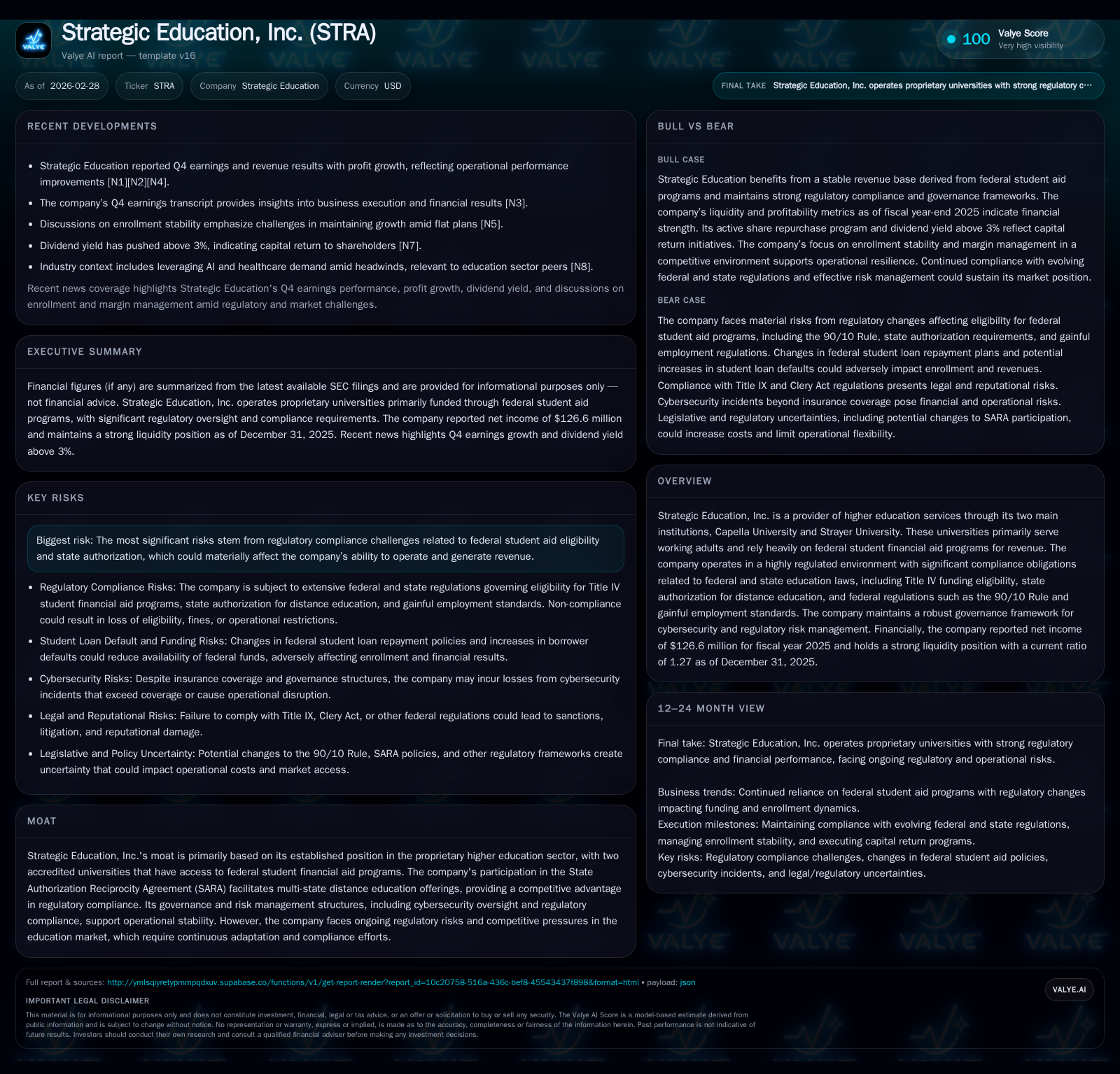
Strategic Education, Inc. operates two accredited universities serving primarily working adult students with substantial reliance on federal student financial aid. Recent years have seen robust revenue and earnings growth driven largely by federal funding, with a 9% top-line increase in FY2025 complemented by double-digit profit expansion. However, the company faces a complex regulatory environment involving Title IV eligibility, the evolving 90/10 Rule, Title IX enforcement, and borrower defense litigation that present ongoing operational risks. Capital allocation has emphasized shareholder returns with growing buybacks alongside steady dividends, supported by strong cash flow generation and liquidity. Stakeholders should watch enrollment trends, regulatory clarifications, and quarterly results as key indicators of forward momentum.
Company Overview: Dual-University Model Focused on Working Adults
Strategic Education, Inc. sustains its business through two accredited proprietary universities: Capella University and Strayer University. Both institutions primarily enroll working adult students who often rely on federal student financial aid for tuition coverage. This demographic focus dictates much of Strategic Education’s revenue composition and regulatory interactions. The company’s participation in multi-state distance education is facilitated through agreements like the State Authorization Reciprocity Agreement (SARA), enabling streamlined compliance amid diverse state regulations [S1]. The intensive regulatory environment envelops federal financial aid rules (Title IV), state authorization mandates, gainful employment standards, and borrower defense frameworks that inherently link operational continuation and financial outcomes.
The firm's governance framework includes an experienced Chief Information Security Officer overseeing cybersecurity risks via a specialized Cybersecurity Incident Response Team (CSIRT). Moreover, an independent Audit Committee ensures ongoing oversight of enterprise risks including regulatory compliance — critical given exposure to government funding programs that demand stringent controls [S1][S12].
Revenue and Profit Expansion: Performance Trends Through FY2025
Financially, Strategic Education reported $263.8 million in revenues for fiscal year ended December 31, 2025, marking a solid 9% increase over FY2024’s $242.1 million [F1]. Operating income expanded by approximately 12% to $174.2 million in FY2025 from $155.6 million the prior year. Net income likewise grew by over 12%, reaching $126.6 million compared to $112.7 million in FY2024 [F1]. This enhanced profitability stemmed from scalable program delivery across both universities coupled with disciplined cost management amid increased compliance expenditures.
Quarterly earnings reports consistently exceeded analyst expectations during late 2025 highlighting operational momentum with strategic investments in educational technologies and content updates enhancing student engagement metrics [N1][N2][N4]. Such performance illustrates the company’s ability to harness its position within the proprietary higher education niche while managing evolving regulatory requirements.
Historical performance (annual)
| FY | Net ($mm) | CFO ($mm) | OpInc ($mm) | Capex ($mm) | Net YoY |
|---|---|---|---|---|---|
| 2025 | 127 | 198 | 174 | 44 | +12.4% |
| 2024 | 113 | 169 | 156 | 41 | +61.5% |
| 2023 | 70 | 117 | 95 | 37 | +49.5% |
| 2022 | 47 | 126 | 71 | 43 |
Source: SEC companyfacts cache [F1].
Capital returns and efficiency (annual)
| FY | Div ($mm) | Buybacks ($mm) | FCF ($mm) |
|---|---|---|---|
| 2025 | 58 | 139 | 154 |
| 2024 | 59 | 12 | 129 |
| 2023 | 59 | 10 | 80 |
| 2022 | 59 | 40 | 83 |
Source: SEC companyfacts cache [F1].
Table: Historical Financial Performance Summary (FY2022-FY2025)
Regulatory Environment: Navigating Federal Student Aid Rules and Compliance Risks
The company's revenue model hinges heavily on Title IV eligibility—an intricate framework governing access to federal student loans and grants crucial for its mostly working-adult student base. For Fiscal Year 2024, Capella University derived approximately 67.9% of its cash-basis revenues from federal education assistance while Strayer’s similar metric stood near the cautionary threshold at approximately 89.6% [S2]. This underscores exposure to the '90/10 Rule' which stipulates proprietary colleges cannot receive more than 90% of their revenue from federal sources or risk losing eligibility or facing provisional certification.
Under legislative updates via the American Rescue Plan Act of 2021 and Department of Education rule amendments finalized in October 2022, 'all federal education assistance' including military tuition assistance and veterans’ benefits now count fully within the federal revenue side calculation—a tightening which took effect for institutional fiscal years starting January 1, 2023 [S2]. Subsequent interpretative guidance released in July 2025 further restricts inclusion exceptions previously allowed for distance education programs.
These changes heighten compliance complexity requiring constant monitoring as Congress also debates potential further amendments lowering the allowable ratio to an '85/15' split [S2]. Additionally, evolving Department of Education borrower defense to repayment regulations pose contingent liabilities amidst litigation settlements affecting automatic loan discharges for former students at listed institutions such as Capella University [S11][S13][S15].
Beyond financial aid rules, the company confronts shifting Title IX mandates applicable to federally funded institutions aiming to curb sex discrimination including sexual harassment allegations investigation protocols—which recently experienced multiple injunctions by district courts favoring older rules due to nationwide lawsuits involving universities including those operated by Strategic Education [S22][S25][S28]. This represents heightened risk related to institutional liability exposures.
Enrollment Dynamics and Competitive Pressures in Proprietary Higher Education
Enrollment levels remain sensitive amid intensified competition from public institutions expanding online offerings and other proprietary peers like Stride Inc., which has pursued growth leveraging innovative digital platforms [N6]. Recent reports highlight that absolute growth within this segment is challenged by demographic trends producing fewer college-age adults while technology-enabled entrants seek cost efficiencies.
Strategic Education’s differentiation partially rests on targeted program portfolios oriented towards career-relevant degrees for adults balancing work-study commitments paired with accreditation credibility ensuring Title IV access.
Analogous sector players increasingly incorporate artificial intelligence tools both for personalized learning paths and operational cost reduction—a theme referenced as growing across listed education stocks but not yet explicitly quantified within Strategic Education’s disclosures [N7]. Nonetheless, these technological advances portend a competitive dynamic necessitating investment to sustain enrollment retention rates amid flattening demand patterns reported elsewhere in the space [N8].
Future Growth Drivers and Potential Headwinds from Policy Changes
Regulatory developments poised to materially influence Strategic Education's growth trajectory include introduction of Workforce Pell Grants slated for implementation commencing July 2026 targeting accredited short-term career-focused programs characterized by instruction durations between eight to fifteen weeks meeting stringent job placement metrics [S9]. Such grants expand aid availability beyond traditional academic degrees into workforce development realms possibly unlocking incremental student segments while pressuring pricing given grant constraints prohibiting combination with standard Pell grants.
Concurrently, modifications under One Big Beautiful Bill Act measure delay certain borrower defense provisions until July 2035 reinstating earlier protections yet leaving uncertainty regarding long-term loan discharge risk exposure for certain cohorts enrolled through disputed periods [S16][S23]. Ongoing legislative scrutiny surrounding loan limits for graduate/professional students—particularly elimination of PLUS loans post-July 2026—could affect graduate enrollment patterns at Capella without grandfather provisions therein emphasizing portfolio shift sensitivity [S9][S27].
Given these fluid policy drivers combined with Congressional proposals potentially tightening revenue source caps further or enacting enhanced accountability rules effective mid-decade, Strategic Education must continuously adapt institutional strategy balancing compliance costs against market differentiation pillars.
Capital Allocation Strategy: Dividends, Share Repurchases, and Liquidity Management
Strategic Education sustained an attractive capital return posture in FY2025 marked by robust shareholder cash deployment activity reflected in dividends paid totaling approximately $57.5 million—a consistent figure relative to prior years averaging near $58–59 million annually since FY2022 [F1]. Notably, share repurchases escalated sharply from modest historical amounts around $11–40 million per year during FY2018–24 into a sizable $139 million buyback outlay during FY2025 representing a meaningful acceleration aligned with surplus operating cash flow generation during this period [F1][S4–S6][S16].
Liquidity stands solid with current assets measured at approximately $278 million against current liabilities near $218 million resulting in a comfortably above-one current ratio metric of about 1.27 at December 31, 2025—signaling sufficient near-term coverage for obligations including capital project spending that hovered near managed levels around $44 million capex annually across recent years [F1][S27].
Governance signals include issuance of Rule 10b5-1 trading plans adopted by senior executives such as CEO Karl McDonnell and CFO Daniel Jackson facilitating transparent insider stock sale frameworks consistent with prudent corporate governance standards observed industry-wide during respective quarters spanning early through late calendar year 2025 [S4][S20].
Financial Health Assessment: Operating Cash Flow, ROE, and Free Cash Flow Analysis
Operating cash flow strengthened materially reaching $198 million in FY2025 reflecting a +17% improvement versus prior year which totaled approximately $169 million underscoring ongoing operational cash conversion efficiency even amid regulatory compliance cost absorption cycles alongside steady revenue expansion drivers [F1]. Recurring capital expenditures remained controlled near mid-$40 million range sustaining necessary IT infrastructure upgrades aligned with digital delivery capability priorities.
Equity base slightly contracted to $1.646 billion year-end FY2025 from prior peak levels reflecting repurchase activity offsetting net income accumulation yielding an approximate return on equity ratio of ~7.7%, denoting modest but stable profitability leveraging invested capital effectively within sector risk parameters flexible enough for ongoing reinvestment or shareholder distributions balance considerations.
Free cash flow defined as operating cash flow less capex approximates $154 million—the financial foundation underpinning elevated buyback activity combined with dividend consistency contributing positively toward investor return profile without compromising liquidity buffers essential amidst regulatory uncertainties [F1].
Looking Ahead: Key Milestones and Metrics to Watch
Looking forward into calendar year 2026 stakeholders should track multiple critical inflection points:
- Updates on institutional eligibility under modified Title IV regulations alongside evolving Office of Postsecondary Education approvals encompassing multi-state distance education authorizations;
- Resolution timelines related to Borrower Defense to Repayment applications especially for post-class applicants subject to court-mandated disclosures anticipated processing outcomes affecting contingent liabilities before January-end deadlines;
- Operational impacts stemming from Workforce Pell Grant program rollout coupled with adjustments required per new loan limits affecting graduate/professional enrollments;
- Quarterly earnings releases starting Q1 ‘26 delivering real-time insights into top-line sustainability alongside margin pressure assessments related to regulatory spending;
- Enrollment metrics monitored closely given competitive pressures compounded by demographic headwinds; periodic reporting here along with attrition rates will illuminate demand-side challenges or stabilization strategies effectiveness;
- Engagement with federal/state Title IX enforcement developments along with institutional internal control upgrades responding proactively to shifting legal frameworks. Monitoring these milestones will be crucial for gauging ongoing strategic execution quality amidst considerable external factors influencing both near-term operating results and longer-duration value creation potential.
Disclaimer: This analysis is prepared solely for informational purposes based on publicly available data cited herein as of early-2026 filings, news disclosures, and recognized company facts without providing investment advice or recommendation.
Disclaimer: This is research-only, informational analysis and not investment advice. It may include AI-generated interpretation and general industry context. Always verify important details using primary sources.

Comments