
Strategic Education’s 2026 Q1 Update Highlights Regulatory and Enrollment Challenges
The latest quarterly filing reveals operational headwinds chiefly driven by enrollment softness and regulatory compliance costs, underscoring critical risks in Strategic Education’s federal aid-dependent business.
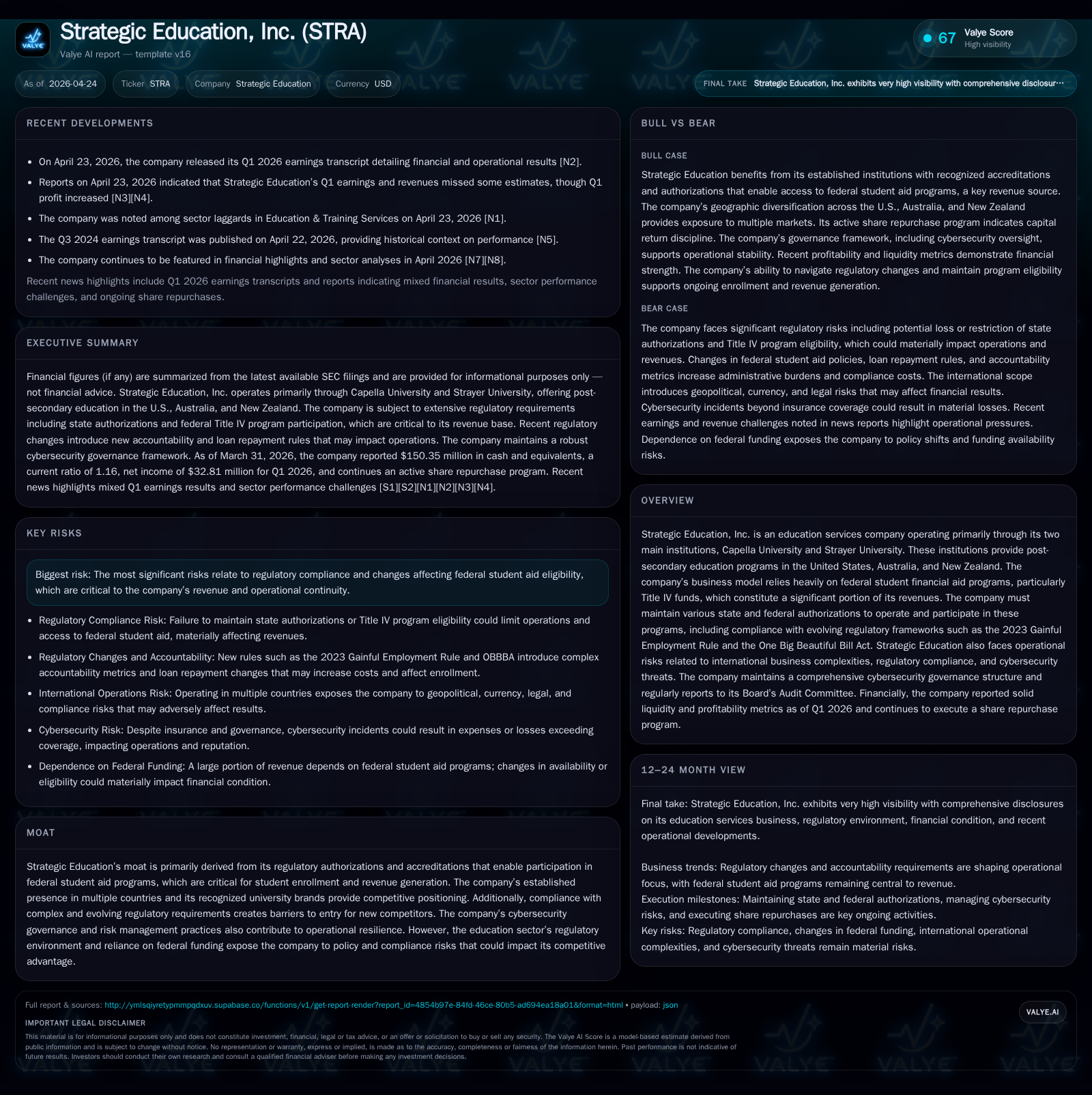
In its 2026 first quarter filing, Strategic Education, Inc. reported revenue and earnings misses largely attributable to declining student enrollment and incremental pressures from evolving regulatory compliance demands. The company’s core business remains highly dependent on Title IV federal student aid programs, necessitating strict adherence to complex state and federal authorizations. Its competitive moat is mainly regulatory-based, supported by accreditations and multi-jurisdictional operations in the US, Australia, and New Zealand. Growth drivers include program and geographic expansion plus digital learning innovation, while constraints center on tightening regulatory scrutiny around borrower defense rules and state authorization reciprocity changes. Financially, the firm maintains solid liquidity and has upgraded capital return via share repurchases. Key upcoming milestones include monitoring regulatory policy shifts, enrollment trends, and accreditation reviews.
Q1 2026 Operating Performance and Key Updates
Strategic Education’s latest quarterly disclosure dated April 23, 2026 [S2] spotlighted a pronounced shortfall against both revenue and earnings expectations as reported in contemporaneous market summaries [N1]. Total revenue pressure stemmed principally from continued declines in student enrollment at its two flagship brands—Capella University and Strayer University—reflecting ongoing challenges in attracting new cohorts amid a competitive post-secondary landscape.
Management commentary in the Q1 earnings transcript [N2] emphasized that while digital program offerings remain robust, overall enrollment softness outpaced prior assumptions. Contributing factors included intensified regulatory scrutiny limiting marketing flexibility along with demographic headwinds shaping demand dynamics. The contemporaneous Form 8-K filing [S3] noted no immediate changes to operational strategy but reiterated focus on margin discipline and regulatory coordination.
Core Business Model: Education Services Driven by Federal Student Financial Aid
Strategic Education operates primarily through Capella University and Strayer University, delivering post-secondary education primarily in the United States alongside locations in Australia and New Zealand [S1]. Its business model hinges on extensive participation in Title IV federal student financial aid programs; these funds constitute a substantial proportion of the firm’s revenue base.
Enrollment decisions heavily depend on access to this funding pool, subject to strict compliance with evolving State Authorization Reciprocity Agreements (NC-SARA) under which institutions must maintain authorization across states where students reside or attend virtually. The company must secure various accreditations specific to its academic programs ensuring eligibility for these aids.
This complex authorization ecosystem imposes high switching costs for students choosing alternative providers because institutional access to Title IV funds directly enables affordable education financing. Hence, STRA’s revenue model is tightly coupled with federal policy parameters governing aid distribution.
Regulatory Authorization and Its Critical Role in Competitive Moat
The company’s competitive moat derives chiefly from its ability to maintain multiple required regulatory accreditations and authorizations necessary for Title IV program eligibility—a considerable barrier against new entrants [S1][S2].
Operational risk is amplified given the fragmented nature of state-level requirements for both physical campuses (Strayer) and distance education programs (Capella). Recent filings stress that loss or suspension of any such state or foreign authorizations could materially truncate operations or restrict access to Title IV funds within those jurisdictions [S2]. Regulatory frameworks such as the 2016 Distance Education Rule require explicit state authorization for enrolling students remotely—imposing ongoing administrative compliance costs.
Compliance governance incorporates dedicated cybersecurity measures overseen by an experienced Chief Information Security Officer who supervises cross-functional teams tasked with mitigating risks including data breaches that could impact reputation or invite penalties [S1][S14]. The Audit Committee receives quarterly briefings reinforcing board-level oversight.
Competitive Dynamics Within Post-Secondary Education Sector
Within its sector, STRA benefits from established brand recognition of Capella University as an online education leader complemented by Strayer’s physical campus footprint predominantly serving adult learners seeking career advancement. Regulatory licenses integrate both into the national post-secondary system conferring a defensible market position relative to non-accredited operators or newer digital-only entrants lacking federal fund participation.
Pricing power is constrained by pricing caps imposed through Title IV program rules which indirectly harmonize tuition levels across competitors reliant on similar aid sources. Nevertheless, STRA differentiates through integrated online delivery platforms coupled with workforce-aligned curricula designed to maximize completion rates—a key performance metric scrutinized under gainful employment regulations effective July 2024 [S1].
Geographic diversity via Australian and New Zealand operations introduces competitive complexity but also diversification; these markets have distinct accreditation processes yet broaden overall addressable market size while exposing STRA to foreign currency volatility risks [S12].
Growth Drivers: Enrollment, Program Innovation, and Market Expansion
The company’s growth agenda concentrates on broadening its program portfolio especially targeting workforce-oriented credentialing that qualifies for newly introduced Workforce Pell Grants effective July 2026 [S10][N2]. These short-term accredited programs target sectors with high job placement rates creating appeal among students seeking rapid upskilling.
Investments in technology-driven learning platforms seek higher student engagement and improved completion metrics which are material under federal accountability measures impacting future funding eligibility. STRA's focus on flexible online offerings addresses adult learners balancing work-life commitments.
Cross-border market penetration remains a longer-term growth lever but faces regulatory hurdles necessitating continuous vigilance regarding international education laws alongside geopolitical uncertainties outlined in recent filings [S12].
Constraints: Regulatory Risks and Compliance Costs
The foremost constraint shaping STRA's operating environment centers on the evolving regulatory landscape governing Title IV funding eligibility. Borrower Defense to Repayment (BDTR) rules have undergone legal contestation culminating in injunctions delaying enforcement of stringent provisions originally slated for full implementation in recent years. This injects uncertainty as settled claims may trigger recoupment actions materially impacting financials if adverse interpretations prevail [S18][S20].
State authorization reciprocity agreements (NC-SARA) face proposed policy modifications that could limit or suspend institutional participation based on academic quality or financial stability indicators—amplifying compliance burdens significantly [S27]. Public comment cycles concluded recently with voting outcomes expected in late 2026.
Heightened disclosure obligations plus potential sanctions relating to Title IX regulatory revisions impose added administrative overhead illustrated by recent court injunctions selectively shielding certain institutions pending final rulings [S22][S26]. These compound baseline operational complexities requiring sustained resource allocation.
Financial Overview: Capital Structure, Cash Flow, and Shareholder Returns
Financially, STRA exhibits a sound liquidity position with cash & equivalents totaling approximately $150 million as of March 31, 2026, supported by current assets exceeding liabilities at a ratio of 1.16 reflecting balanced near-term solvency metrics [F1]. Although total debt figures date less recently (circa 2013), net debt appears negative implying robust cash cushions relative to obligations.
Profitability has trended positively over recent fiscal years with operating income reaching $174 million FY2025 representing a double-digit year-over-year increase (12%) accompanied by net income growth of approximately 12.4% over prior year periods illustrating operational leverage despite macro headwinds [F1]. Strong free cash flow generation (~$154 million) underpins consistent dividend distributions near $57 million annually alongside aggressive share repurchase programs authorized up to $250 million extending into late 2026 [F1][S24]. Q1 repurchase activity amounted to $40 million demonstrating continued capital return prioritization despite mixed operating signals.
Historical performance (annual)
| FY | Net ($mm) | CFO ($mm) | OpInc ($mm) | Capex ($mm) | Net YoY |
|---|---|---|---|---|---|
| 2025 | 127 | 198 | 174 | 44 | +12.4% |
| 2024 | 113 | 169 | 156 | 41 | +61.5% |
| 2023 | 70 | 117 | 95 | 37 | +49.5% |
| 2022 | 47 | 126 | 71 | 43 |
Source: SEC companyfacts cache [F1].
Capital returns and efficiency (annual)
| FY | Div ($mm) | Buybacks ($mm) | FCF ($mm) |
|---|---|---|---|
| 2025 | 58 | 139 | 154 |
| 2024 | 59 | 12 | 129 |
| 2023 | 59 | 10 | 80 |
| 2022 | 59 | 40 | 83 |
Source: SEC companyfacts cache [F1].
Key Milestones to Monitor for Strategic Execution
Near term catalysts will revolve around updates from the NC-SARA policy decision cycle culminating by quarter four 2026 which may materially alter licensing fees or operational restrictions applying to distance education enrollments nationwide [S27]. Equally consequential will be judicial developments concerning Borrower Defense litigation outcomes due early next year potentially affecting liability exposure or reimbursement obligations tied to discharged loans originating before settlements took effect [N2][S15].
Enrollment trend disclosures each quarter provide directional insight into demand recovery prospects particularly as incremental Pell Grant program adjustments take hold starting mid-2026 potentially broadening affordability for targeted demographics [N2][S10]. Accreditation renewal schedules at both Capella University and Strayer campuses merit close observation given their pivotal role sustaining access to Title IV funds.
Robust execution against digital platform enhancements enabling higher completion ratios would further fortify growth trajectories while regulatory risk mitigation efforts remain paramount given ongoing political shifts influencing education funding policies nationally.
Disclaimer: This analysis is provided for informational purposes only without investment recommendation or advice. It synthesizes publicly available SEC filings including Form 10-Q/10-K reports dated through April 23, 2026 along with associated transcripts cited herein.
Disclaimer: This is research-only, informational analysis and not investment advice. It may include AI-generated interpretation and general industry context. Always verify important details using primary sources.

Comments