
Stevanato Group’s 2025 Growth Surge Signals Strategic Expansion
A comprehensive analysis of Stevanato Group’s recent financial progress, operational intricacies, and strategic initiatives in the bio-pharma manufacturing sector.
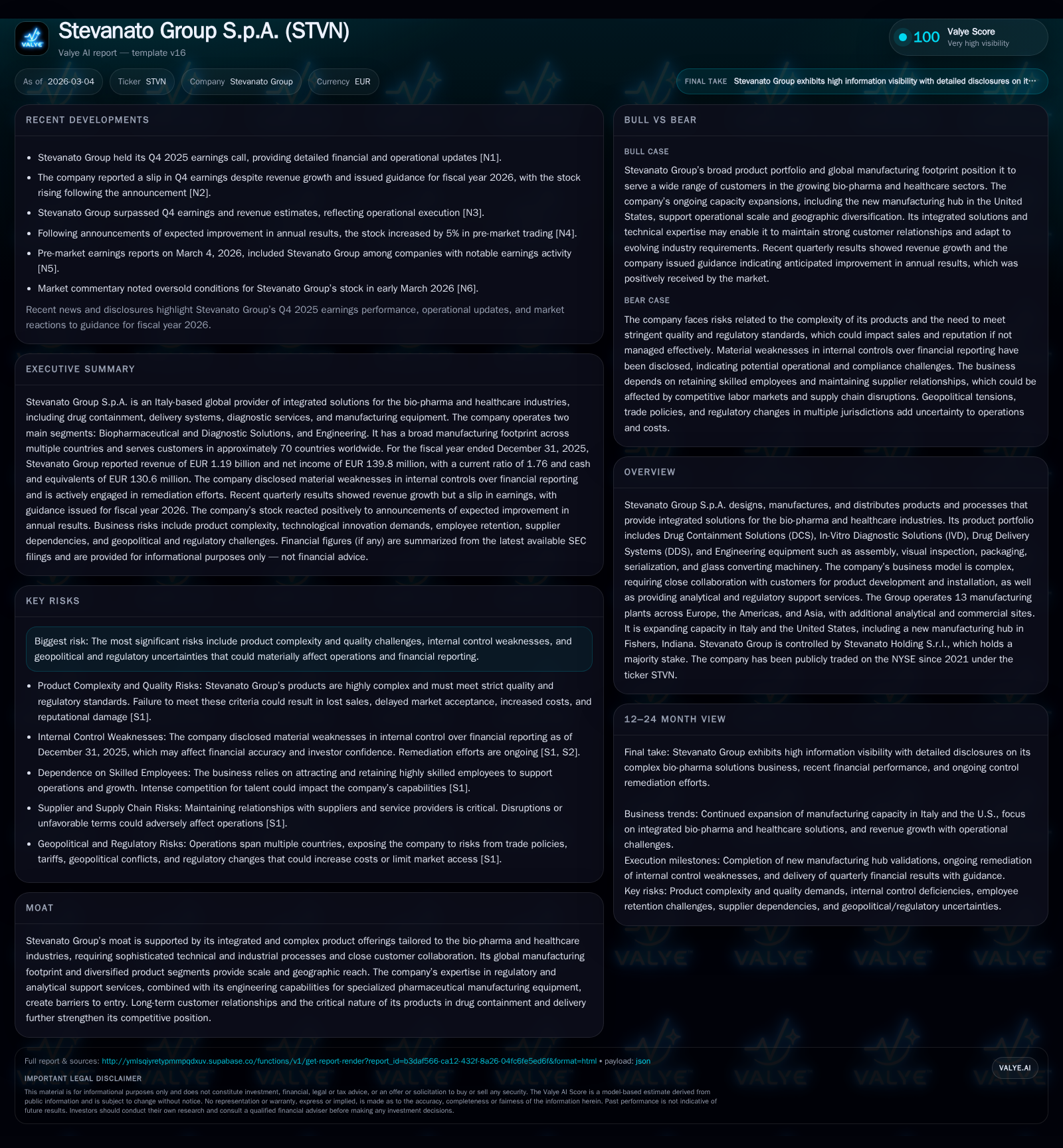
Stevanato Group S.p.A. delivered robust revenue growth in 2025, driven by its integrated bio-pharma solutions and customer-centric manufacturing model. Despite facing material internal control weaknesses and product complexity challenges, the company is expanding capacity notably in Italy and the U.S. Its capital allocation reflects steady dividend payments and significant investment in production capabilities. Ongoing remediation efforts aim to strengthen reporting controls while its global footprint and specialized offerings create durable competitive barriers.
Robust Historical Growth and Profitability Trends
Stevanato Group demonstrated considerable top-line momentum over the four fiscal years ending 2025, highlighted by a 7.4% increase in revenue from €1.10 billion in FY2024 to €1.19 billion in FY2025 [F1]. Its net income similarly showed an upswing of 18.7%, climbing to roughly €140 million during the same interval [F1]. Equity expanded steadily to approximately €1.49 billion by year-end 2025, yielding an approximate return on equity (ROE) of 9.4%, a respectable figure given the capital-heavy nature of pharmaceutical manufacturing [F1]. Though net income exhibited some volatility across FY2023-FY2025, the underlying upward trajectory points to strong operational leverage.
Historical performance (annual)
| FY | Rev ($mm) | Net ($mm) | Rev YoY | Net YoY |
|---|---|---|---|---|
| 2025 | 1186 | 140 | +7.4% | +18.7% |
| 2024 | 1104 | 118 | +1.7% | -19.2% |
| 2023 | 1085 | 146 | +10.3% | +1.9% |
| 2022 | 984 | 143 |
Source: SEC companyfacts cache [F1].
Capital returns and efficiency (annual)
| FY | Div ($mm) | ROE% |
|---|---|---|
| 2025 | 15 | 9.4 |
| 2024 | 14 | 8.4 |
| 2023 | 14 | 12.9 |
| 2022 | 14 | 14.4 |
Source: SEC companyfacts cache [F1].
Derived % changes calculated based on available period data [F1].
Unpacking Revenue Drivers and Operational Challenges
Stevanato’s revenue growth stems primarily from its Drug Containment Solutions (DCS) and Drug Delivery Systems (DDS), supplemented by In-Vitro Diagnostic (IVD) products and proprietary engineering machinery for assembly and inspection [N1][N3][S1]. Its business model emphasizes co-development partnerships with leading biopharma customers, aligning product design with specific clinical needs, which enhances customer retention but adds complexity to manufacturing processes.
This integrated offering demands high precision glass forming combined with advanced packaging innovations, necessitating specialized engineering support onsite for installation and scaling . However, Stevanato disclosed material weaknesses in internal controls over financial reporting tied to IT general controls (ITGC), especially related to user access management and change approval workflows for financial systems [S1]. These control gaps have elevated risk around period-end closing accuracy and could complicate response agility if product quality or operational disruptions emerge.
Evaluating Future Growth Prospects and Geographic Expansion
Strategically, Stevanato is aggressively expanding capacity to meet evolving pharmaceutical outsourcing trends favoring ready-to-use injectable solutions spanning syringes to cartridges [N2]. The company launched ramp-up at its Latina site in Italy aimed at high-value syringe production initially started in commercial scale production in late-2023, with cartridge output expected commercially by mid-2026 [S9]. Concurrently, the Fishers facility in Indiana represents a greenfield investment into EZ-fill® technology manufacturing predominantly targeting the U.S market.
Yet geopolitical risk — including tariffs and regulatory shifts between the EU, U.S., and China — remains a moderating factor on seamless cross-border production scheduling [S17]. Intensified regulatory scrutiny also pressures quality assurance systems further complicated by ongoing ITGC weaknesses [S1]. Successful mitigation of internal control risks will be vital for scalable compliance as volumes grow.
Key Financial Metrics and Forecast Indicators
In Q4 FY2025 earnings calls, reported revenue surpassed estimates despite a modest slip in operating margin reflecting cost inflation pressures [N3][N1]. Management flagged FY26 guidance as cautious citing uncertainty around macroeconomic conditions and continuing investments diluting short-term profitability metrics [N2][N4]. Observers should monitor order backlog size as a gauge of sustained demand along with margin trajectory indicating operational efficiency enhancements or pressure.
Capex commitments remain elevated focused on completing new manufacturing hubs; their project milestones will serve as leading indicators for volume ramp timing as well as potential breakthrough into higher-margin product lines supported by proprietary assembly machinery sales [S15].
Capital Allocation: Dividends, Buybacks, and Investment Strategy
Capital deployment reflects a judicious balance between shareholder returns via steady dividends around €14–15 million annually and substantial reinvestment into production infrastructure [F1][S6][S10][S12]. No share buyback programs have been disclosed recently, aligning with a strategy favoring organic growth investments rather than financial engineering.
Free cash flow sufficiency underpins this approach although capex intensity signals flattening net cash generation margins near term amid heavy buildout phases [S6][F1]. Dividend stability signals management’s commitment to returning cash whilst maintaining liquidity buffers (~€130 million cash & equivalents at YE25) for operational flexibility [F1][S14].
Internal Controls and Reporting Transparency Risks
Stevanato’s disclosure highlights persistent material weaknesses within its internal controls over financial reporting as of December 31, 2025 — centered on inadequate IT general controls impacting access management protocols and program change approvals that underpin accurate data output integrity [S1][S4]. These deficiencies translate into risks around unauthorized transactions or errors undetected until after reporting timelines.
The company has embarked on comprehensive remediation efforts including reinforcement of segregation-of-duties through organizational redesigns, automation of journal entry workflows, dedicated control awareness training across finance and IT teams plus employing external consultants specializing in SEC reporting frameworks [S8][S22]. Despite improvements made during fiscal year 2025, full effectiveness is projected progressively over FY26 timelines.
This focus aligns with broader industry shifts where pharmaceutical manufacturing suppliers must demonstrate stringent compliance amid increasing regulatory expectations related to traceability and serialization technology governance.
Strategic Positioning Within Bio-Pharma Manufacturing Ecosystem
Stevanato’s competitive moat derives from the integration of advanced drug containment technologies (glass vials, syringes), drug delivery systems engineered through collaborative partnerships, plus their uniquely complementary offering of specialized pharmaceutical production equipment like assembling machines and visual inspection systems that few competitors replicate at scale globally .
Operating thirteen manufacturing locations spread across Europe, Americas, and Asia diversifies geopolitical risks while offering proximity benefits to leading pharma clusters—a critical factor when lengthy validation timelines demand localized supply chain consistency.
By coupling regulatory advisory services with analytical testing capabilities alongside hardware manufacturing expertise, Stevanato constructs high barriers to entry against newcomers lacking equivalent domain know-how or geographic reach.
Disclaimer: This report synthesizes publicly available information sources without offering investment recommendations or price forecasts. All financial figures are derived strictly from disclosed filings or direct company communications as cited; no speculative projections are included beyond clearly marked analytical commentary.
Disclaimer: This is research-only, informational analysis and not investment advice. It may include AI-generated interpretation and general industry context. Always verify important details using primary sources.

Comments