
Synlogic, Inc. Transitions to Public Shell Status Following Clinical Setbacks and Nasdaq Delisting
Synlogic ceased clinical development of its lead product, becoming a non-operating shell focused on strategic alternatives with limited liquidity and uncertain future growth.
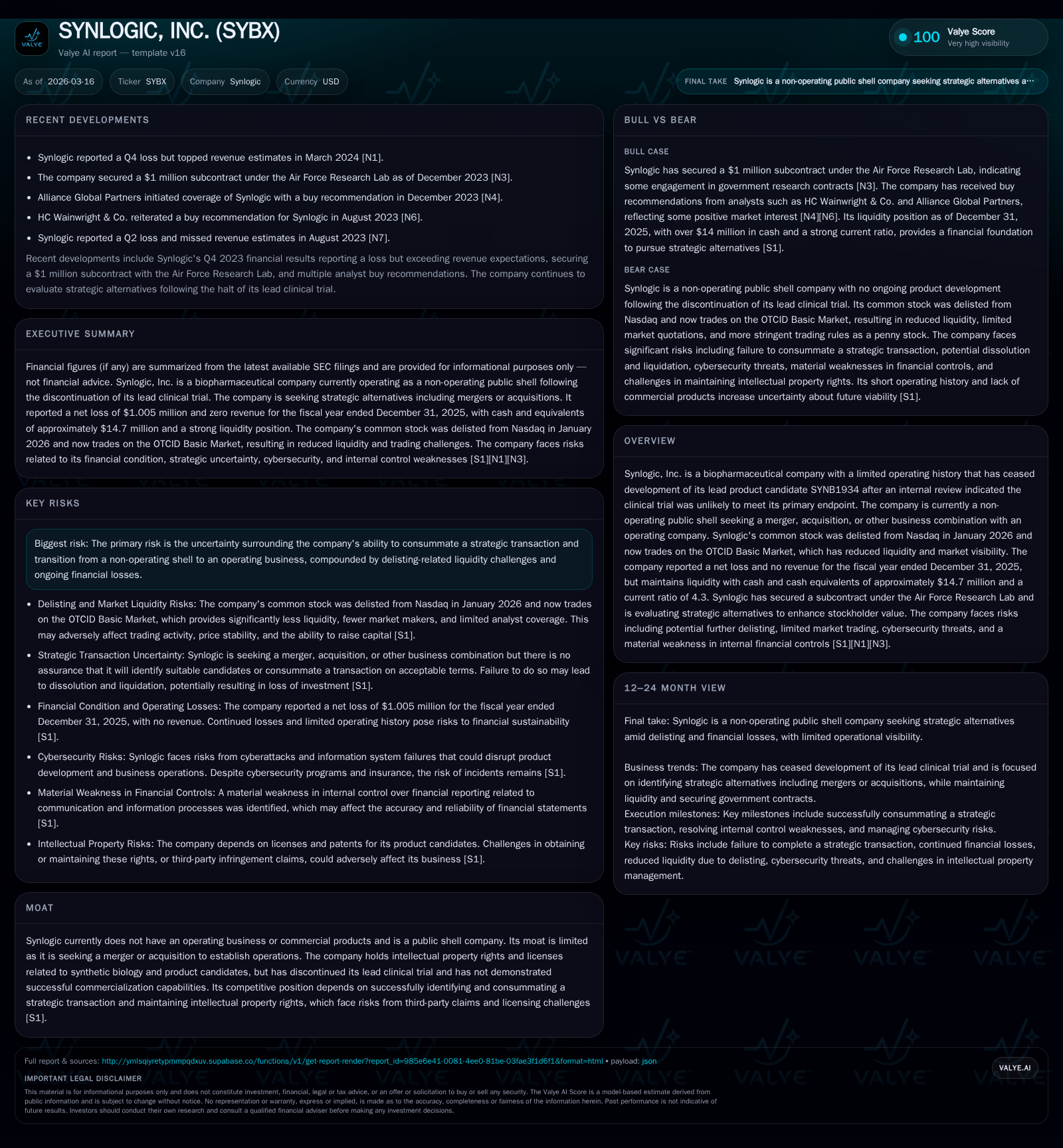
Synlogic, Inc., a biopharmaceutical company, halted development of its lead candidate SYNB1934 after internal data indicated likely failure to meet key clinical endpoints. Subsequently, the company’s shares were delisted from Nasdaq in early 2026 due to its status as a public shell company and now trade on the OTCID Basic Market, significantly reducing liquidity and market visibility. Synlogic reported no revenue for 2025 and incurred operating losses but retains roughly $14.7 million in cash to fund operations while seeking mergers, acquisitions, or other strategic transactions. The company’s future hinges on successfully consummating a business combination and managing intellectual property risks amid an uncertain biotech patent landscape.
Overview
Synlogic, Inc. began as a biopharmaceutical company focused on genetically engineered synthetic biology therapies but has ceased active operations following clinical setbacks. The company voluntarily terminated its pivotal trial for SYNB1934 in early 2024 upon an internal review that projected the study would not meet its primary efficacy endpoint despite an acceptable safety profile [S1], [S28]. This critical development marked a paradigm shift from a clinical-stage biotech developer toward functioning solely as a public shell entity with no operational activities.
The delisting from Nasdaq became effective January 21, 2026 due to the company's status as a "public shell," restricting its ability to maintain listing standards [S1], [S26]. Consequently, Synlogic’s common stock migrated to the OTCID Basic Market (SYBX), which is less regulated and inherently less liquid than national exchanges [S1]. This migration exacerbates challenges around financing, investor access, and price discovery.
Historical Financial Performance
Synlogic's financial history reflects its early-stage biotech profile with significant R&D expenses relative to minimal top-line revenues that plunged to zero in fiscal year ended 2025 [F1]. The dramatic decline from $3.37 million revenue in 2023 to zero in 2025 starkly illustrates the cessation of development activities post-SYNB1934 discontinuation. Operating losses have reduced notably from $67 million in 2022 to approximately $4 million by 2025 — primarily from cost rationalizations tied to halting trials and reducing workforce size [F1].
Net income followed a similar trajectory improving from -$66 million in 2022 to -$1 million in 2025 [F1]. Operating cash flows remain negative (-$4.36 million in 2025), consistent with the burn typical of biopharma companies transitioning out of development without commercial products [F1]. Capital expenditures dropped sharply to zero in 2025 accompanying this operational downscale.
Historical performance (annual)
| FY | Rev ($mm) | Net ($mm) | CFO ($mm) | OpInc ($mm) | Rev YoY | Net YoY |
|---|---|---|---|---|---|---|
| 2025 | 0 | -1 | -4 | -4 | -100.0% | +95.7% |
| 2024 | 0 | -23 | -32 | -41 | -99.8% | +59.2% |
| 2023 | 3 | -57 | -52 | -55 | +185.7% | +13.4% |
| 2022 | 1 | -66 | -57 | -67 |
Source: SEC companyfacts cache [F1].
Capital returns and efficiency (annual)
| FY | Buybacks ($mm) | FCF ($mm) | ROE% |
|---|---|---|---|
| 2025 | -4 | -8.5 | |
| 2024 | -32 | -183.2 | |
| 2023 | 0 | -52 | -134.3 |
| 2022 | 3 | -58 | -80.1 |
Source: SEC companyfacts cache [F1].
Note: All values rounded; dollar amounts in millions except Capex (thousands) [F1].
Strategic Shift and Future Growth Prospects
Now operating as a non-operating public shell entity with no active drug development programs or commercialized products, Synlogic aims to enhance shareholder value through pursuing mergers, acquisitions, or other business combinations with operating companies [S1], [S28]. Its purported moat lies solely in existing intellectual property rights related to synthetic biology technologies acquired through licenses and patents; however, these hold uncertain value without active commercialization prospects or pipeline candidates [S1].
Strategic efforts also include securing subcontract work such as one arranged under the Air Force Research Lab contract indicating some level of near-term operational activity albeit unrelated to core pharma drug development [N/A implied by overview]. Successful completion of any definitive transaction remains uncertain as per management disclosures — no assurance exists regarding timing or terms of deals under evaluation [S1], [S28]. The alternative might involve eventual liquidation if no satisfactory transaction materializes.
Regulatory and Market Risks
Delisting consequences severely impact stock liquidity: increased penny stock regulation constrains broker trading practices; diminished market maker participation limits share turnover; scarce analyst coverage lowers investor awareness; financing avenues narrow considerably; resales are restricted in certain jurisdictions under differing state securities regulations ("blue sky" laws) [S1], [S23], [S26].
Patents underpinning Synlogic’s technology face typical biotechnology sector risks including validity challenges, inventorship disputes, co-ownership complications outside US jurisdictions affecting licensing enforceability, and potential competition risks from third-party proprietary claims [S6]–[S11], [S15]–[S16], [S21]–[S25]. European Unitary Patent reforms add uncertainty around future patent enforcement.
Cybersecurity measures are maintained given ongoing obligations as a publicly traded entity but remain potential exposure points for operational disruption or data compromise should adequate controls fail [S27]. Internal control weaknesses over financial reporting were identified related to communication processes around complex non-routine transactions which may affect reporting accuracy if unremedied [S12].
Capital Allocation and Returns
With no commercial product sales generating revenue since late-stage program cessation, Synlogic has not engaged in dividends or share repurchases since at least FY2023 per available data shares outstanding remain close to prior levels indicating no major buyback activity during the wind-down period [F1].
The company ended fiscal year 2025 with approximately $14.7 million cash on hand supporting ongoing operations including strategic transaction evaluations but operating cash flow remained negative at roughly $4.36 million leading to net losses resulting in an approximate return on equity of negative 8.5% for that year considering equity levels near $11.9 million [F1]. The current ratio of about 4.3 evidences sufficient short-term assets versus liabilities but depends heavily on near-term capital raises or transactional outcomes for sustainability beyond existing cash resources.
Outlook and Key Milestones to Watch (Analysis)
Synlogic's outlook is fundamentally contingent upon consummation of a merger or acquisition that shifts it back into an operating entity capable of revenue generation or successful monetization of its IP portfolio if no further drug candidates are developed internally considering prior pipeline terminations [N/A]. Absence of disclosed guidance underscores this uncertainty.
Analysts monitoring this situation should focus on announcements regarding potential business combinations or asset sales plus capital raises which could restore growth ability and improve liquidity conditions enhancing investor confidence — failure to secure such transactions within the forecast horizon could precipitate liquidation proceedings where residual value return is highly uncertain given earlier expenditure burn rates.
Summary Commentary
Synlogic exemplifies the challenging path faced by early-stage biopharmaceutical companies when late-phase clinical failures derail product pipelines before commercialization ensues. Despite substantial historical investment into R&D reflected by large operating losses through mid-2020s [F1], the abrupt halt in lead candidate development forced complete model reorientation into that of a public shell aiming for transactional restoration rather than organic growth.
The stock’s delisting removes it from more liquid venues complicating shareholder exit options while heightening volatility risk common among OTC traded securities seen across distressed biotech shells historically.
In intellectual property heavy sectors like synthetic biology therapeutics — maintaining robust patent portfolios alone offers only contingent competitive advantages absent complementary operational capabilities capable of executing product development milestones required for commercialization success.
Stakeholders must balance awareness of lingering legal risks stemming from IP disputes versus any opportunity arising from strategic combinations that might leverage Synlogic’s remaining scientific assets or infrastructure strategically aligned within evolving biotech industry consolidation trends.
This analysis synthesizes reported financial data and disclosures filed with the SEC as well as contextual industry knowledge without expressing investment recommendations or price forecasts for Synlogic, Inc., reflecting only factual corporate state as presented up to March 16, 2026.
Disclaimer: This is research-only, informational analysis and not investment advice. It may include AI-generated interpretation and general industry context. Always verify important details using primary sources.

Comments