
In-Depth Analysis of Synaptics Inc’s Edge AI and Connectivity Semiconductor Strategy
Synaptics is advancing AI-enabled edge semiconductor solutions across IoT, automotive, and mobile markets while navigating supply chain and competitive challenges.
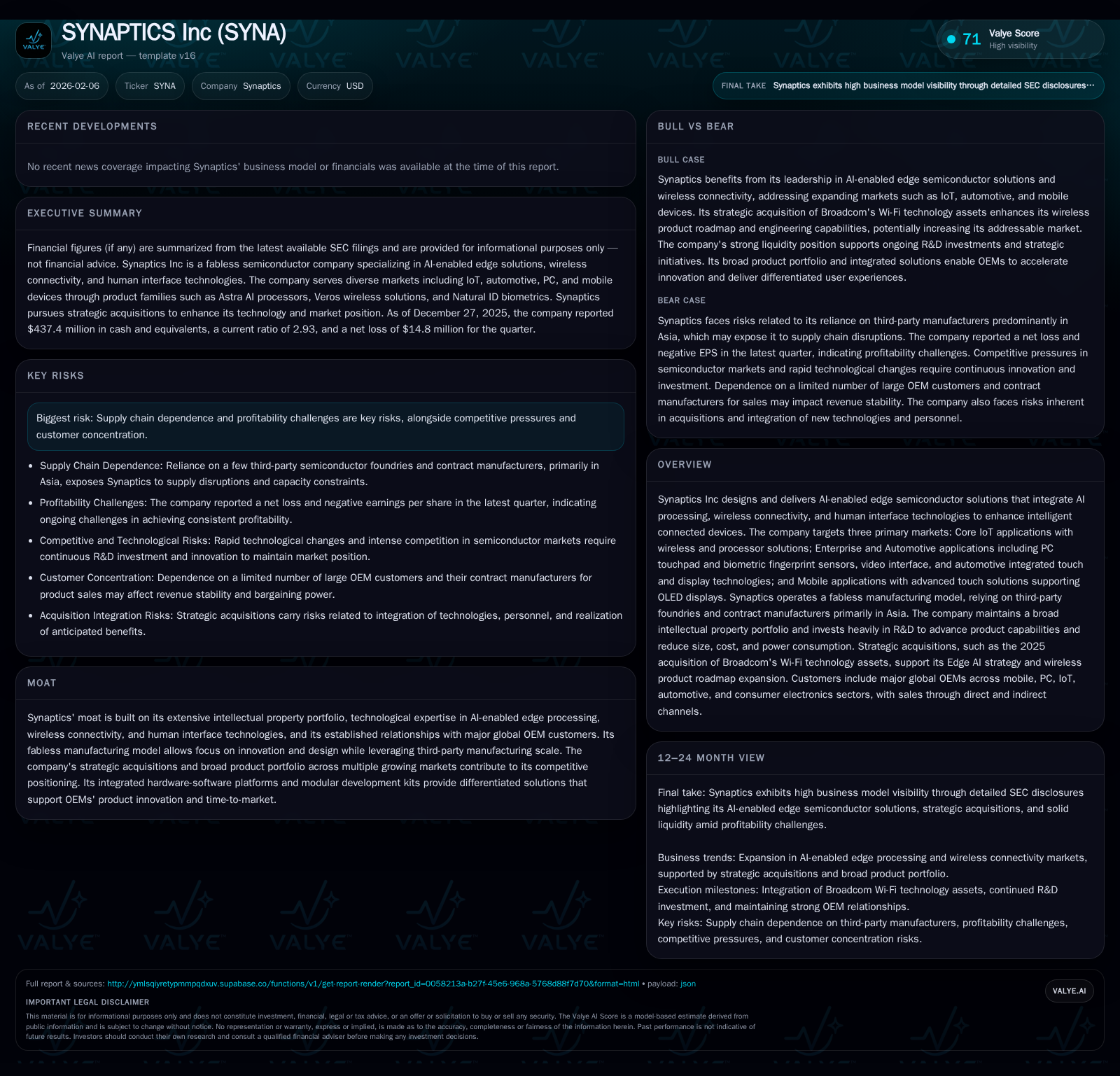
Synaptics Inc specializes in integrated AI-enabled edge semiconductor solutions with a diversified product portfolio spanning Core IoT, Enterprise and Automotive, and Mobile markets. The company leverages a fabless manufacturing model to focus on innovation and maintains a broad IP portfolio that fortifies its competitive position. Fiscal 2025 saw meaningful revenue growth driven by Core IoT wireless products and strategic acquisitions like assets from Broadcom that bolster its connectivity roadmap. Challenges persist around supply chain dependencies, automotive sector softness, and profitability despite new product launches and collaborations that strengthen the company’s technology leadership in low-latency AI processing and advanced wireless standards.
Company Overview
Synaptics Inc operates at the confluence of AI-enabled edge processing, wireless connectivity, and human interface technologies. Founded in 1986 with roots in California but now incorporated in Delaware, Synaptics has evolved into a fabless semiconductor provider focusing on premium mixed-signal solutions that power intelligent connected devices across consumer electronics, enterprise systems, automotive applications, and emerging IoT sectors [S1].
Their product framework integrates embedded AI compute with multispectral sensing — including touch controllers for OLED displays, biometric fingerprint sensors for security, video interfaces for rich media experiences, and advanced wireless communication standards pivotal to the IoT ecosystem.
Strategic Market Segments
Synaptics concentrates on three core markets:
Core IoT Applications: Driving wireless connectivity through the Veros™ family supporting Wi-Fi (up to Wi-Fi 8), Bluetooth (including BLE), Zigbee, Thread protocols alongside UWB and location services (GPS/GNSS). This includes applications spanning smart home automation devices to wearable fitness trackers.
Enterprise & Automotive: Providing touchpads, biometric sensors, video interface hardware primarily for PCs and automotive dashboards. Though automotive has softened recently due to sector-specific challenges, enterprise demand remains robust.
Mobile: Focusing on cutting-edge touch controllers optimized for OLED displays including foldable phones. Notably impacted by lifecycle events such as end-of-life shipments signaling transitional phases in smartphone OEM partnerships.
Financial Performance Insights
Fiscal 2025 signals robust expansion with consolidated revenues rising 12% year-over-year to roughly $1.07 billion. This growth outpaced prior year benchmarks mainly via the Core IoT segment's impressive 53% surge attributed to strong market uptake of wireless connectivity solutions and strategic acquisition benefits following the Broadcom Wi-Fi asset transaction [S1].
Enterprise & Automotive segment revenues increased moderately at 7%, driven predominantly by enterprise product strength that partially offset weakening sales linked to softer automotive demand cycles. Conversely, Mobile revenues slipped 9%, reflective of maturation stages within key handset client engagements [S1].
The latest quarterly report for December 2025 notes continuing operational investment effects reflected in a net loss of $14.8 million despite stable revenue streams [F1]. However, liquidity metrics remain solid with cash balances exceeding $437 million and current assets maintaining a leverage-friendly ratio near three times current liabilities.
Technological Differentiation & Intellectual Property Moat
Synaptics’ competitive moat stems from extensive intellectual property encompassing cutting-edge semiconductor design integrating AI-native processing capabilities alongside holistic hardware-software platforms. Their Astra™ line represents a scalable portfolio ranging from microcontroller units (MCUs) optimized for low-power AI inference at the edge to high-performance microprocessors engineered for latency-sensitive applications.
Complementing this is the Veros™ series addressing complex wireless coexistence demands under modern IoT scenarios where multiple radio protocols operate concurrently without interference—an increasingly critical differentiator.
Further fortifying this position is ongoing R&D investment focused on reducing size footprints (e.g., sub-millimeter touch controller packages like the S3930 designed for ultrathin foldables), improving power efficiency, and enabling multi-frequency parallel sensing technologies.
Strategic Acquisitions & Collaborations
A pivotal strategic move was Synaptics’ acquisition of certain Broadcom assets relating to their Wi-Fi technology portfolio completed in fiscal year 2025 [S1]. This expanded Synaptics' field of use to embrace all Wi-Fi products targeting emerging AR/VR devices alongside enhancing offerings for Android smartphones and consumer audio sectors. The deal also incorporated ultrawide band technology IP crucial for precise spatial awareness functions increasingly necessary in connected devices.
Additionally, collaboration with Google research underscores Synaptics' ambitions in co-developing next-generation edge AI platforms that marry energy-efficient processing with seamless device interoperability.
Manufacturing Model & Supply Chain Considerations
Operating exclusively as a fabless semiconductor entity enables Synaptics to concentrate resources on design innovation while leveraging third-party foundries primarily situated across Asia-Pacific markets including Taiwan, China, South Korea, and Japan [S1]. This model promotes agility but also introduces dependencies on external manufacturing capacity, geopolitical risks associated with tariffs or export controls, as well as logistical vulnerabilities prevalent amid recent global supply chain disruptions.
The company recognizes these risks explicitly as material factors influencing profitability and operational continuity [S2]. Appropriate risk mitigation strategies and relationship management with OEM customers remain essential components of their business resilience framework.
Industry Context & Competitive Landscape Analysis (Analyst Commentary)
The semiconductor industry is experiencing accelerating demand for integrated AI engines combined with low-latency wireless connectivity hardware—attributes crucial for realizing true ambient intelligence across personal devices and smart environments alike. Synaptics competes against diversified rivals offering discrete or software-only solutions; however, its vertically integrated approach combining silicon IP with embedded software stacks presents a unique value proposition enhancing time-to-market advantages for OEMs.
Competitive pressures remain intense due to rapid innovation cycles inherent to consumer electronics segments where cost sensitivity clashes with feature-rich demands. Moreover, customer concentration—especially reliance on marquee handset manufacturers—can impose revenue volatility tied to product refresh timings.
Risks Summary
Material risks outlined include:
- Exposure to macroeconomic conditions affecting international trade policies impacting component sourcing costs or timelines.
- Customer concentration risks particularly within mobile due to dependency on limited OEMs.
- Profitability pressures from elevated R&D spending necessary to maintain technological leadership.
- Automotive sector softness amidst broader cyclicality restricting near-term revenue diversification efforts from this segment [S1][S2].
Conclusion
Synaptics Inc stands at an inflection point leveraging its deep-rooted IP assets and burgeoning edge AI/IoT capabilities enhanced by strategic acquisition integrations like those from Broadcom. While recent financials depict cautious optimism supported by strong Core IoT growth and disciplined capital structure management, the company must navigate competitive headwinds including evolving customer needs and supply chain complexities to sustain momentum.
Its broad technology platform coupled with ongoing collaborations positions it well within the emergent landscape of intelligent connected devices. Continued focus on modular development tools, close OEM partnerships, and diversified application domains will be key levers moving forward.
Disclaimer: This analysis is intended solely for informational purposes based on publicly available data as of early 2026. It does not constitute investment advice or recommendations regarding any securities mentioned herein. Investors should perform their own due diligence before making investment decisions.
Disclaimer: This is research-only, informational analysis and not investment advice. It may include AI-generated interpretation and general industry context. Always verify important details using primary sources.

Comments