
TransAct Technologies: Recovering Profitability Through Software Integration and Supply Chain Management
TransAct's turnaround from sustained losses to improved cash flow is anchored by its strategic software license acquisition and meticulous management of manufacturing risks.
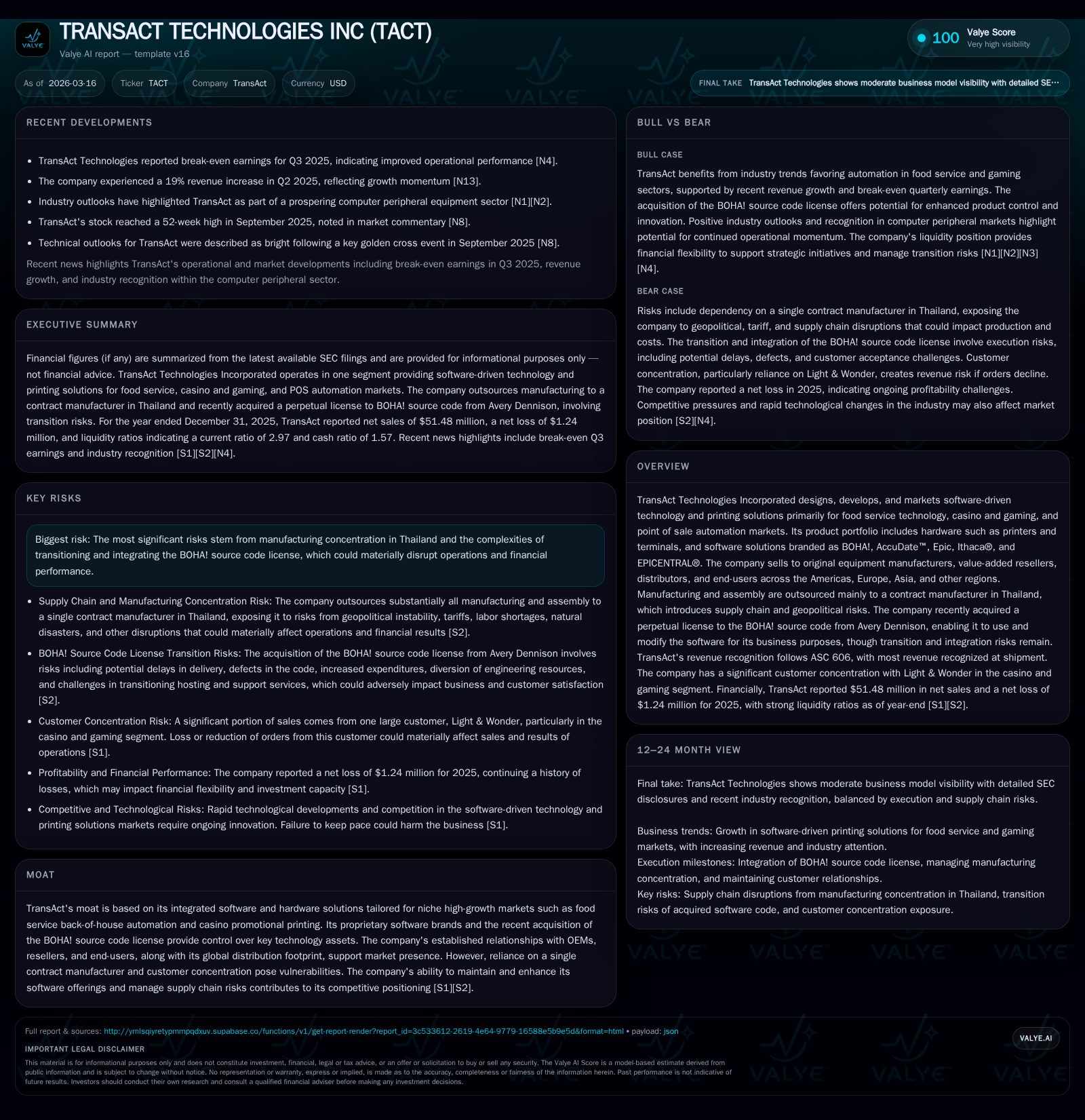
TransAct Technologies has experienced significant financial volatility in recent years, oscillating between losses and a return to positive operating cash flow. The acquisition of a perpetual license for the BOHA! source code represents a strategic pivot allowing greater product control in the food service technology market, offsetting prior dependency on external licensors. However, reliance on a single contract manufacturer in Thailand introduces ongoing operational risks. Despite net losses in 2025, the company demonstrated a marked improvement in operating income and a robust surge in operating cash flow, driving positive free cash flow generation. Capital allocation remains focused on growth investments, particularly in software development, within existing leverage and covenant constraints.
Track Record of Fluctuating Profitability and Underlying Growth Drivers
TransAct Technologies has experienced notable financial volatility over recent years. Its operating results reveal a multi-year pattern of losses punctuated by intermittent profitability, followed by renewed challenges. After an operating income loss of -$7.68 million in fiscal year (FY) 2022, the company returned to profitability with an operating income of $5.71 million in FY 2023 before again facing losses of -$3.63 million and -$1.42 million during FY 2024 and FY 2025 respectively [F1]. Net income followed a similar trajectory, with notable net losses of nearly -$8 million in FY 2024 improving substantially to just -$1.13 million in FY 2025.
This volatility primarily stems from fluctuations in demand within its core markets—food service back-of-house automation, casino promotional printing, and point-of-sale (POS) automation—and macroeconomic pressures affecting cost structures and customer buying cycles [S1]. Operating cash flow underscores this narrative: after a dismal -$12.22 million outflow in FY 2022 it rebounded strongly to $5.51 million (FY 2023), then surged further by over threefold (+312%) to $7.67 million by FY 2025 [F1], signaling improved cost control and working capital management even as top-line growth remained modest.
Historical performance (annual)
| FY | Net ($mm) | CFO ($mm) | OpInc ($mm) | Capex ($) | Net YoY |
|---|---|---|---|---|---|
| 2025 | -1 | 8 | -1 | 109000 | +85.8% |
| 2024 | -8 | 2 | -4 | 322000 | -12733.9% |
| 2023 | 0 | 6 | 6 | 901000 | -123.8% |
| 2022 | 0 | -12 | -8 | 1299000 |
Source: SEC companyfacts cache [F1].
Capital returns and efficiency (annual)
| FY | FCF ($mm) | ROE% |
|---|---|---|
| 2025 | 8 | -3.6 |
| 2024 | 2 | -26.0 |
| 2023 | 5 | -0.2 |
| 2022 | -14 | 0.8 |
Source: SEC companyfacts cache [F1].
Despite the oscillations, these figures hint at a business gradually leveraging cost discipline and operational efficiencies to stabilize margins.
Impact of the BOHA! Source Code License Acquisition on Product Control and Market Position
A pivotal strategic move occurred on August 5, 2025, when TransAct purchased a perpetual, royalty-free license for the BOHA! software source code from Avery Dennison Corporation for $2.55 million [S2]. This licensing encompasses critical components like BOHA! Control Center and BOHA!Ops applications central to food service back-of-house automation solutions—one of TransAct’s high-growth niches.
Prior reliance on Avery Dennison for earlier proprietary software versions limited TransAct's agility in feature development and customization tailored specifically for OEMs and end-users across their markets [S1]. The new license allows the company full rights to use, modify, market, host, distribute, sublicense, copy, and create derivatives.
This inward control is expected to bolster product differentiation by fostering bespoke innovation aligning closely with evolving customer needs; however, it introduces significant transition risks including:
- Potential delays or defects during code integration into TransAct’s platforms.
- Increased expenses from diverting engineering resources toward migration efforts.
- Possible disruption or interruption of existing services if code handover or migration encounters issues.
Avery Dennison maintains ownership of the source code itself which adds an additional layer of complexity concerning long-term rights beyond this non-exclusive license structure [S2]. Successfully navigating these challenges will be critical to unlocking anticipated benefits.
Operational Challenges from Manufacturing Concentration in Thailand
TransAct outsources substantially all printer and terminal manufacturing operations to a single contract manufacturer located in Thailand [S1][S14]. This concentration creates several vulnerabilities:
- Supply Chain Disruptions: Regional geopolitical tensions, pandemic resurgence risks akin to COVID-19 related shutdowns previously observed industry-wide, or natural disasters could abruptly halt production.
- Inflationary Pressures: Rising costs of components, raw materials, energy inputs and freight within Southeast Asia erode gross margins unless adequately offset by pricing or efficiency gains.
- Intellectual Property Risks: Contract manufacturers have access to proprietary technologies embedded within device assembly processes; enforcement under foreign IP laws may not mirror U.S protections creating exposure for misappropriation.
Management acknowledges these dynamics as material risks that require diversified sourcing strategies or contingency plans though such shifts would be costly and time-intensive [S21][S23]. Adequate inventory buffers and supply chain monitoring are thus prudent tactical priorities going forward.
Financial Recovery Evident in Operating Cash Flow and Reduced Operating Losses
The company’s financial statements for FY 2025 highlight meaningful progress toward earning stability despite sustaining modest net losses:
- Operating cash flow reached $7.67 million versus capex spending constrained at approximately $109 thousand—a fraction reflecting prudent capital expenditure prioritizing growth investments without eroding liquidity [F1][S9].
- Free cash flow consequently approximates $7.56 million annually (CFO less Capex), underscoring operational leverage improvements tied partly to cost rationalization efforts amid uneven revenues.
- Net loss narrowed significantly from nearly -$8 million the prior year down to about -$1.13 million with equity shrinking slightly but still strong at just over $31 million indicating ongoing potential for return enhancement [F1].
Return on equity remains negative at around -3.6%, yet positive cash generation rekindles prospects for sustained narrowing losses with disciplined expense management combined with revenue growth initiatives within niche sectors where integrated hardware/software remains critical competitive factor.[F1]
Capital Allocation Focused on Sustainable Growth Investments and Risk Mitigation
Capital allocation strategies emphasize investment primarily directed toward technology enhancements particularly software R&D associated with BOHA!, EPICENTRAL®, AccuDate™ products while staying within conservative spending limits:
- Research & development expenses ran near $6.7 million in FY 2025 focusing on specialized engineering supporting new product introduction rather than aggressive capex deployment which was kept below past levels [$109K vs ~$322K prior] [S8][F1].
- The company maintains no dividend payments post-2020 reflecting cautious capital preservation amidst restructuring phases [F1][S9].
- There were no share buybacks during recent years; historical repurchases ceased after cumulative spend exceeding $32 million through FY2019 at an average price near $7.94 per share [F1][S9].
- A revolving credit facility with Siena Lending Group LLC caps borrowing capacity at $10 million subject to borrowing base calculations related to accounts receivable/inventory supporting manageable leverage ratios; compliance with covenants including minimum excess availability ensures financial flexibility while preventing aggressive debt accumulation or structural changes absent lender approval [S5][S6][S25].
These measures position the company cautiously yet enable targeted innovation critical for regaining growth momentum.
Near-Term Milestones and What to Monitor in TransAct's Transition Phase
Key near-term developments will center on smooth execution of the transition mandated by the BOHA! source code acquisition agreement including milestone deliverables from Avery Dennison as well as internal integration timelines:
- Whether defect remediation requests arise post-license handover affecting operational continuity or require costly reengineering efforts remains uncertain but pivotal for long-term software reliability [S2].
- Order fulfillment rates driven by contract manufacturer performance amid global inflationary pressures need continuous observation given their direct impact on sales recognition cadence and customer satisfaction levels [S1].
- Expansion within food service back-of-house automation leveraging proprietary BOHA! capabilities could catalyze revenue gains if penetration deepens among restaurant chains/supermarkets leveraging real-time production workflow automations .
Earnings calls or quarterly disclosures updating progress milestones related to these operational transitions should offer valuable indications into execution quality.
Risk Factors Defining Future Performance Stability for Investors
Risks that could materially affect future performance include:
- Heavy dependence on single contract manufacturing operations concentrated exclusively in Thailand exposes ongoing supply chain disruption risk along with geopolitical challenges not entirely mitigable through inventory alone [S14][S21][S23].
- Customer concentration risk surfaces via major gaming customer Light & Wonder constituting up to ~9–11%+ of sales requiring vigilance on order stability amid competitive pressures or gaming industry cyclicality [S10][S21].
- Integration complexity surrounding acquired BOHA! source code carries uncertainty both technically and financially given possibilities of increased non-recurring charges or delayed feature rollouts impacting customer retention cycles [S2].
- Intensifying competition within POS automation threatens pricing power highlighting need for continued innovation under proprietary integrated solutions offered through bundled hardware & software like Epic®, AccuDate™ platforms maintained by TransAct [Analysis based on competitive landscape dynamics discussed internally].[S20]
- Economic headwinds including inflation-driven cost escalation coupled with fluctuating end-user demand patterns may constrain top-line growth requiring agile pricing tactics balanced against customer retention incentives.
Transparency around mitigation strategies addressing these risks will be essential for assessing medium-term viability.
This report presents an analysis synthesized exclusively from verified SEC filings and company disclosures as enumerated; no speculative financial projections or investment advice are provided herein.
Disclaimer: This is research-only, informational analysis and not investment advice. It may include AI-generated interpretation and general industry context. Always verify important details using primary sources.

Comments