
Target Corp: Navigating Retail Transformation with Integrated Digital-Physical Channels
Target continues evolving its discount retail model through digital expansion and retail media initiatives amid tightening liquidity metrics.
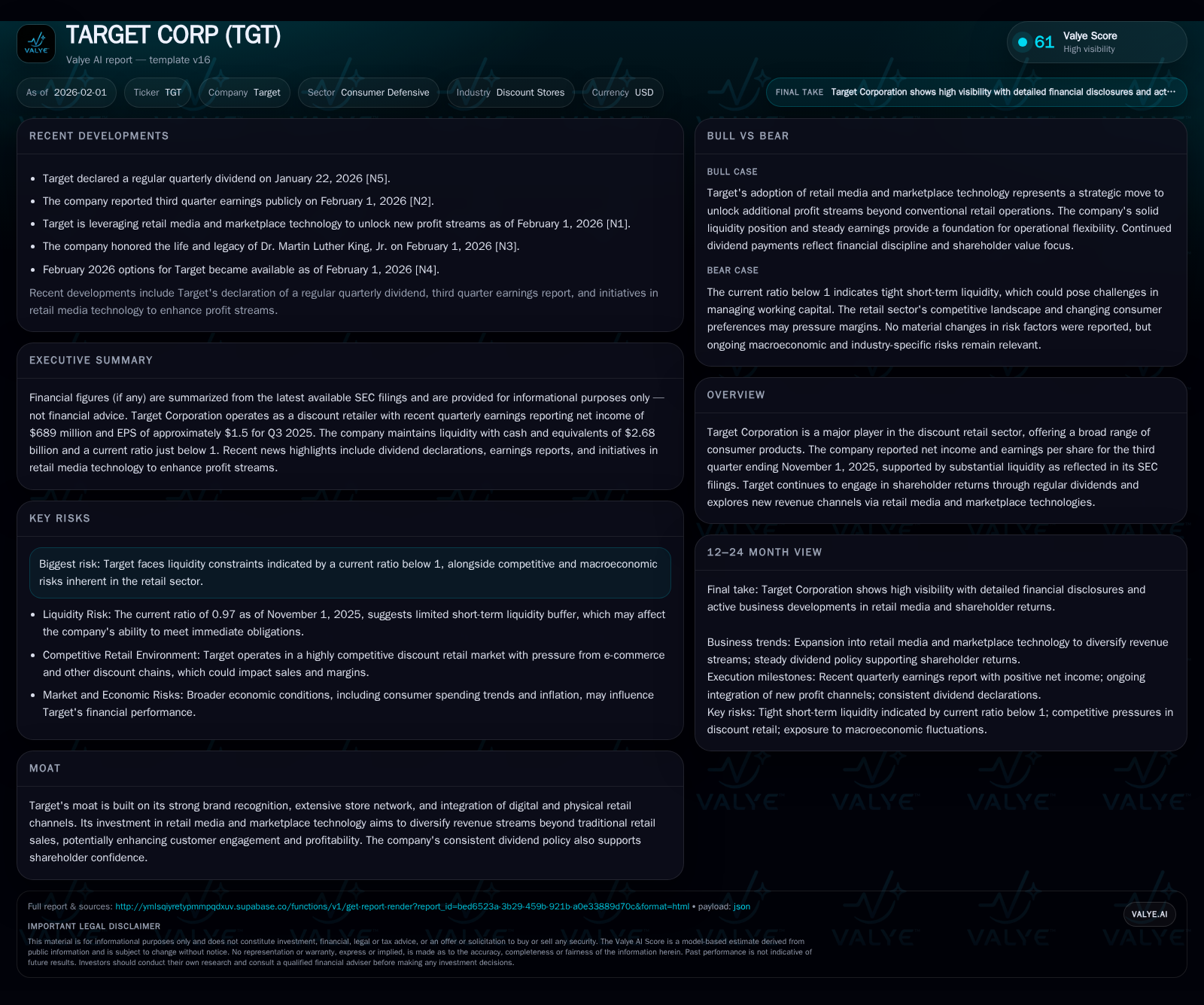
Target Corporation reported steady third-quarter results supported by strong brand positioning and an expansive store footprint. The company is actively expanding its digital capabilities via retail media and marketplace technology, aiming to diversify revenue streams beyond traditional retail sales. However, a current ratio below 1.0 highlights liquidity constraints that warrant close monitoring. Competitive pressures and macroeconomic headwinds remain key challenges in the discount retail industry.
What Changed Recently
Target reported third quarter earnings for the period ending November 1, 2025, showing net income of $689 million. While overall performance remained stable, liquidity metrics revealed some pressure with a current ratio just under 1.0 at 0.97, indicating current liabilities slightly exceed current assets [N1][S3]. Concurrently, Target has been vocal about its efforts to unlock new profit streams through retail media and marketplace technologies. These initiatives are designed to capitalize on Target’s rich consumer data and leverage its physical and digital footprint to generate higher-margin revenue beyond traditional product sales [N2]. The company also maintained its regular quarterly dividend, underscoring a commitment to returning capital to shareholders amidst a challenging retail environment [N6].
Business Model as a System
Target operates as a discount retailer providing a broad assortment of merchandise including apparel, home goods, electronics, and groceries. The company’s extensive store network is complemented by an omnichannel strategy integrating physical stores with digital platforms. This integration enables customers to shop online with options like same-day delivery, in-store pickup, and drive-up services.
Financially, Target generates revenue primarily through product sales, but it is increasingly monetizing its platform via retail media — advertising services targeted to the shopper base — and a marketplace model that allows third-party sellers to list goods on Target’s digital platform. These emerging revenue streams aim to improve gross margins by reducing reliance on lower-margin product sales.
From a risk perspective, Target’s disclosures indicate no material changes in risk factors as of the latest filings. Key risks remain macroeconomic volatility affecting consumer spending, supply chain disruptions, and intensifying competition within the discount retail sector [S1][S2]. The company’s liquidity position, with current assets slightly below current liabilities as reflected in the 0.97 current ratio, suggests some operational flexibility constraints which management must navigate carefully.
Industry Map & Competitive Battlefield
The discount retail industry is characterized by high competition and thin margins, with dominant players including Walmart, Costco, and Amazon. Consumer preferences increasingly favor convenience, price sensitivity, and seamless digital shopping experiences.
Target distinguishes itself by combining value pricing with a differentiated brand image that emphasizes style and quality. Its network of approximately 1,900 stores serves as a physical touchpoint that supports its digital offerings, creating a hybrid retail experience.
The rise of retail media platforms introduces a new dimension of competition, where retailers seek to monetize shopper data and attract third-party sellers. Amazon remains a formidable competitor in this space due to its scale and advanced advertising technology. Other traditional retailers are also investing in marketplace models to capture incremental revenue.
Supply chain efficiency is a critical battlefield, with successful players investing heavily in logistics automation and inventory management systems to ensure product availability and cost control. Inflationary pressures on input costs and labor further squeeze margins across the sector.
Where the Economics Become Real
At the unit level, Target’s economics depend heavily on inventory turnover, supply chain costs, and the ability to convert foot traffic into sales across channels. The physical stores serve not only as sales points but also as fulfillment hubs, which reduces last-mile delivery costs and improves customer convenience.
Retail media and marketplace monetization offer attractive margin expansion opportunities. Advertising revenue scales with digital traffic and shopper engagement, while marketplace commissions provide fee-based income without the inventory risk. However, these new revenue streams require upfront tech investment and ongoing data analytics capabilities.
Liquidity constraints reflected in the current ratio below 1.0 can limit the company’s ability to invest aggressively in growth initiatives or absorb supply chain shocks. Cash and equivalents stand at approximately $2.68 billion, which provides some buffer but does not eliminate near-term financial risks [S3].
Diligence Questions / Disconfirming Signals
- How scalable and defensible are Target’s retail media and marketplace platforms against entrenched competitors like Amazon?
- What is the impact of the sub-1.0 current ratio on Target’s operational agility, especially in managing inventory and supply chain disruptions?
- How effective is Target’s omnichannel integration at driving incremental sales and customer loyalty in the face of rising digital competition?
- Are there signs of margin compression due to inflationary cost pressures or competitive discounting beyond what management has disclosed?
- How is Target addressing labor cost inflation and logistics challenges that could impair supply chain efficiency?
- What is the runway for digital revenue streams to meaningfully offset pressure on traditional retail margins?
- Are there emerging risks in the retail media space such as privacy regulations or advertiser concentration?
This analysis is based on public sources and company disclosures as of February 2026. It is intended for informational purposes and does not constitute investment advice. Readers should conduct their own due diligence before making any financial decisions.
Disclaimer: This is research-only, informational analysis and not investment advice. It may include AI-generated interpretation and general industry context. Always verify important details using primary sources.

Comments