Thermon Group’s Financial Resilience and Strategic Positioning Amid Industrial Digitization
An in-depth look at Thermon’s recent strong earnings, liquidity strength, and market standing within a digitizing industrial landscape.
Thermon Group Holdings posted a robust Q3 fiscal 2026 earnings beat contrasting peers’ misses, underscoring operational momentum and financial solidity. With a current ratio of 2.9 and $46.9 million in cash and equivalents, Thermon appears well-positioned to weather industrial cyclicality. While detailed disclosures on its competitive moat remain limited, industry coverage highlights Thermon’s alignment with growing digitization trends, presenting thematic opportunities. Key risks persist around market volatility and execution challenges, demanding close monitoring as the company navigates an evolving sector.
Clarity in Numbers: Decoding Thermon’s Latest Financial Results
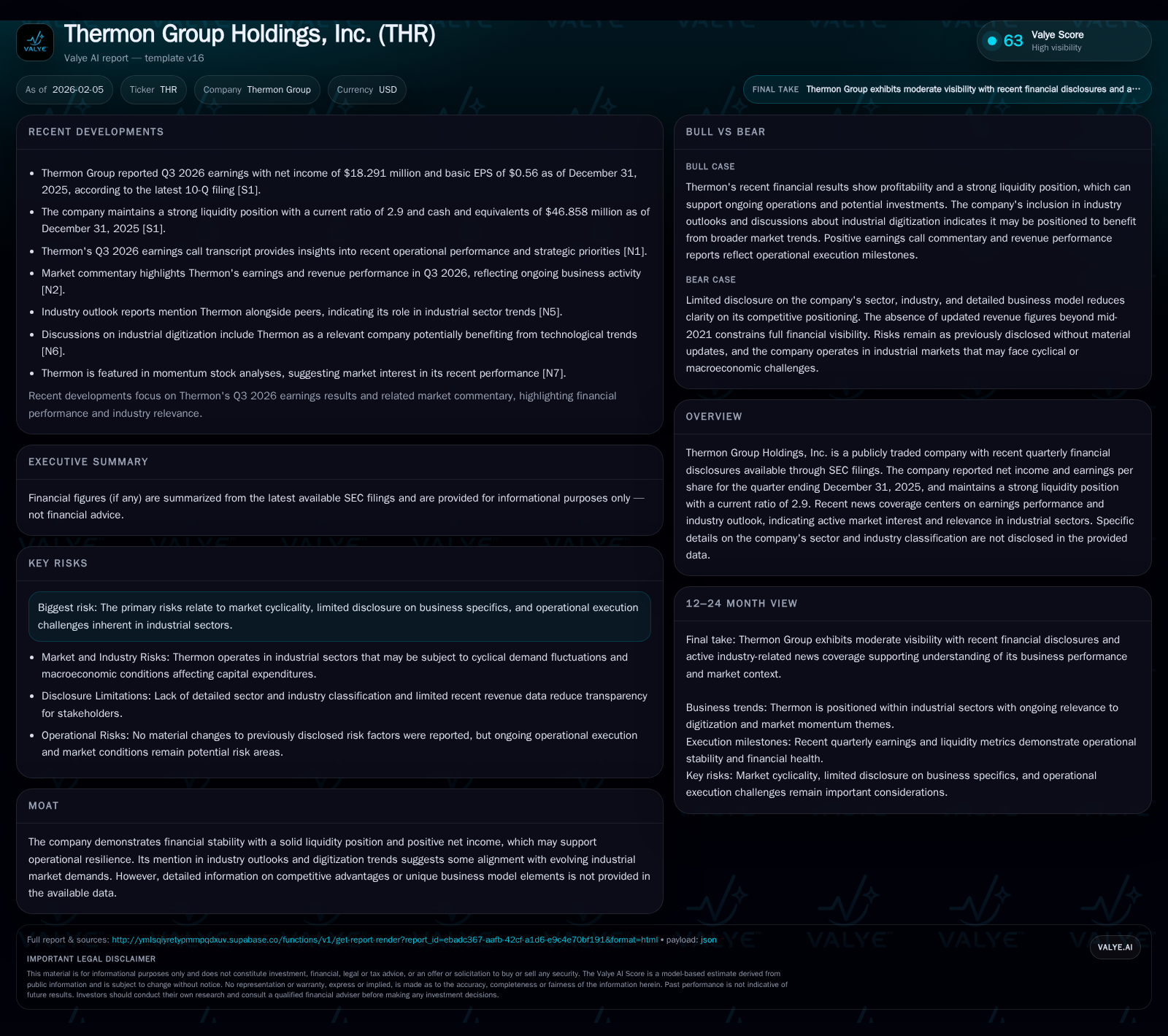
Thermon Group Holdings (THR) delivered an impressive third-quarter performance for fiscal year 2026, notably beating analyst revenue and earnings estimates according to the February 5 earnings release [N2]. The company reported net income of approximately $18.3 million for the quarter ending December 31, 2025 [F1], signaling healthy profitability in a challenging industrial environment. Earnings per share similarly outpaced consensus, reflecting efficient cost management alongside revenue growth momentum indicated in both transcript insights [N1] and numerical disclosures.
This robust quarterly showing contrasts sharply with contemporaneous results from industry peers such as Transcat and Badger Meter, who reported earnings misses in the same period [N3][N4]. Thermon’s outperformance highlights its resilience amidst sector headwinds, positioning the company positively relative to comparable industrial instrumentation firms.
Liquidity and Operational Resilience: Beyond the Headlines
Digging deeper into Thermon's financial stability reveals a noteworthy current ratio of 2.9 as of December 31, 2025 [F1], derived from current assets totaling about $321 million against current liabilities near $111 million. This liquidity buffer is further supported by roughly $46.9 million held in cash and equivalents [F1], underscoring substantial short-term financial flexibility.
Strong liquidity is particularly significant given the cyclicality often intrinsic to industrial markets—a theme explicitly referenced in the company's risk disclosures which remain unchanged from prior filings [S2]. This resource availability could enable Thermon to sustain operational consistency through volatile demand cycles, invest selectively in strategic initiatives, or absorb unexpected disruptions without compromising core business functions.
Industry Context: Thermon Within an Evolving Industrial Landscape
While exact industry classification details are not explicitly provided, multiple recent analysts’ commentaries frame Thermon squarely within the broader narrative of industrial digitization—a key transformative trend across instrument manufacturers [N5][N6]. Coverage from Zacks highlights Thermon among companies poised to benefit from integrating advanced digital technologies into traditional industrial equipment frameworks.
Such alignment suggests that Thermon's business model may incorporate or be evolving towards enhanced connectivity, data analytics capabilities, or automation solutions, which are increasingly demanded by end markets seeking efficiency and remote monitoring options. These themes resonate strongly with growth opportunities identified in the instrumentation space as digitization reshapes customer expectations.
Competitive Edges or Gaps: What We Know and Don’t About Thermon’s Moat
Thermon demonstrates signs of financial stability conducive to operational resilience — a foundational component of competitive strength—yet explicit details on proprietary technology, customer contracts, or differentiated product offerings remain limited within the disclosed data set [valye_report_excerpt].
This opacity makes it difficult to definitively assess the uniqueness or defensibility of its business model relative to peers. However, its ability to consistently generate profits while maintaining robust liquidity suggests competent execution and possibly entrenched customer relationships facilitating repeat business amid cyclical pressures.
Acknowledging these informational gaps candidly is crucial; without granularity on strategic differentiators such as intellectual property or specialized service capabilities, conclusions about moat strength must be guarded.
Risk Profile: Persistent Challenges in Industrial Cyclicality and Disclosure Gaps
Thermon’s risk landscape carries forward familiar challenges common across industrial sectors. Foremost among these is exposure to market cyclicality driven by fluctuating capital expenditures of end-users sensitive to economic cycles—a reality expressly acknowledged without material change in the latest SEC filing [S2][valye_report_excerpt].
Additionally, operational execution risks persist given the complexity of sustaining product quality, supply chain reliability, and timely innovation in rapidly evolving markets. Limited public disclosure on detailed business operations complicates external assessments of risk mitigation effectiveness.
This combination calls for vigilance around potential downturns impacting sales volumes or margins, as well as uncertainties tied to emerging investments in digitization initiatives whose returns may lag cost timelines.
Market Perception and Peer Comparisons: Analyzing Investor Sentiment
The contrasting earnings narratives within the instrumentation peer group accentuate Thermon's favorable positioning. Where Transcat (TRNS) notably missed its Q3 earnings estimates by wide margins [N3], and Badger Meter (BMI) reported lagging Q4 results [N4], Thermon's beat fueled comparatively optimistic investor reception [N2].
Such differentiation may stem from superior operational execution or favorable market positioning that enables capturing incremental orders or commanding pricing power amid broader industry softness. It also suggests that investors recognize some degree of margin of safety or upside potential embedded within Thermon's fundamentals relative to peers grappling with more pronounced cyclical setbacks.
The Digitization Opportunity: Aligning Thermon’s Strategy with Emerging Trends
Despite relatively scant direct commentary from management regarding specific digital products or platforms, external analyses affirm that Thermon stands among select instrument stocks likely to benefit from ongoing industrial digitization waves [N5][N6].
These insights point toward an implicit strategic alignment where Thermon may leverage digital instrumentation advancements—such as IoT-enabled sensors or real-time analytics—to enhance value propositions for clients aiming at process optimization and predictive maintenance.
While this thematic fits within broader sector dynamism attracting buy-side interest (‘two instruments stocks’ thesis), the extent to which these initiatives translate into material revenue streams remains a critical investigative avenue going forward.
Outlook and Questions for Investors: Navigating Uncertainties Ahead
Summarizing the above paints a picture of a fiscally sound company executing well against peer benchmarks while operating within a transforming industrial domain ripe with digital growth possibilities. Nevertheless, persistent risks related to cyclical demand swings and limited transparency around competitive moats warrant caution.
Investors might focus on how upcoming quarters unfold concerning:
- Evidence of sustained top-line expansion linked to digital product adoption,
- Maintenance or improvement in liquidity supporting strategic flexibility,
- Management disclosures offering clearer insights into competitive differentiators,
- Resilience against macro-driven industry slowdowns noted historically.
As per the latest SEC filing highlighting no material changes in risk factors compared to last year [S2], steady-state challenges remain unchanged but are tempered by demonstrated momentum thus far [valye_report_excerpt]. Ongoing scrutiny will be essential to distinguish transient volatility from fundamental shifts shaping long-term trajectory.
This analysis is prepared solely for informational purposes based on publicly available data as of February 2026 without any form of investment advice or recommendations.
Disclaimer: This is research-only, informational analysis and not investment advice. It may include AI-generated interpretation and general industry context. Always verify important details using primary sources.

Comments