
TJX Companies Inc (TJX) Equity Analysis: Navigating Operational Challenges and Growth in Off-Price Retail
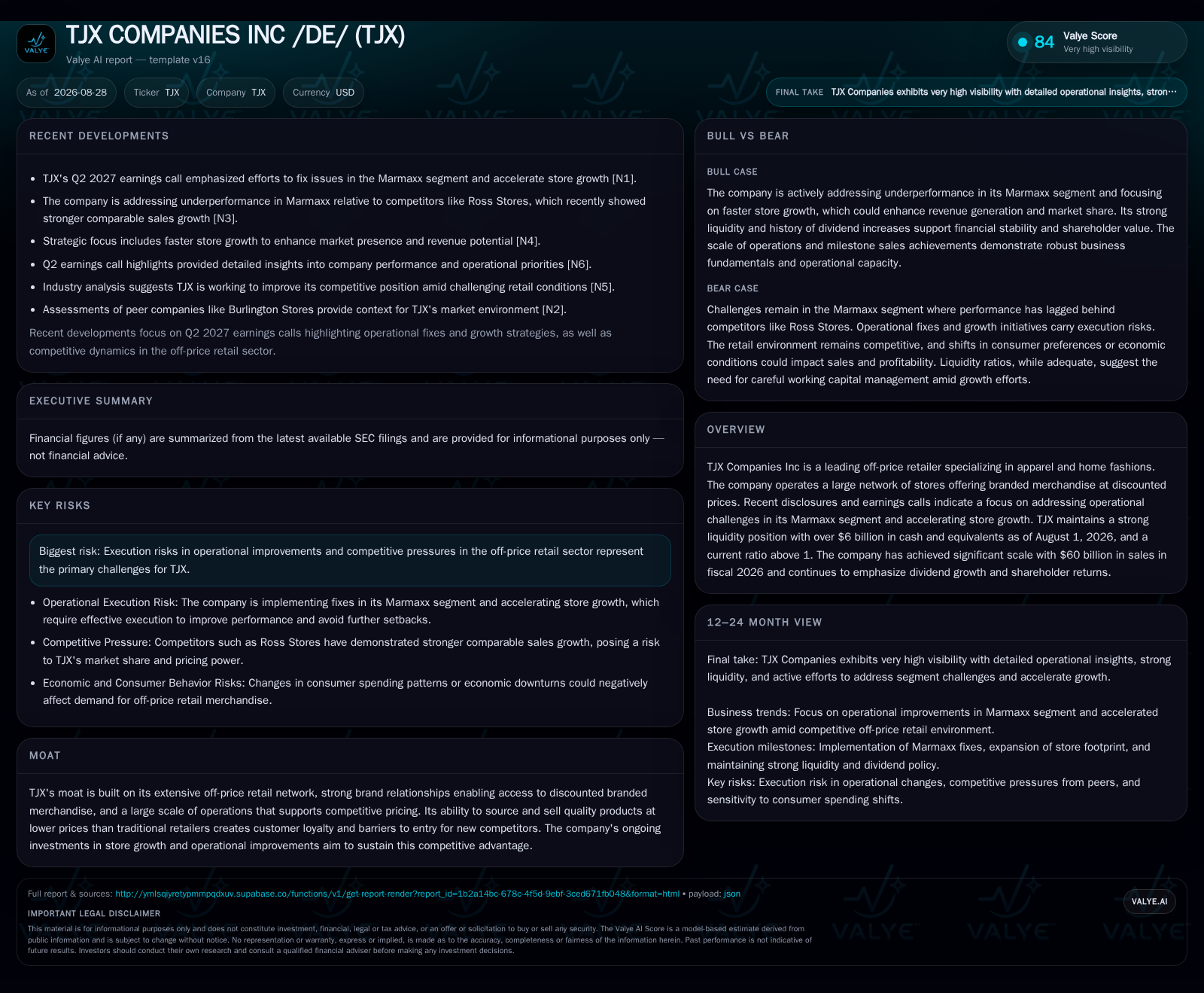
TJX is a leading off-price retailer with a vast store network and robust scale, currently addressing operational setbacks in its Marmaxx segment while pursuing accelerated store growth to strengthen its competitive position amid evolving retail dynamics.
TJX operates a large off-price retail platform with significant scale but faces execution risks tied to operational improvements in its underperforming Marmaxx segment. The company’s reported liquidity position and milestone sales achievement underscore financial stability, while strategic emphasis on faster store growth aims to restore competitive momentum against peers like Ross Stores. TJX’s durable advantage stems from its extensive sourcing and distribution network, but competitive pressures and consumer behavior shifts remain key risks. The near-term outlook hinges on effective execution of operational fixes and growth initiatives in a challenging retail environment.
TJX Companies Inc is a dominant player in the off-price retail sector, offering branded apparel and home fashions at discounted prices through a large store network. As of mid-2026, TJX boasts a sizable $60 billion sales run rate and reported liquidity position, positioning it well for growth investments. However, the company faces operational headwinds, notably in its Marmaxx division, which has lagged behind competitors such as Ross Stores. Management’s current strategic focus on addressing these operational challenges while accelerating store growth is critical to regaining market share and enhancing profitability amid a competitive and evolving retail landscape.
Latest Operating Snapshot
TJX reported a net income of $1.52 billion for the quarter ended August 1, 2026, with basic EPS of $1.38 and diluted EPS of $1.36, signaling solid profitability despite segment challenges [S2]. The company holds approximately $6.0 billion in cash and equivalents, alongside current assets of $15.3 billion and current liabilities of $13.4 billion, yielding a current ratio of 1.15 and a cash ratio of 0.45, indicative of adequate short-term liquidity [S2].
Recent earnings calls in August 2026 emphasized active efforts to rectify underperformance in the Marmaxx segment and accelerate store growth initiatives, underscoring management’s prioritization of operational improvements and market expansion [N1][N4][N6]. Notably, industry comparisons show Ross Stores outperforming TJX in comparable sales growth, highlighting competitive pressures in the off-price retail space [N3]. TJX also achieved a milestone $60 billion in sales for fiscal 2026, reflecting its scale and market reach [S1].
Business Model and Unit Economics
TJX’s business model centers on off-price retailing—sourcing branded apparel and home goods at discounted prices and selling through a large network of stores. Revenue generation primarily depends on volume sales bolstered by a compelling value proposition of discounted quality merchandise. Pricing is generally constrained by off-price market dynamics, but product mix and sourcing efficiency affect gross margins. Fixed costs include store leases and logistics infrastructure, while variable costs relate to inventory procurement and labor.
Operating leverage is plausible if TJX efficiently scales store expansion and improves Marmaxx performance, spreading fixed costs over higher volumes. However, capital intensity is moderate; new stores require upfront investment but benefit from established supply chains. The unit economics hinge on maintaining inventory freshness and shopper frequency, with switching frictions driven by brand assortment and price competitiveness. Successful operational fixes could improve turnover and margins, but failure risks margin compression amid competitive price pressure.
Moat, Competition and Counterforces
TJX’s moat derives from its extensive off-price retail network, strong vendor relationships enabling access to branded merchandise at deep discounts, and scale economies allowing competitive pricing and broad geographic reach. These factors create customer loyalty by delivering strong value and limit new entrants due to complex sourcing and distribution requirements. The company’s multi-format presence (including Marmaxx and T.J. Maxx) further diversifies risk and captures different shopper segments.
Countervailing forces include intensifying competition from Ross Stores and Burlington, which have demonstrated stronger comparable sales growth and operational agility. Shifts in consumer preferences, economic downturns, or inventory mismanagement could erode TJX’s positioning. Moreover, the underperformance in Marmaxx reveals vulnerabilities in execution. The off-price sector’s reliance on opportunistic sourcing may also expose TJX to supply chain volatility and inventory risk, challenging consistent assortment quality.
Bull Case
In the bull scenario, TJX successfully implements operational fixes in the Marmaxx segment, improving merchandising, inventory management, and customer experience. Accelerated store growth increases market penetration and drives meaningful revenue and profit expansion. reported liquidity position enables continued dividend growth and selective investments in technology and supply chain efficiency, reinforcing competitive advantages.
The company’s scale and vendor relationships allow it to maintain superior pricing and product assortment, attracting value-conscious consumers amid inflationary or economic uncertainty. Comparable sales growth rebounds, narrowing the gap with Ross Stores. Evidence supporting this scenario includes improving comparable store sales metrics, rising gross margins, and positive commentary on operational improvements in subsequent earnings calls. Failure to show sustained progress on these fronts would falsify the bull thesis.
Base Case
The base case envisions gradual progress in resolving Marmaxx’s operational issues, with moderate improvement in sales and profitability offsetting ongoing competitive pressures. Store growth continues at a measured pace, contributing incremental revenue but with limited margin expansion due to cost inflation and competitive discounting.
TJX maintains reported liquidity position and dividend policies, supporting shareholder confidence but faces persistent challenges in matching peer comparable sales performance. Market share remains stable but does not significantly expand. This scenario is confirmed by modest improvements in segment results, stable but unspectacular comparable sales trends, and continued cautious commentary from management. Contrarily, a sharp deterioration in sales or liquidity would contradict this outlook.
Bear Case
In a downside scenario, execution risks materialize as fixes in Marmaxx fail to yield meaningful improvements, resulting in continued underperformance relative to competitors. Store expansion dilutes capital without generating expected returns, while inflationary pressures compress margins. Consumer shifts away from off-price retail or macroeconomic downturns reduce traffic and spending.
Liquidity tightens as working capital needs increase, constraining investment capacity. Competitive pricing pressure from Ross Stores and others erodes pricing power and volume growth. Evidence includes sustained negative comparable sales, margin contraction, inventory write-downs, and weakening cash flow metrics. A reversal of operational setbacks or improved sales trends would falsify the bear case.
What Matters Next
Key performance indicators to monitor include comparable store sales growth by segment—especially Marmaxx—to gauge operational improvements. Store expansion pace and productivity will indicate success in growth initiatives. Gross margin trends and inventory turnover metrics will reflect cost control and merchandising effectiveness.
Liquidity ratios, including cash and working capital trends, are vital to assess potential financial flexibility amid growth investments. Dividend sustainability and potential increases signal confidence in cash flow. Competitive positioning metrics, such as market share shifts relative to Ross Stores and Burlington, provide context on relative performance. Finally, management commentary on supply chain stability and consumer demand patterns will offer early signals of risk or opportunity.
Disclaimer: This is research-only, informational analysis and not investment advice. It may include AI-generated interpretation and general industry context. Always verify important details using primary sources.

Comments