
T-Mobile Leverages Multi-Layered 5G Spectrum to Sustain Subscriber Momentum and ARPU Expansion
T-Mobile’s Q2 2026 results highlight continued postpaid subscriber growth, enhanced ARPU, and the strategic value of its multilayer 5G spectrum amid rising cybersecurity risks.
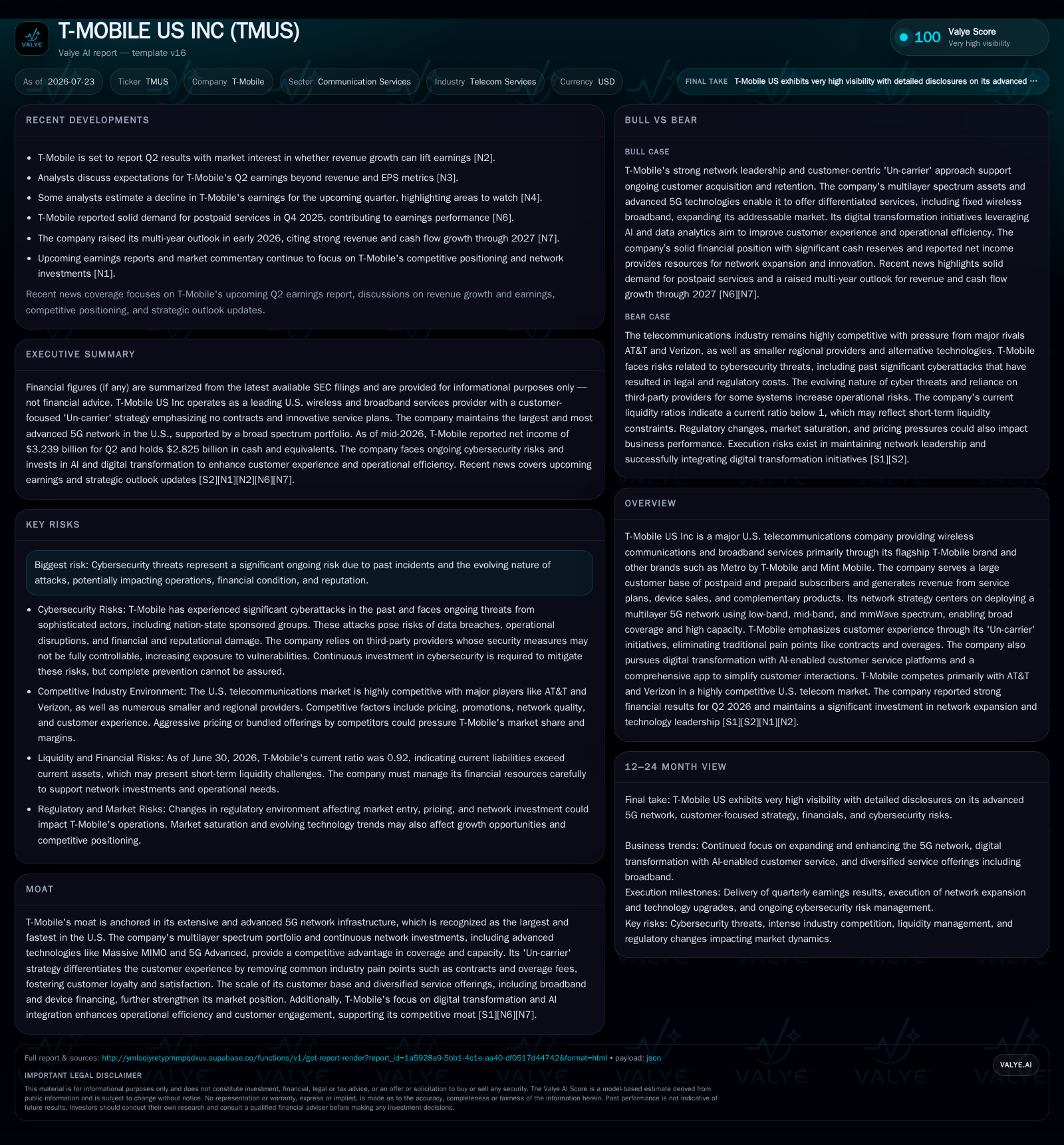
In its latest quarterly filing dated July 23, 2026, T-Mobile US demonstrated sustained net additions across both postpaid and prepaid segments, underpinned by its Un-carrier strategy that eliminates contractual friction and fosters customer loyalty. The company’s broad spectrum portfolio—including low-, mid-, and mmWave bands—supports superior network coverage and capacity, allowing innovative offerings such as fixed wireless broadband. Digital transformation initiatives leveraging AI-driven service automation have improved operational efficiency and customer engagement. However, escalating cybersecurity threats remain a significant risk requiring ongoing vigilance. Capital expenditure commitments continue to focus on network densification despite balance sheet constraints. Key upcoming metrics around subscriber growth, ARPU trends, churn rates, and security outcomes will be critical to assess execution in a competitive landscape dominated by AT&T and Verizon.
Q2 Results Spotlight: Sustained Subscriber Growth Amid Competitive Pressures
In its July 23, 2026 Form 10-Q filing [S2], T-Mobile reported ongoing robust net additions in its subscriber base across both postpaid and prepaid segments. This growth is notable given an intensely competitive U.S. wireless telecom market where major peers AT&T and Verizon aggressively invest in network capacity and aggressive pricing [S1]. The ability to add subscribers while maintaining ARPU indicates that T-Mobile's differentiated value proposition resonates with consumers navigating increasingly commoditized wireless offerings.
Subscriber momentum reflects the company’s success in targeting diverse demographics through multiple brands including flagship T-Mobile, Metro by T-Mobile, and Mint Mobile [S1]. Expanding total subscribers remains a fundamental lever for revenue growth since wireless carriers monetize mainly through monthly service plans whose revenues scale with subscriber volume.
'Un-carrier' Initiatives Reshape Customer Economics and Churn Dynamics
T-Mobile’s proprietary Un-carrier strategy is a core driver behind improving customer economics evidenced this quarter [S1][S2]. By abolishing annual contracts, overage charges, unpredictable roaming fees, and data buckets, T-Mobile removes longstanding industry pain points that historically triggered customer dissatisfaction.
This approach boosts loyalty metrics by fostering a more transparent pricing structure with no surprise fees—directly supporting lower churn rates relative to legacy models reliant on lock-in contracts [S1]. High customer satisfaction scores reported by the company validate these benefits. Moreover, improved retention allows for better lifetime value per user even amid competitive pressure on headline prices.
Layered Spectrum Portfolio Fuels Superior Network Coverage and Capacity Advantage
Central to T-Mobile's competitive moat is its expansive control of spectrum licenses spanning low-band (600/700 MHz), mid-band (AWS/PCS/2.5 GHz), and millimeter-wave segments [S1]. As of end-2025, the company controlled approximately 394 MHz of combined low- and mid-band spectrum nationwide—the largest portfolio among national carriers barring Verizon’s exclusive mmWave holdings.
This multilayer spectrum strategy enables comprehensive geographic coverage (low-band) combined with enhanced capacity and throughput (mid-band) plus ultra-high speeds in dense urban areas (mmWave). Such diversity not only supports superior consumer mobile experiences but also facilitates premium fixed wireless broadband offerings designed to substitute traditional wireline internet services [S1]. This breadth differentiates T-Mobile from peers weighted more heavily toward either low-band or mmWave alone.
'Digital First' Enhances Experience with AI-Powered Service Automation
Complementing its network strength is T-Mobile's transformation into a digital-first operator embracing AI-based platforms to streamline customer service interactions [S1][S2]. The company’s T-Life app offers customers seamless self-service features including line additions, device upgrades, and plan changes at their convenience.
This digital sophistication helps reduce customer acquisition costs (CAC) by lowering dependence on physical retail or call-center support while simultaneously enhancing personalization through data analytics. Such improvements likely contribute to higher ARPU by enabling tailored offers that drive incremental spending without appearing intrusive.
Cybersecurity Exposure: Operational Risk Escalation Necessitates Vigilance
A pressing risk area highlighted in the updated Q2 risk disclosures involves persistent cybersecurity threats targeting confidential customer, employee, supplier data as well as critical systems [S25]. The company acknowledges cyberattacks are increasing both in frequency and complexity—perpetrated by actors ranging from nation-states to insiders exploiting credentials or software vulnerabilities.
Given telecom’s reliance on vast interconnected networks combined with regulated financial product offerings (like device financing credit functions), successful breaches could severely disrupt operations or damage reputation. While ongoing investments aim at mitigating these risks, evolving attack methods underscore the necessity for continuous security enhancements as an operational priority [S25].
Growth Opportunities Through Fixed Wireless Access and Enterprise Contracts
T-Mobile leverages its multi-spectrum infrastructure not only for mobile connectivity but also fixed wireless access (FWA) products envisioned as cost-effective alternatives to wired broadband especially in underserved areas [S1]. Joint ventures building fiber wireline trails complement these efforts by securing backbone capacity where required.
Additionally, expanding enterprise/government wireless contracts present stable revenue avenues beyond consumer segments [S1]. These verticals demand specialized SLAs supported by network depth reflecting spectrum ownership breadth—a structural advantage for T-Mobile amid growing IoT adoption and smart city initiatives
Capital Deployment Focus: Balancing Network Investment Against Financial Discipline
Consistent with prior years, capital expenditures remain heavily focused on expanding and densifying the 5G network infrastructure [S2]. Such investments are critical to maintaining technological leadership but compete against cash flow availability given balance-sheet constraints.
As of June 30, 2026, the company's current ratio stood at approximately 0.92 with cash & equivalents around $2.8 billion [F1]. This modest liquidity cushion implies that capital allocation decisions must prudently balance aggressive capex spend with operating income sustenance and shareholder return objectives.
What to Watch: Upcoming KPIs & Milestones That Will Validate Execution Clarity with Risks
Future quarters will reveal if T-Mobile can sustain or accelerate subscriber net additions in the face of intensifying competition and macroeconomic factors affecting consumer spending patterns [N3][N4]. Continued ARPU growth amid potential industry price erosion will validate pricing power derived from Un-carrier differentiation.
Closely monitoring churn rates will indicate how effective contract elimination strategies remain as competitors respond innovatively. Equally important will be disclosures regarding cybersecurity incident frequency/severity along with investments made toward mitigation demonstrating resilience.
Finally, progress reports on further spectrum acquisitions or deployment milestones for mid-band/ mmWave densification efforts can signal solidification of network leadership relative to AT&T/Verizon benchmarks. The evolution of fixed wireless broadband revenues alongside enterprise contract wins will also serve as bellwethers for diversification success.
This analysis refrains from speculative forward-looking statements absent explicit disclosure but anchors expectations firmly on current operating realities as documented in recent SEC filings supported by contemporaneous market commentaries.
Financial Profile Discussion
As of June 30, 2026 [F1], T-Mobile maintains cash & equivalents totaling approximately $2.8 billion. Current assets of $21.8 billion and current liabilities of $23.6 billion imply a current ratio near 0.92x [F1].
Overall financial dynamics emphasize prudent balancing acts necessary between growth investments—especially spectrum acquisitions/network densification—and disciplined working capital plus shareholder return executions within an increasingly competitive environment.
Disclaimer: This analysis is provided solely for informational purposes without investment advice or research views regarding securities purchases or sales.
Disclaimer: This is research-only, informational analysis and not investment advice. It may include AI-generated interpretation and general industry context. Always verify important details using primary sources.

Comments