
Tapestry Inc: Navigating Luxury Goods with Iconic Brands and Strategic Focus
Tapestry Inc leverages a robust portfolio of luxury brands, innovative omni-channel strategies, and geographic expansion amid market headwinds.
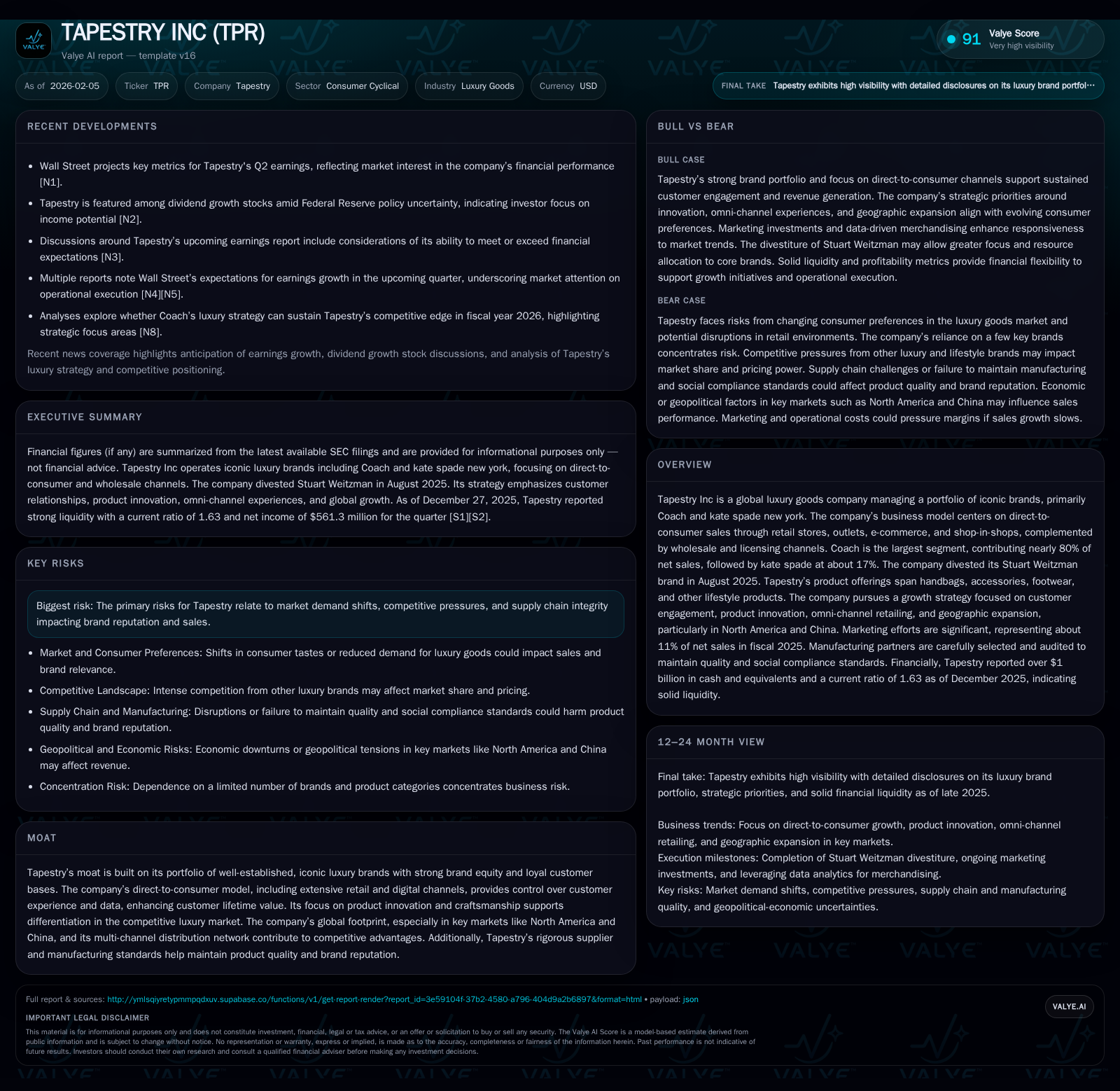
Tapestry Inc operates as a global leader in the luxury goods sector through its flagship brands Coach and kate spade new york, which together represent nearly 97% of net sales. Its business model emphasizes direct-to-consumer (DTC) channels supported by wholesale and licensing, with significant focus on product innovation, customer engagement, and geographic expansion in North America and China. The divestiture of Stuart Weitzman in FY2025 sharpens brand focus, while the company manages evolving risks from macroeconomic volatility, international trade policies, and competitive pressures. Solid liquidity and strong profitability underscore Tapestry's operational resilience despite uncertainties in consumer discretionary spending.
Company Overview
Tapestry Inc stands as a prominent global luxury goods conglomerate anchored by its iconic brands — principally Coach and kate spade new york. The firm's heritage stretches back to the foundation of Coach in New York City in 1941, establishing a legacy centered on craftsmanship and inclusive luxury. Kate Spade new york, launched in 1993, adds vibrancy with bold designs appealing to modern lifestyles. The company recently sharpened its strategic brand portfolio by divesting Stuart Weitzman in August 2025 [S1].
Operating primarily through direct-to-consumer channels such as an extensive retail footprint, outlet stores, e-commerce platforms, and shop-in-shops enables Tapestry to maintain tight control over customer engagement and brand experience. Wholesale and licensing remain complementary distribution mechanisms contributing to global reach.
Business Model & Brand Positioning
Coach drives nearly 80% of sales with an extensive collection ranging from handbags to accessories and footwear crafted under the ethos of "Expressive Luxury." This brand leverages emotional connection built on authenticity and community spirit that resonates well in both mature North American markets and emerging Asian geographies.
Kate Spade new york focuses on delivering optimism through colorful lifestyle products including ready-to-wear apparel, jewelry, gifts, home decor alongside traditional handbags. This segment represents about 17% of revenue but is strategically important for diversifying Tapestry's appeal to younger demographics seeking distinctive design narratives.
The divestiture of Stuart Weitzman offloads a smaller segment (about 3% of net sales) specializing in artisanal footwear — allowing management to concentrate capital allocation directly on scaling Coach and kate spade globally.
Distribution Channels & Omni-Channel Strategy
Tapestry’s approach centers on controlling the consumer journey via DTC channels that integrate physical retail environments with digital commerce seamlessly. This multi-channel engagement not only bolsters customer lifetime value through personal data insights but also enhances inventory management efficiency during demand fluctuations.
Retail stores remain flagship touchpoints for experiential luxury showcasing craftsmanship firsthand. Outlets enable access to value-conscious customers without diluting brand prestige. E-commerce platforms are continually optimized for convenience amid shifting shopping behaviors accelerated by digital penetration globally.
Complementing these are wholesale partnerships and licensing deals that facilitate presence in premium department stores or third-party boutique environments — critical for broad market penetration especially outside core markets.
Geographic Footprint & Expansion Priorities
Approximately 40% of Tapestry’s revenues derive from international operations [S1], emphasizing the importance of global growth drivers.
North America continues as the largest market; however, management’s strategic initiatives notably prioritize expansion in Greater China where rising affluence facilitates demand for aspirational luxury products. Other Asian regions also manifest growth potential supported by evolving consumer lifestyles favoring western luxury aesthetics.
Expansion involves not just store openings but tailored product assortments aligning with local tastes plus strengthened marketing efforts targeting regional consumer clusters.
Supply Chain & Manufacturing Risks
Tapestry outsources manufacturing primarily across Vietnam, Cambodia, the Philippines, India for Coach; Vietnam, Cambodia, mainland China, Philippines for kate spade [S1]. This sourcing strategy rests on balancing production cost-efficiency with quality assurances.
However, possible shifts in trade agreements or escalated tariffs—especially under recently reformed U.S. trade policies—create uncertainty around cost structures. The company’s dependency on countries subject to potential tariff increases entails risk pass-through challenges adversely affecting margins or necessitating price adjustments.
Additional risks arise from compliance related to customs enforcement actions or labor standards audits which could impact shipment timing or reputational capital if not properly managed.
Financial Snapshot & Performance Highlights
Fiscal year 2025 performance culminated in net income reported at $561.3 million with cash & equivalents standing strong at approximately $1.05 billion; current assets totaled $2.79 billion against current liabilities of $1.72 billion yielding a healthy current ratio near 1.63 [F1]. These figures highlight ample liquidity enabling operational flexibility amidst economic cyclicality.
Marketing expenditures equate to roughly 11% of net sales indicating sustained investment behind brand equity enhancement — crucial given rapid shifts in consumer trends within luxury fashion segments.
While recent earnings conference calls [N1] suggest steady growth momentum ahead fueled by optimistic Wall Street expectations [N3,N4], heightened scrutiny remains warranted regarding margin expansions given input cost inflation tied to raw materials or logistics.
Competitive Landscape & Market Dynamics (Analysis)
The luxury goods sector is characterized by intense competition from established global players like LVMH, Kering alongside emerging digital-native brands pushing innovative designs at scale.
Tapestry’s moat lies substantially in its iconic brand equity complemented by omni-channel retailing control enabling deeper engagement versus wholesale-dependent competitors. Product craftsmanship further distinguishes offerings within a crowded space where authenticity retains paramount importance for discerning buyers.
Nonetheless, evolving consumer preferences around sustainability practices compel continuous adaptation in sourcing policies and manufacturing protocols aiming at reducing environmental footprints—a trend gaining traction industrywide.
Risks Outlook
Economic downturns remain material threats given Tapestry’s exposure to discretionary spending categories sensitive to inflationary pressures or unemployment spikes [S1]. An economic recession could soften demand sharply across all geographic regions.
Trade policy volatility introduces cost unpredictability stemming from tariff impositions or regulatory restrictions impacting goods movement internationally. Any retaliation measures against sourcing countries might hinder supply predictability or escalate expenses rapidly.
Additionally, maintaining rigorous supplier oversight is essential lest supply chain disruptions negatively influence delivery schedules or product quality perception thus eroding customer trust long-term.
Strategic Takeaways & Future Considerations (Analysis)
Recent strategic moves such as portfolio pruning via Stuart Weitzman divestiture position Tapestry for focused capital deployment toward high-growth potential avenues within Coach and kate spade franchises.
Persistent emphasis on omni-channel integration leverages proprietary data analytics fostering personalized marketing engagements poised to elevate lifetime value metrics relative to peer groups.
Continued geographic diversification underscoring Asia-Pacific expansion aligns well with long-term luxury market forecasts anticipating fastest growth trajectories outside Western economies.
Nonetheless, success hinges squarely on navigating geopolitical uncertainties surrounding tariffs alongside agile responses to shifting consumer behavior patterns influenced by macroeconomic variables.
Conclusion
Tapestry Inc exemplifies a curated luxury house blending heritage craftsmanship with modern retail execution strategies anchored mainly by Coach and kate spade new york brands. Its strong balance sheet coupled with disciplined brand management underpins resilience amid sector challenges including discretionary spending volatility and external supply chain pressures.
Looking forward, continued investment toward innovative product development complemented by strategic geographic penetration appear vital for sustaining competitive standing within an increasingly dynamic luxury landscape.
Disclaimer: This is research-only, informational analysis and not investment advice. It may include AI-generated interpretation and general industry context. Always verify important details using primary sources.

Comments