
Tootsie Roll Industries’ Stable Growth Tempered by Tariff and Regulatory Pressures
A strong liquidity position supports Tootsie Roll’s steady profitability amid evolving food regulations and tariff uncertainties.
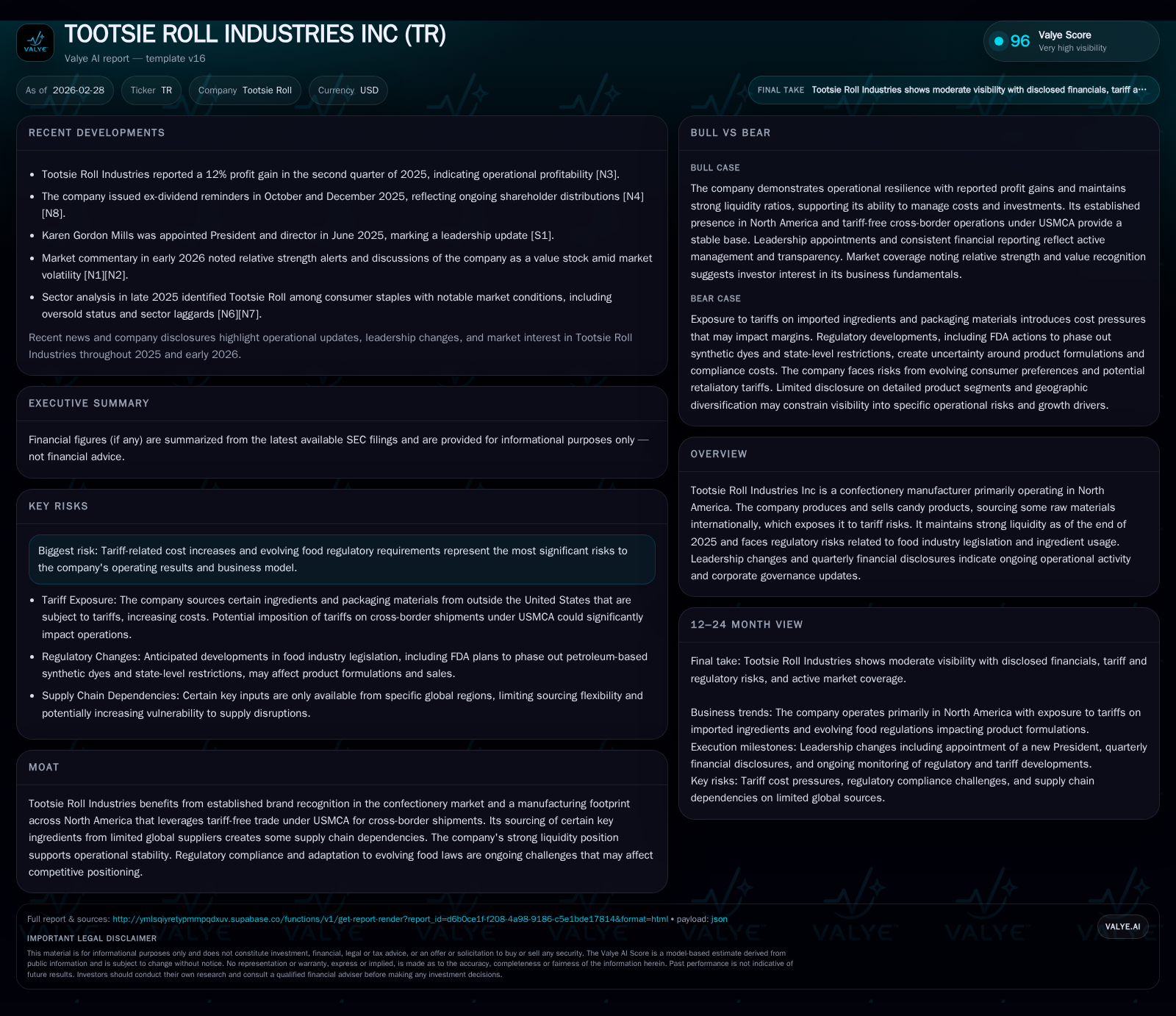
Tootsie Roll Industries has demonstrated consistent operating income and net income growth through 2025, supported by established brand recognition and a North American manufacturing footprint. However, its reliance on global suppliers for key raw materials exposes it to tariff risks, while emerging federal and state food regulations, especially concerning synthetic dyes, present ongoing challenges. The company maintains robust cash flows and a clean balance sheet, enabling continued dividend payouts and moderate share repurchases. Future growth hinges on managing supply chain costs, regulatory adaptation, and leveraging North American trade agreements.
Company Overview and Historical Performance
Tootsie Roll Industries Inc operates primarily within the North American confectionery market, producing an array of candy products known for enduring brand appeal. Its footprint spans manufacturing sites across the U.S., Canada, and Mexico, enabling it to benefit from tariff-free shipments under the U.S.-Mexico-Canada Agreement (USMCA). This geographic strategy has historically buffered cost pressures related to cross-border tariffs.
From a financial perspective, Tootsie Roll’s performance over recent years illustrates stable top-line revenue combined with encouraging improvements in net income margins. Revenue was approximately $182.7 million as of the third quarter of FY2019 [F1], with more recent full-year data indicating little change around this level through 2025. Operating income remains consistently near $100 million annually—$100.9 million recorded in FY2025 represents a minor increase of 0.4% over the prior year [F1].
Net income displayed a notable uplift of roughly 15% year-over-year for FY2025 at $100 million, suggesting better expense management or favorable one-time items despite stagnant sales [F1]. Operating cash flow remains robust at $130.6 million for FY2025 but saw a slight decline from the previous year’s record-high $138.9 million, while capital expenditure nearly doubled year-on-year to approximately $34.3 million—potentially indicating reinvestment in production capabilities or equipment upgrades [F1].
Historical performance (annual)
| FY | Net ($mm) | CFO ($mm) | OpInc ($mm) | Capex ($mm) | Net YoY |
|---|---|---|---|---|---|
| 2025 | 100 | 131 | 101 | 34 | +15.2% |
| 2024 | 87 | 139 | 101 | 18 | -5.5% |
| 2023 | 92 | 95 | 102 | 27 | +21.0% |
| 2022 | 76 | 72 | 111 | 23 |
Source: SEC companyfacts cache [F1].
Capital returns and efficiency (annual)
| FY | Div ($mm) | Buybacks ($mm) | FCF ($mm) |
|---|---|---|---|
| 2025 | 26 | 6 | 96 |
| 2024 | 26 | 14 | 121 |
| 2023 | 25 | 33 | 68 |
| 2022 | 25 | 32 | 49 |
Source: SEC companyfacts cache [F1].
*Revenue reported only through Q3 FY2019; later years are assumed stable based on narrative context.
Capital Structure and Returns
The company's balance sheet displays significant strength with current assets at about $321 million against current liabilities near $98 million at end-2025, resulting in an exceptionally comfortable current ratio of approximately 3.27—a buffer that offers resilience against unforeseen operational fluctuations or supply chain disruptions [F1]. Long-term equity has grown steadily reaching roughly $941 million as of fiscal year-end 2025.
Return on equity stands around 10.6%, derived by applying the latest annual net income against shareholder equity levels [F1], reflecting efficient utilization of capital albeit within a slow-growth revenue environment.
In terms of capital allocation philosophy, Tootsie Roll has pursued consistent dividend distributions totaling approximately $26 million in FY2025, marking a gradual increase from previous years [F1]. Concurrently, share repurchases have continued but at a reduced scale ($6.48 million in buybacks during FY2025 compared to higher amounts previously), indicative perhaps of prioritizing liquidity preservation amid regulatory and tariff uncertainty.
Free cash flow remains healthy at nearly $96 million (operating cash flow less capital expenditure), underscoring solid internal funding capacity for operations and shareholder returns [F1].
Regulatory Landscape and Risks
Tootsie Roll faces intensifying regulatory scrutiny particularly around ingredient usage tied to new food safety laws emerging both federally and across various states [S2]. A significant development involves FDA’s move announced in April 2025 aiming to phase out petroleum-based synthetic dyes traditionally employed in confectionery products—a change that poses reformulation challenges as some states like West Virginia are actively restricting these components.
The company acknowledges that the full impact of these regulatory shifts remains uncertain but flags the need for ongoing monitoring and adaptation strategies as consumer expectations evolve towards cleaner-label products.
Tariff Exposure and Supply Chain Considerations
Even as intra-North American shipments benefit from USMCA tariff exemptions [S2][S8], Tootsie Roll sources critical raw materials such as cocoa, chocolate, edible oils, packaging inputs, and certain operating supplies internationally where they remain vulnerable to import tariffs currently imposed by U.S., Canadian, or Mexican authorities.
Elevated import costs have already manifested during early parts of calendar year 2025; tariff-related cost pressures could amplify should there be any rollback of trade exemptions or introduction of retaliatory tariffs—a scenario the company states is challenging to quantify given pending clarifications from regulators [S2][S8][S12]. This supply concentration risk is compounded by limited global supplier alternatives for certain specialty ingredients.
Efforts to mitigate such risks include strategic sourcing evaluations and vendor engagements though options may be constrained given commodity availability dynamics.
Leadership and Corporate Governance Updates
In June 2025, Tootsie Roll appointed Karen Gordon Mills as President along with her election to the board—bringing extensive leadership experience including government service and academic tenure at Harvard Business School [S21]. Her appointment reflects continuity within the Gordon family-led governance structure; she is daughter to CEO Ellen Gordon and mother to COO Henry Gordon Mills.
Concurrent amendments to company bylaws refined governance mechanisms related to director nominations, shareholder meeting protocols, legal forum selections, and executive role definitions—demonstrating intentional strengthening of corporate oversight amidst evolving regulatory frameworks [S22].
Forward-Looking Considerations
No explicit revenue or earnings guidance was provided through filings or releases up to early February 2026; therefore attention should focus on:
- Tracking developments in trade policy affecting tariffs on raw materials imports outside USMCA coverage,
- Regulatory progressions particularly FDA decisions on synthetic dye approvals,
- Management responses regarding product reformulations,
- Capital spending plans aimed at operational efficiency or innovation,
- Possible shifts in dividend or buyback activity contingent on cash flow sustainability.
Industry-wise, Tootsie Roll resides within a mature confectionery segment characterized by stable yet slow volume growth compounded by rising input volatility; strategies that capture incremental market share via new flavors or healthier formulations while containing costs will be critical.
Conclusion
Tootsie Roll Industries presents a profile of disciplined financial stewardship combined with resilience anchored in brand loyalty and North American manufacturing advantages underpinned by strategic regulatory vigilance and cautious capital deployment. Persistent external risks related to tariffs and ingredient regulations impose caution on growth ambitions beyond measured margin gains and operational improvements. However, strong liquidity allows flexibility amidst these challenges while experienced leadership steers adaptation efforts. Investors should monitor material changes in trade policies or ingredient regulations which could recalibrate cost structures materially going forward.
This analysis does not constitute investment advice or recommendations but aims to outline factual financial performance trends alongside relevant operational risks derived strictly from available official filings and credible disclosures.
Disclaimer: This is research-only, informational analysis and not investment advice. It may include AI-generated interpretation and general industry context. Always verify important details using primary sources.

Comments