
How TransUnion’s OneTru Platform Drives Expanding Market Reach and Resilient Profitability
TransUnion leverages its integrated data and AI-enabled OneTru platform to deepen vertical penetration and diversify geographically, supporting sustainable earnings growth.
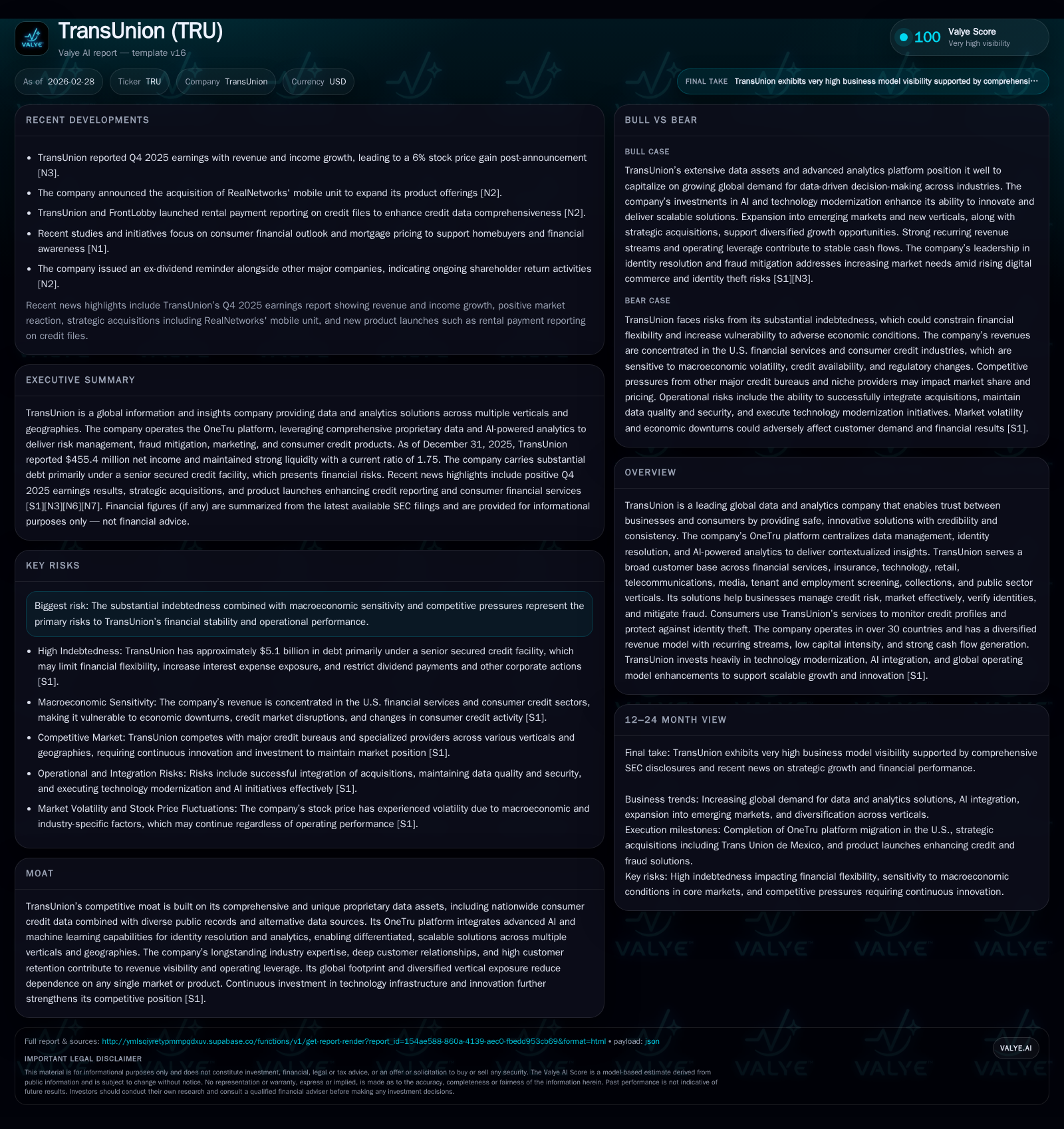
TransUnion has shown accelerating revenue and earnings growth supported by strategic investments in its OneTru platform, which centralizes data management and AI-powered analytics to deliver industry-tailored solutions. Its broad global presence across more than 30 countries and diversified exposure to financial services, insurance, retail, telecom, and other emerging verticals mitigate customer concentration risks. Capital allocation balances robust free cash flow generation against targeted acquisitions and shareholder returns within a capital-light model. Key risks stem from elevated leverage and evolving regulatory scrutiny related to consumer data use and AI governance.
Historical Growth Patterns: Revenue and Earnings Expansion Drivers
TransUnion’s financial trajectory in recent years illustrates a compelling rebound and acceleration in both top-line and profitability metrics. As of FY2025, reported revenue reached approximately $8.58 billion—a sharp increase of 16.1% compared to the prior fiscal year—driven primarily by technology modernization investments embodied in the OneTru platform alongside steady expansion across its diverse customer base spanning financial services through to emerging verticals such as media and telecommunications [F1,S1]. Operating income rose sharply by 28.7% year-over-year to $857.8 million in FY25, reflecting meaningful gains in operating leverage as fixed costs were absorbed by faster sales growth alongside ongoing efficiency improvements stemming from Global Capability Centers (GCC) optimizing cost structures [F1,S4]. The net income of $455.4 million also showed significant improvement (60.1% YoY), indicating solid bottom-line conversion aided by more efficient tax and interest expense management despite elevated leverage [F1].
Operating cash flow grew by nearly 18.6%, reaching $987.6 million for FY25 while capital expenditures increased modestly by 3.2% to $326 million — underscoring the company’s capital-light model optimized around digital infrastructure rather than heavy physical assets [F1]. These dynamics point to sustained positive momentum fueled chiefly by deepening data assets and AI-driven analytics capabilities that have enhanced customer value propositions.
Historical performance (annual)
| FY | Net ($mm) | CFO ($mm) | OpInc ($mm) | Capex ($mm) | Net YoY |
|---|---|---|---|---|---|
| 2025 | 455 | 988 | 858 | 326 | +60.1% |
| 2024 | 284 | 833 | 667 | 316 | +4562.3% |
| 2023 | 6 | 645 | 61 | 311 | -97.7% |
| 2022 | 270 | 297 | 631 | 298 |
Source: SEC companyfacts cache [F1].
Capital returns and efficiency (annual)
| FY | FCF ($mm) | ROE% |
|---|---|---|
| 2025 | 662 | 10.3 |
| 2024 | 517 | 6.7 |
| 2023 | 335 | 0.2 |
| 2022 | -1 | 6.5 |
Source: SEC companyfacts cache [F1].
Note: Revenue YoY percent compared between FY24-FY25.
OneTru Platform’s Role in Business Evolution and Customer Solutions
Central to TransUnion's strategic evolution is the OneTru platform—a consolidated technological foundation that integrates heterogeneous data sets including nationwide credit profiles, public records, device information, marketing data, and alternative credit sources into a single ecosystem empowered by AI-driven analytics and machine learning models [S1,S25]. OneTru delivers enhanced identity resolution—a process whereby disparate consumer identifiers across offline and online channels are linked reliably—thereby enabling downstream applications like fraud mitigation deploying real-time automated decisions and predictive modeling that dynamically assess risk or fraud likelihood during customer interactions.
Key offerings enabled via OneTru encompass TruVision risk management solutions addressing lending lifecycle needs; TruAudience marketing measurement tools facilitating omnichannel campaign optimization; TruValidate identity authentication with device risk scoring; alongside consumer interactive products that empower individuals with actionable credit insights [S6,S9]. The layered architecture standardizes data ingestion, processing, identity graphing, model building, decisioning workflows, and compliance controls ensuring stringent data governance.
This platform-centric innovation aids customers across verticals—from traditional mortgage lenders deploying advanced credit risk scoring models to insurers leveraging telematics-derived driver violation data for precise underwriting pricing—illustrating its versatility across industry-specific use cases [S17]. Moreover, the platform's cloud-native hybrid infrastructure accelerates product deployment cadence globally while reducing total cost of ownership for client integrations.
Segment and Geographic Diversification: Reducing Market Concentration Risk
TransUnion operates predominantly through two reportable segments: U.S. Markets—which accounts for the majority of revenue concentrated heavily in Financial Services—and International operations spanning over thirty countries including Canada (operating since ’89), Latin America (notably Colombia, Brazil), the U.K., Africa, India, plus Asia Pacific markets [S4,S7,F1]. This wide geographic footprint dampens dependency on any singular regional economy or regulatory environment.
Within U.S. Markets segment revenue composition, financial services verticals such as mortgages, auto lending, banking/card payments continue to represent core demand drivers while emerging verticals including Technology, Retail & E-Commerce, Telecommunications enrich solution diversity supporting full customer lifecycle—from acquisition analytics through fraud prevention and retention analytics [S27]. Internationally, presence is bolstered via acquisitions like Neustar boosting telecom-related identities in EMEA regions as well as a pending transaction to increase majority control at Trans Union de Mexico enhancing Latin America exposure [N10,S7].
Complementing this strategy is a tiered global sales organization aligned along vertical specialization allowing focused account management for large clients alongside shared seller teams serving mid-market customers—enhancing cross-functional collaboration that drives deeper penetration within existing accounts while reducing client churn risk [S6,S11]. Seasonality effects linked to mortgage origination cycles manifest primarily in Q2/Q3 but are offset internationally by diversified local economic trends reducing overall volatility.
Near-Term Outlook: Guidance Insights and Acquisition Strategy
The company’s recent Q4 FY25 earnings release exceeded consensus revenue estimates leading to positive market reaction with a roughly six percent stock uptick post-announcement [N1,N4]. Management commentary highlighted continued momentum into Q1 FY26 backed by higher lending activity among traditional banks alongside increased adoption among FinTech platforms utilizing POS/BNPL credit reporting enhancements developed under regulatory collaboration frameworks [N2,N5].
Strategically impactful is the acquisition announced on February 2nd for RealNetworks' Mobile Unit aimed at expanding mobile identity verification capabilities—complementing existing fraud mitigation suites—with integration expected within current OneTru architecture allowing accelerated time-to-market for mobile-centric customer workflows [N10]. Also noteworthy is the initiation of rental payment reporting services launched jointly with FrontLobby providing additional alternative data inputs improving credit profile completeness for consumers traditionally underserved by mainstream credit models [N11].
While explicit forward-looking guidance figures were not detailed beyond confirmed Q1 expectations within the transcript releases reviewed so far [N5], monitoring integration progress against acquisition milestones alongside adoption rates for newly launched products will be critical near-term performance indicators.
Capital Allocation Strategy: Balancing Investment, Buybacks, and Cash Flow Generation
TransUnion’s capital allocation reflects a measured approach balancing investment in technology infrastructure with shareholder returns within constraints imposed by senior secured credit facilities limiting dividend distributions under certain covenant conditions [S14,S15,N13]. During FY25 the firm returned approximately $302 million through share repurchases—a marked increase compared with prior years where buyback programs were paused or limited—signaling confidence driven by strong cash generation capacity supported by nearly $988 million operating cash flow against $326 million capital expenditure outlays invested primarily towards platform modernization efforts [F1].
The company maintains an approximate ROE of roughly 10.3% calculated via latest annual net income divided by equity base giving an indicator of capital efficiency amid substantial balance sheet leverage (equity base near $4.44 billion at year end ’25) [F1]. The relatively high capex figure consistent over recent years underlines commitment towards sustaining competitive advantage through technological innovation rather than asset-heavy expansions.
Looking forward, prudent scrutiny of debt service coverage ratios alongside share repurchase efficacy versus incremental organic growth returns will remain key metrics assessing capital stewardship effectiveness.
Risk Profile: Debt Leverage, Regulatory Challenges, and AI Governance
TransUnion bears considerable indebtedness reflective of its leveraged recapitalization structures—with principal repayments scheduled at $78.5 million in ’25 plus significant annual interest expense (approximately $235.8 million)—posing liquidity risks if operating cash flows falter due to macroeconomic slowdown or customer attrition impacting recurring revenues from primarily U.S.-based financial institutions sensitive to credit cycles [S3,S15]. Refinancing risks remain pertinent given evolving credit markets though covenant adjustments offer some flexibility subject to leverage thresholds being maintained.
Regulatory landscapes present evolving compliance burdens particularly surrounding consumer privacy laws (e.g., FCRA amendments), heightened oversight linked to tenant/employment screening activities (recent consent orders totaling millions in penalties), as well as novel challenges arising from fast-moving AI regulatory frameworks at federal and state levels—including California Consumer Privacy Act enhancements targeting automated decision-making disclosures—and international equivalents mandating transparency of generative AI usage in processing consumer data [S5,S8,S21]. These factors could elevate operational costs and expose TransUnion to class action risks if controls wane.
Cybersecurity remains paramount given the extensive sensitive information processed globally; third-party risk management policies must evolve continually to safeguard intellectual property rights underpinning proprietary algorithms housed within OneTru while guarding against disruptive cyber events detrimental to reputation or operational continuity .
This analysis summarizes publicly available financial results as filed with the SEC along with recent news disclosures concerning material corporate developments relevant through early February 2026 but does not constitute investment advice or recommendations.
Disclaimer: This is research-only, informational analysis and not investment advice. It may include AI-generated interpretation and general industry context. Always verify important details using primary sources.

Comments