
T-REX Acquisition Strengthens Bitcoin Mining Roots with Strategic Facility Acquisition
The company’s recent operational moves and leadership reshuffle underscore efforts to expand capacity amid capital constraints in a competitive mining sector.
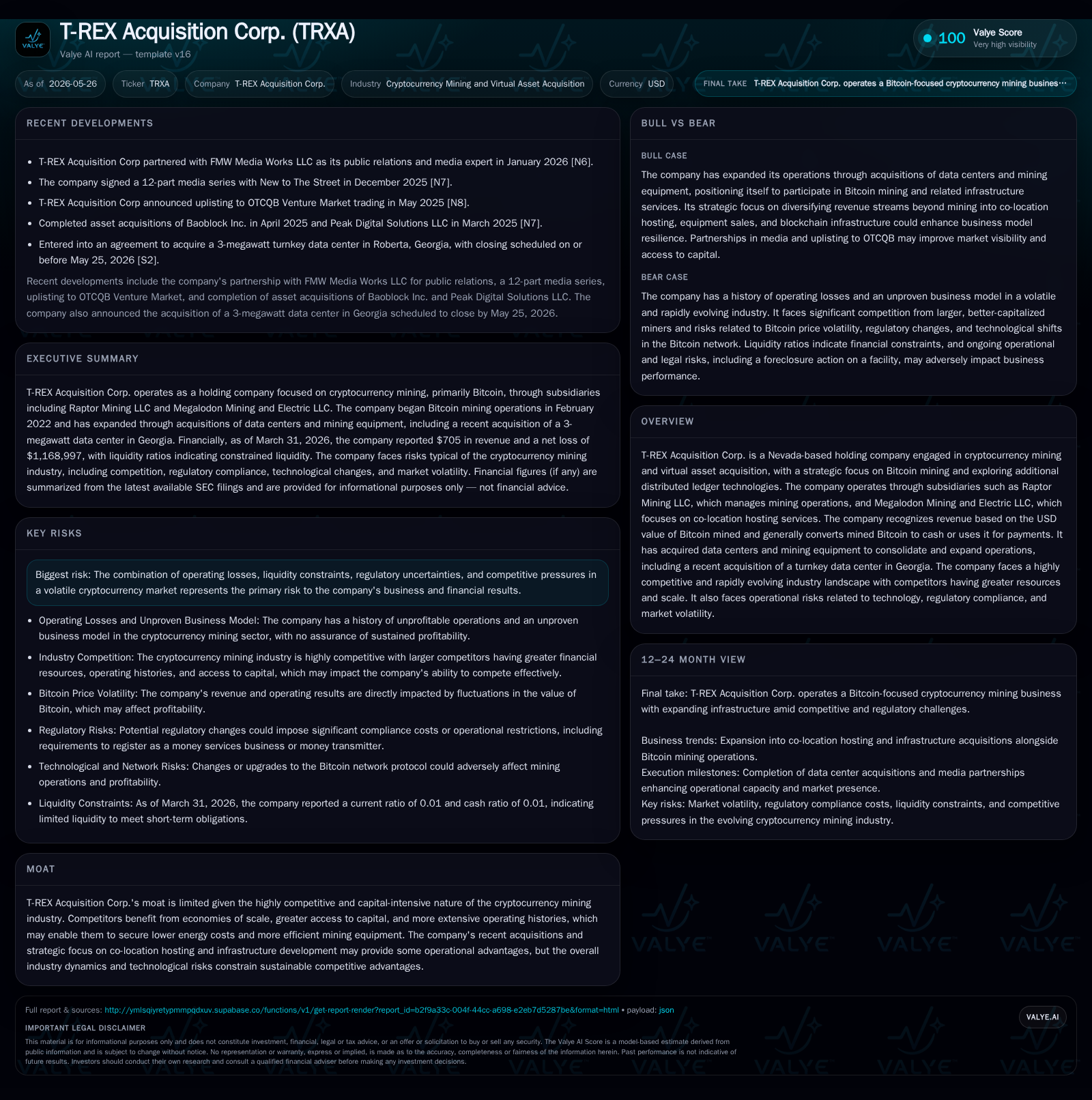
In its latest quarterly filing, T-REX Acquisition Corp. reported a key acquisition of a turnkey data center in Georgia, reflecting its strategy to broaden Bitcoin mining capacity and co-location hosting offerings. The company also underwent leadership changes, appointing David McPhail as CEO and Frank Horkey as Chairman, signaling a potential strategic inflection point. Despite these initiatives, T-REX operates in a highly competitive, capital-intensive environment with significant leverage and liquidity pressures that may restrict growth. Near-term focus lies on completing refinancing arrangements, scaling mining operations, and enhancing co-location services to improve operational leverage.
Recent Quarterly Operating Update Highlights
T-REX Acquisition Corp.’s most recent 10-Q filing dated May 26, 2026 [S2] reveals pivotal developments shaping its near-term trajectory. Foremost is the April 2026 definitive agreement to acquire a fully operational 3-megawatt turnkey data center situated in Roberta, Georgia—an acquisition scheduled for closure by May 25, 2026 [S19]. This facility includes six portable mining containers and an electrical supply contract providing up to 4.5 megawatts from Flint Electric Membership Corporation, aligning with the company's strategy to boost both proprietary mining capacity and co-location hosting service offerings.
Complementing this operational expansion, May 15, 2026 corporate governance updates [S3][S27] highlight leadership transitions: David McPhail was instated as Chief Executive Officer while Frank Horkey ascended to Chairman of the Board. These appointments follow the resignation of former CEO Matthew Cohen and Board member Katharyn Field but were not linked to any disputes or operational concerns per disclosures.
On the refinancing front, earlier in Q1 2026 T-REX successfully refinanced its Orofino data center note [S13], curing prior default with split payment terms due between March and June 2027—an essential step given the sizeable liability associated with this asset.
Business Model and Product Offering Overview
T-REX operates primarily as a vertically-integrated Bitcoin-focused cryptocurrency miner generating revenue based on the USD value of mined Bitcoin recognized upon receipt [S1][S5]. The business is structured under several subsidiaries: Raptor Mining LLC oversees core mining activities; Megalodon Mining and Electric LLC targets co-location hosting by leasing data center access and electricity to third-party miners; Sabretooth Mining Containers fabricates deployable mining units; Deinodon supports auxiliary operations.
The company converts mined Bitcoin predominantly into U.S. dollars or utilizes it for settling obligations rather than holding cryptocurrency inventory [S1]. Co-location hosting aims to diversify revenue streams beyond direct mining rewards by monetizing access to its acquired data centers using low-cost electricity—a critical input given energy's outsized impact on unit economics in mining.
The facility acquisition in Georgia is expected to enhance this co-location model by bundling infrastructure with power supply contracts — providing service differentiation against peers solely dependent on third-party colocation or fluctuating power sourcing.
Industry Structure and Competitive Positioning
The broader cryptocurrency mining arena remains capital-intensive and fiercely competitive with dominant participants benefiting from substantial scale economies [S1][S4][S5]. Leading public miners like Marathon Digital Holdings and Riot Platforms command cost advantages via bulk equipment procurement, access to cheaper electricity contracts often through renewables or strategic partnerships, and more efficient ASIC hardware deployment.[S26]
T-REX competes as a relatively smaller player battling higher unit costs due to limited scale and financing resources. Its asset acquisitions partially mitigate this disadvantage by consolidating operations within owned or controlled data centers versus pure co-location models reliant on external providers.
Technology risk is elevated given ASIC miners’ exclusivity for Bitcoin proof-of-work algorithms — limiting agility should alternative cryptocurrencies or consensus protocols gain prominence [S1]. Regulatory uncertainty regarding power consumption restrictions adds an additional structural constraint that could increase compliance costs or necessitate operational relocations.
Growth Drivers Anchored in Asset Acquisition and Service Expansion
Growth for T-REX hinges on increasing hashing throughput alongside augmenting co-location revenues. The Georgia turnkey data center acquisition directly expands proprietary mining capacity through bundled infrastructure enabling rapid deployment of new ASIC units [S19]
Simultaneously, enhanced colocation capabilities at acquired facilities such as Orofino (refinanced recently) provide recurring fee income prospects from third-party miners securing favorable input costs [S13]
Strategic initiatives encompassing infrastructure development—such as Sabretooth’s container fabrication—and exploration into SaaS solutions targeting blockchain ecosystems position T-REX for incremental future revenue segments beyond pure hardware intensity [S5]
Operational KPIs critical for growth monitoring include hash rate expansion rates post-acquisition, utilization ratios of colocation space powered by low-cost electricity contracts, machine efficiency improvements from deploying next-gen miners acquired via capital expenditure programs.
Risks and Constraints Within a Capital-intensive Crypto Mining Environment
T-REX demonstrates enduring challenges related to profitability sustainability; it recorded an operating loss nearing $2.1 million as per latest reported annual figures [F1]. Liquidity is notably strained — proxied by a severely deficient current ratio around 0.01 attributable to current liabilities ($1.92 million) vastly outpacing current assets ($12K) at quarter-end March 31, 2026 [F1]. Total debt stands near $270K with net debt after cash adjustment at approximately $246K [F1].
Regulatory risk looms large amid evolving scrutiny over cryptocurrency power consumption exemplified by jurisdictional restrictions that can disrupt operational continuity or necessitate costly relocations/reconfigurations.[S1][S29]
Technological obsolescence restricts flexibility since ASIC equipment procured is currently specialized exclusively for Bitcoin consensus operations — raising vulnerability should non-Bitcoin digital currencies gain market share or face differential regulations.[S1]
Competitive pressures from better-capitalized peers exacerbate challenges acquiring cutting-edge equipment at scale discounts or negotiating more advantageous energy rates likewise constraining margin improvement trajectories [S26]
Key Upcoming Milestones and Market Signals to Monitor
Upcoming events warrant close attention:
- Completion status of the Georgia data center acquisition closing by late May 2026 marks a tangible capacity inflection point [S19].
- Progress in deploying additional ASIC units into newly acquired facilities will signal tactical execution toward hashing power growth goals.
- Updates on refinancing efforts tied to legacy notes such as those originally maturing mid-2025 on Orofino center measurements provide insight into capital structure durability [S13].
- Client onboarding rates within colocation hosting services will expose early traction outside proprietary mining alone.
- Volatility in Bitcoin spot pricing remains the ultimate revenue demand driver given direct exposure of recognition accounting processes tied to mined coin converted into USD [S1].
Monitoring these metrics provides visibility into whether T-REX can navigate capital constraints while scaling operational footprint profitably.
Brief Financial Profile: Liquidity, Debt, and Profitability Context
Financially, T-REX faces significant headwinds despite strategic asset investments. As of March 31, 2026 balance sheet metrics document total debt approximating $270K offset modestly by liquid cash balances near $24K yielding net indebtedness around $246K [F1]. Current liabilities substantially exceed current assets, resulting in a current ratio near 0.01 at quarter-end March 31, 2026 [F1].
Continued operating losses documented near $2.1 million undermine internal resource generation capacity necessary for reinvestment or deleveraging initiatives [F1]. The company’s refinancing actions around the Orofino facility demonstrate attempts at liability management but remain pivotal stress points pending further capital market access or operational cash flow improvements [S13].
This financial backdrop underlines inherent tradeoffs between aggressive expansion opportunities against potentially precarious funding horizons requiring prudent risk management strategies aligned with evolving industry dynamics.
This analysis is based on public regulatory filings dated through May 26, 2026. It aims to objectively dissect recent developments impacting T-REX Acquisition Corp.’s strategic positioning without providing investment advice. Readers are encouraged to consider broader market conditions alongside this detailed company-specific review when assessing the implications for stakeholders.
Disclaimer: This is research-only, informational analysis and not investment advice. It may include AI-generated interpretation and general industry context. Always verify important details using primary sources.

Comments