
Champion Homes Reinforces Market Presence Through Strategic Expansions and Operational Shifts
Champion Homes advances its leadership in factory-built housing with recent retail acquisitions and plant capacity realignments designed to optimize efficiency and market reach.
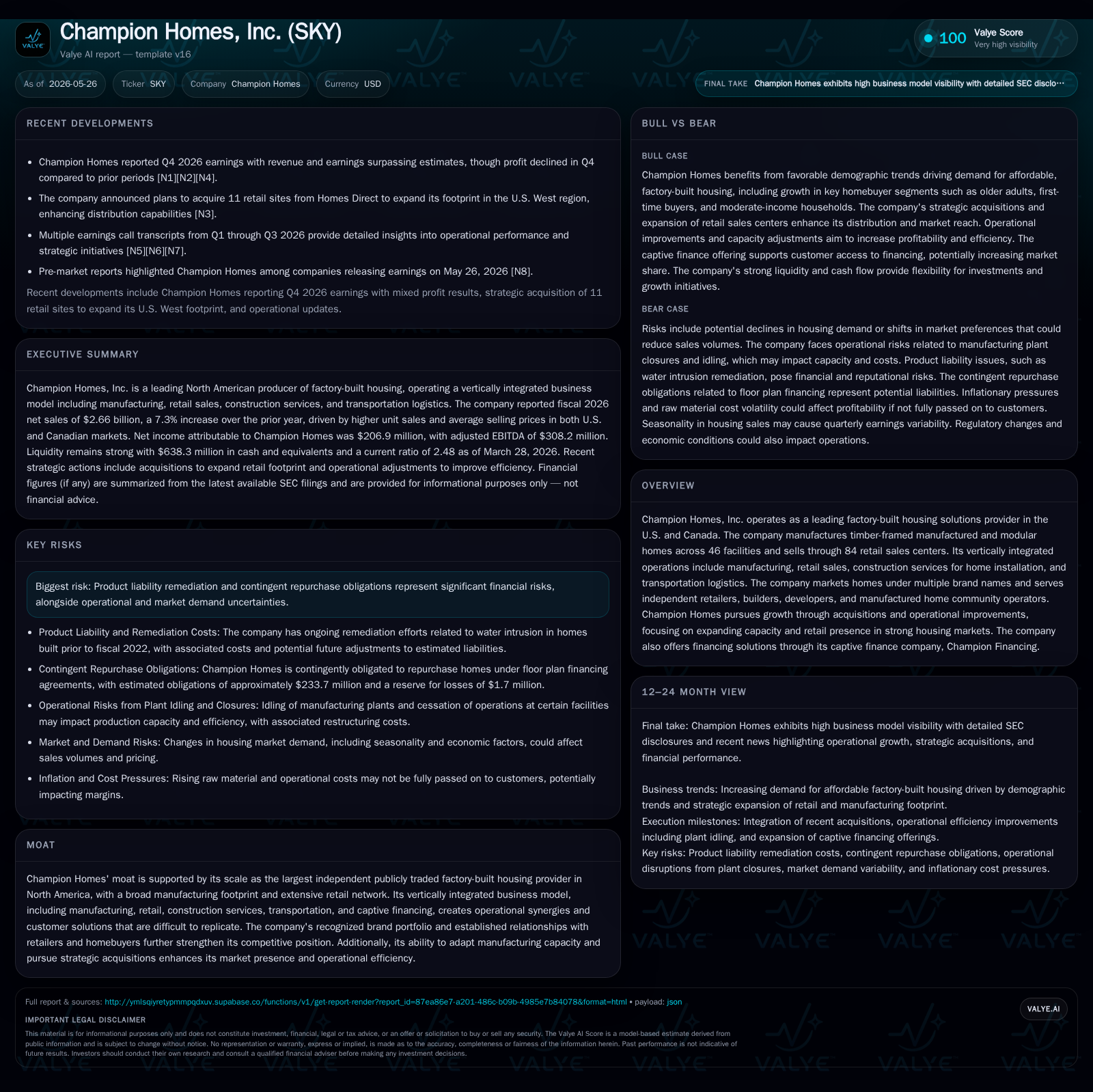
In its May 2026 8-K update, Champion Homes announced the acquisition of 11 retail sites from Homes Direct, significantly enhancing its U.S. West Coast footprint. Concurrently, the company has idled production at certain manufacturing facilities in Bartow, Florida, and Kelowna, British Columbia, while divesting an idled plant, signaling a strategic focus on operational efficiency amid rising demand. The firm's vertically integrated business model spans manufacturing, retail, installation services, transportation, and captive financing, positioning it well within the North American factory-built home industry. Growth is driven by measured acquisitions that align geographically with manufacturing capacity and by financing solutions supporting customer access. However, risks including water intrusion product liability remediation and contingent repurchase obligations require ongoing monitoring. Champion Homes maintains a strong liquidity profile with $638 million cash against $24 million debt as of Q3 2026.
Recent Operational Developments and Strategic Implications
Champion Homes' May 26, 2026 8-K filing revealed two pivotal moves shaping its near-term trajectory: the acquisition of 11 retail sales centers from Homes Direct to broaden its U.S. West Coast footprint [S3][N7], alongside operational shifts including idling production at its Bartow, Florida plant and ceasing operations at the Kelowna facility in British Columbia [S1]. These actions collectively signal a calibrated strategy transitioning from expansion-focused growth towards balanced optimization—aimed at leveraging geographic synergies between manufacturing hubs and retail outlets while pruning underperforming assets.
The newly acquired retail sites support Champion's goal of reinforcing distribution channels in strong housing markets where demand for affordable homes remains structurally robust. Meanwhile, reallocating capital from idled or closed plants enhances capacity utilization rates at active manufacturing locations—a critical determinant of margin sustainability in timber-framed factory-built housing [S1][N7]. The sale of one previously idled plant further indicates management's preference to streamline fixed costs rather than maintain dormant capacity.
This dual approach addresses both top-line market coverage needs via retail expansion and bottom-line cost structure through operational efficiency measures.
Business Model: Vertical Integration and Product Offering
Champion Homes operates a comprehensive vertically integrated model encompassing timber-framed factory-built home manufacturing (manufactured and modular), sales via an extensive network of retail centers (84 across the U.S.), construction services for installation and setup onsite, plus transportation logistics handled through independent owner/operators covering North America [S1]. This integration affords direct control over product quality, delivery timelines, service consistency, and margin capture across the value chain.
Customer segments served are diverse: independent retailers who sell homes under various regional brand names; builders and developers requiring volume supply; manufactured home community operators seeking turnkey solutions; and direct consumer sales through company-owned centers [S1]. The broad brand portfolio — including Champion Homes itself alongside Genesis Homes, Skyline Homes, Regional Homes, Moduline (in Canada), and others — caters to differentiated market niches varying by price point, geography, style preferences, and regulatory regimes.
In addition to physical products and services, Champion operates a captive finance company (Champion Financing), spun out jointly with Triad Financing Services under ECN Capital. Though ECN was recently acquired by private equity (leading to liquidation of Champion’s ECN shares), Champion Financing remains operational independently [S1][S17]. This captive finance capability reduces friction in buyer credit access—a known hurdle in factory-built housing—and supports sustained revenue growth by enabling more purchase transactions.
Overall, Champion’s business model balances broad geographic reach with end-to-end service offerings accessible under trusted national brands — creating switching costs for customers due to integrated execution reliability.
Competitive Position and Industry Structure
As the largest independent publicly traded factory-built home provider across North America measured by revenue [S1], Champion leverages scale advantages absent among many smaller regional competitors. The structural operating environment is shaped by several factors:
- Manufacturing Capacity Utilization: Stable throughput correlates strongly with profitability given significant fixed costs in plant operation.
- Regulation: Compliance with HUD construction standards governs manufactured homes; modular homes face distinct local building codes adding complexity.
- Price Competition: Regional homebuilders compete on cost efficiency; however vertical integration combined with captive financing gives Champion pricing flexibility not easily matched by fragmented peers.
- Barriers to Entry: Substantial capital outlay needed for production facilities plus navigation of regulatory approvals limits new entrants.
Champion’s expansive footprint—46 manufacturing facilities combined with deep retailer presence—creates logistical efficiencies inaccessible to competitors lacking either scale or integration. Its captive finance offering further differentiates by reducing homeowner credit risk hurdles ubiquitous in affordable housing markets.
Peers tend to operate either regionally or specialize narrowly (e.g., modular only or retailer only). Champion’s breadth enables cross-selling opportunities while buffering against localized demand shocks.
Growth Drivers: Acquisitions, Capacity Expansion, and Financing Solutions
Near-term growth catalysts pivot around geographically targeted acquisitions alongside tactical capacity redeployments:
- The October 2023 Regional Homes acquisition added three Alabama manufacturing plants plus 44 Southeastern U.S. retail centers solidifying presence in historically strong HUD markets.
- May 2025 saw acquisition of Iseman Homes’ North Central US retail portfolio (10 centers) enhancing alignment between nearby manufacturing units and retail reach.
- Most recently ([S3],[N7]), acquiring 11 additional retail sites from Homes Direct strengthens western U.S. coverage aligning distribution with manufacturing clusters.
By matching new retail footprints close to existing or expanded factory locations, Champion seeks operational synergies lowering transportation costs while improving delivery lead times [S1][N7]. Plant idling in low-performing regions reallocates resources toward higher-demand zones enhancing return-on-capital employed.
Complementing physical expansion is Champion Financing’s role enabling purchase transactions through floor plan loans to retailers as well as consumer mortgage-style products for homebuyers [S1][S17]. Access to affordable credit solutions remains a crucial lever unlocking latent demand among lower- to middle-income buyer segments—especially first-time buyers or older demographics prioritizing affordability.
Collectively these initiatives address structural demand drivers: demographic tailwinds including rising populations aged over 55 years; increasing first-time buyers constrained by conventional housing cost inflation; plus growing appetite for ADUs (Accessory Dwelling Units) and rent-to-own housing alternatives [S1].
Risks and Constraints: Operational Efficiency and Legal Risks
Key risk elements warrant scrutiny given their potential impact on results:
- Product Liability - Water Intrusion: The Company faces remediation obligations linked to certain homes built pre-fiscal 2022 exhibiting water damage attributable to substandard materials usage [S15]. Reserves have been adjusted upwards by $8.5 million during fiscal 2026 reflecting greater insight from inspection efforts—total liability now stands estimated around $35.6 million. Continued monitoring may lead to further revisions impacting operating costs.
- Contingent Repurchase Obligations: Under financing arrangements linked to floor plan payables (~$94.6 million outstanding), Champion carries contingent repurchase risk approximated at $233.7 million associated with defaults by financed independent retailers [S10][S25]. While historical loss experience remains minimal due to re-sale options for repossessed homes, this represents significant off-balance-sheet exposure dependent upon retailer credit health.
- Operational Efficiency: Idling multiple plants illustrates ongoing pressure to enhance capacity utilization amid variable market cycles [S1]. Failure to optimize production can erode margins or undermine ability to meet demand spikes promptly.
- Legal Proceedings: Routine claims related to warranties or workplace regulations exist but are not presently material. Future unknown legal risks remain inherent given product warranty profiles typical in construction sectors [S6].
Key Monitorables: Upcoming Milestones and Market Signals
Investors should closely watch forthcoming quarterly disclosures elucidating:
- Impact of recent retail acquisitions on sales volumes and backlog replenishment trends providing forward visibility into demand strength ([S3],[N3]).
- Manufacturing capacity utilization metrics reflecting success of plant idling strategies versus need for potential restarts if demand accelerates ([S1],[N5]).
- Loan origination volumes through Champion Financing serving as barometers for end-consumer purchase activity supported by captive credit solutions ([S17],[N4]).
- Updates on water intrusion remediation progress including provision adjustments influencing future operating expenses ([S15],[S11]).
- Resolution developments regarding contingent repurchase obligations in volatile dealer credit environments ([S25]).
- New product launches or service enhancements targeting emerging market segments such as ADUs or rent-to-own structures ([S1]).
These data points will clarify whether recent strategy shifts translate effectively into volume expansion coupled with margin improvement amid economic variability.
Financial Profile and Liquidity Overview
As of March 28, 2026 quarter-end [F1], Champion Homes reported cash & equivalents totaling $638 million against total debt approximating $24 million yielding a net cash position near $614 million. Operating income totaled $251.8 million with net income attributable to Champion Homes at approximately $206.9 million for fiscal year ended March 2026 [F1], supporting continued reinvestment into strategic initiatives along with share repurchases as reported in recent filings [S3]. The company’s revolving credit facilities remain unused as of Q3-end yet provide ample backstop financial flexibility if needed [S4][S5].
This conservative leverage posture combined with solid cash generation underscores capacity for organic growth funding alongside disciplined acquisition spending without undue refinancing pressure.
This analysis is based solely on public SEC filings dated through May 26, 2026, supplemented by related earnings transcripts; it intentionally avoids speculative conclusions beyond documented facts.
Disclaimer: This is research-only, informational analysis and not investment advice. It may include AI-generated interpretation and general industry context. Always verify important details using primary sources.

Comments